
In December 2001, after terrorists attacked India’s Parliament, the Indian Army set out to punish Pakistan. It took roughly three weeks to get its heavy strike formations to the border. By then, Pakistan had mobilised, the world had picked up the phone, and the moment had passed. Operation Parakram ended without India crossing the border.
In this article
- The short version
- Why the old Army was too slow
- Integrated Battle Groups: Rawat’s idea, finally delivered
- Rudra brigades: the same logic, one size down
- Bhairav battalions: commandos for the grey zone
- Drones everywhere: the lesson of Operation Sindoor
- The two-front problem: why this matters now
- Will it work? Four questions to watch
- Our take
- Frequently asked questions
- Sources and further reading
That failure has shaped Indian military thinking for a quarter of a century. In 2026, the fix it inspired is finally being built. The Indian Army is in the middle of its biggest reorganisation in decades, breaking old structures into smaller, faster units and wiring drones into almost everything. Here is what is changing, why it took so long, and whether it will work.
The short version
- Integrated Battle Groups (IBGs) carve the Army’s big strike divisions into self-contained teams of up to about 5,000 soldiers. The first were raised in July 2026.
- Rudra brigades turn single-arm brigades into all-arms formations that mix infantry, tanks, artillery, special forces and drones.
- Bhairav battalions are new light commando units of around 250 soldiers, sitting between regular infantry and the elite Para Special Forces.
- Drones everywhere: new drone-heavy artillery units, a drone platoon in every infantry battalion, and a plan to train every soldier to fly one.
Why the old Army was too slow
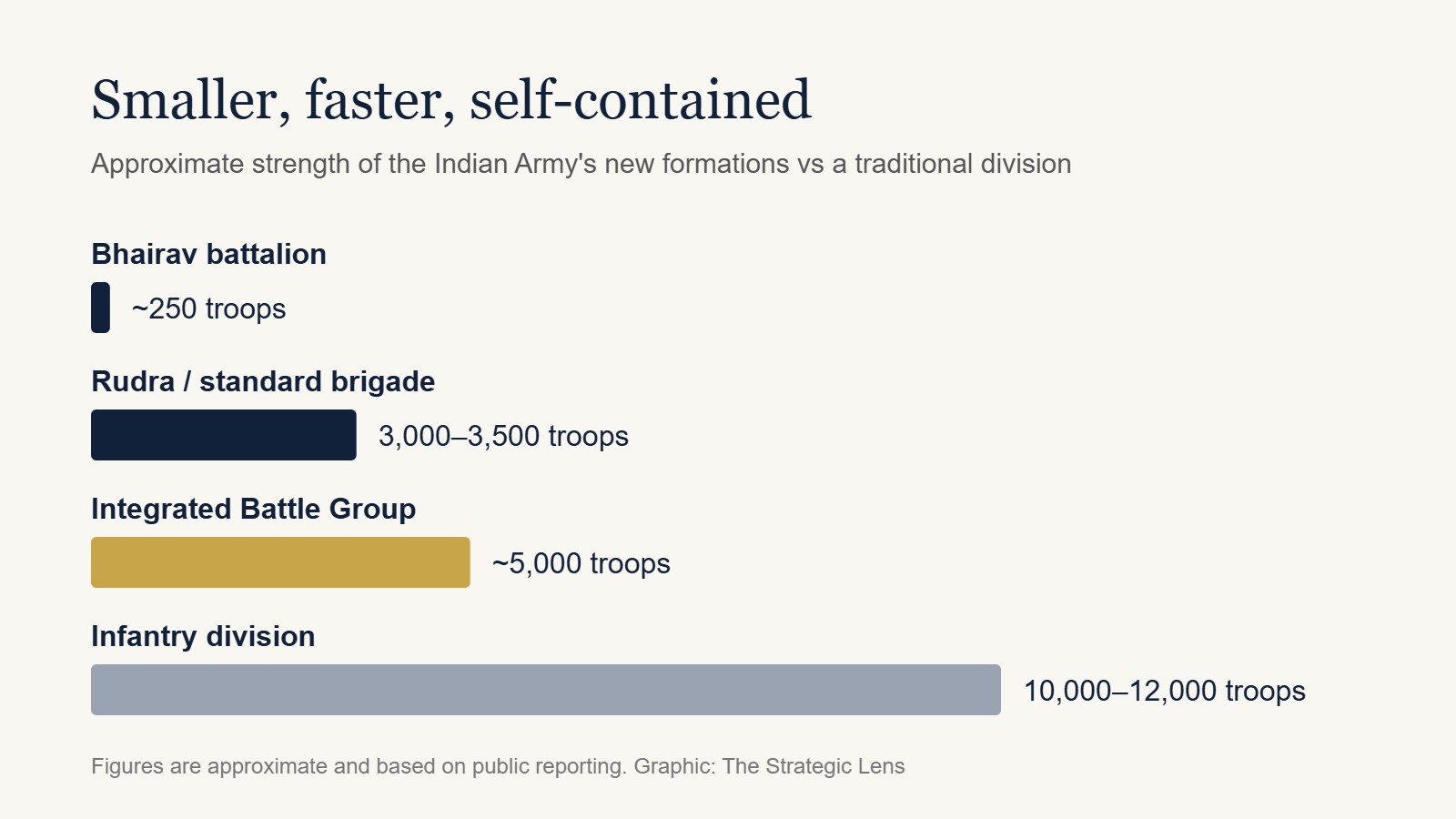
For most of its history, the Indian Army has been built around the division, a formation of 10,000 to 12,000 soldiers, and around a few strike corps designed to punch deep into enemy territory. On paper, that is a lot of power. In practice, it needs time: time to gather tanks and guns from different places, time to move them by rail and road, and time to put the pieces together under one commander.
Time is exactly what India no longer has. Crises now erupt and peak in days. After the Pahalgam attack on 22 April 2025, India struck Pakistan on 7 May, and a ceasefire followed on 10 May. The fighting lasted about four days. A force that needs three weeks to get ready arrives after the war is over.
After Parakram, the Army began working on what became known as the Cold Start doctrine: the idea of launching quick, limited thrusts into Pakistan before diplomacy or nuclear threats could stop them. For years, the Army would not openly acknowledge it. Gen Bipin Rawat, who became Army chief at the end of 2016, was the first to talk about it publicly, and he pushed the next logical step: rebuilding the force itself so that quick action was physically possible.
Integrated Battle Groups: Rawat’s idea, finally delivered
The IBG concept is simple. Instead of keeping infantry, tanks, artillery, air defence, engineers and logistics in separate formations that must be stitched together in a crisis, you put the right mix together permanently, under one commander, ready to move.
Rawat’s restructuring studies formally shaped the idea in 2018, and it was tested in 2019. During Exercise Him Vijay in Arunachal Pradesh, which culminated in late October 2019, the China-focused 17 Mountain Strike Corps organised its troops into three battle groups, backed by air-transported reinforcements. Pre-exercise reports put the plan at about 15,000 soldiers in groups of roughly 5,000 each. IX Corps, which faces Pakistan, ran its own trials.
Then progress stalled. Early targets came and went. The Galwan clash with China in June 2020, which killed 20 Indian soldiers, and the long standoff in eastern Ladakh kept the Army busy, while restructuring a force of more than a million people proved to be slow, political work. In January 2026, approval for the first IBGs was reported, and the formal government sanction letter is dated 1 July 2026.
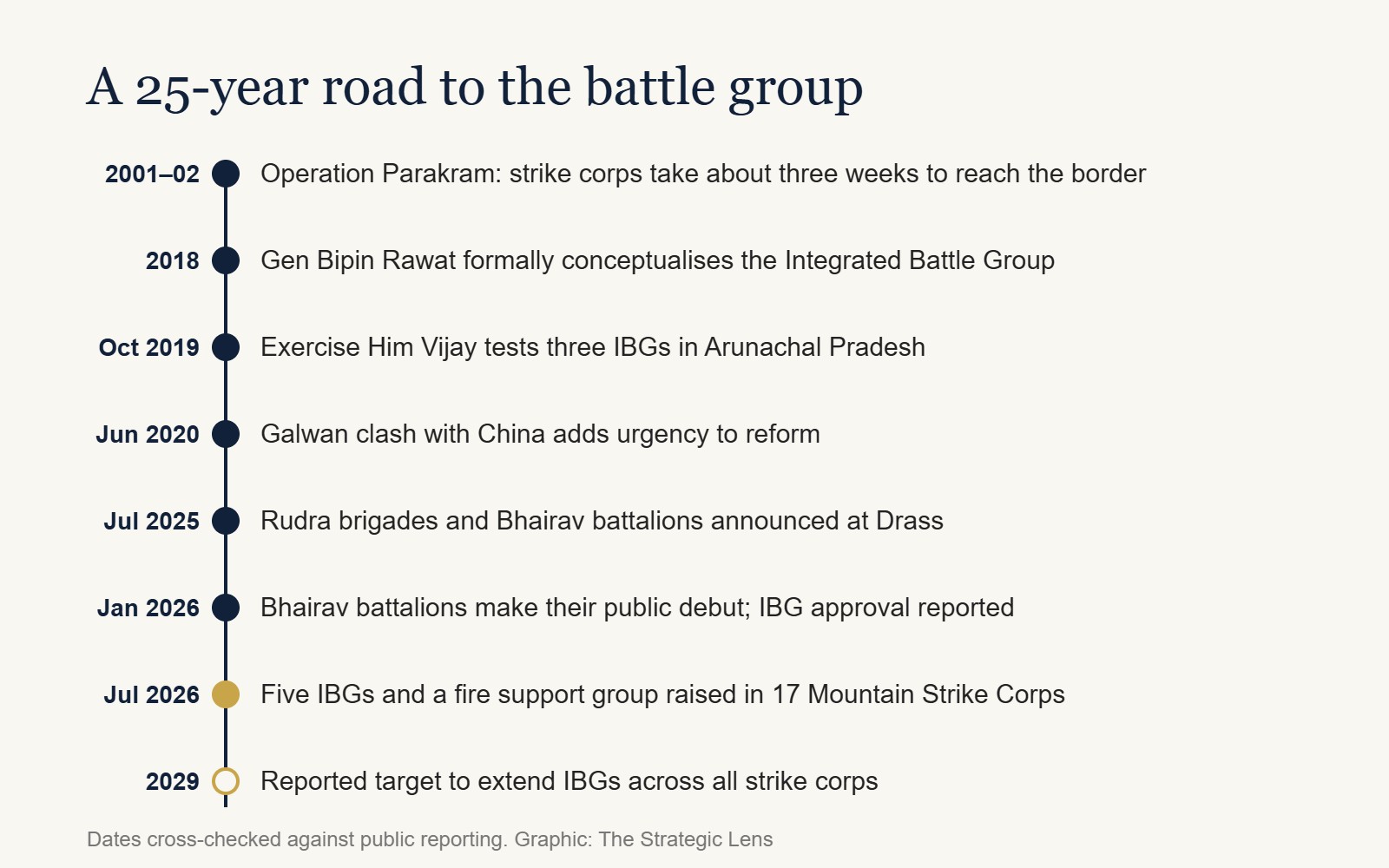
That same day, the rollout began where the idea was first tested. According to Business Standard and Bharat Shakti, six Major Generals took command of five newly raised IBGs and a fire support group under 17 Mountain Strike Corps. Accounts of the details vary: some earlier reports expected four groups, and ThePrint reported that converting the corps’ 23 Division would run until mid-2027. ThePrint has also reported a goal of extending IBGs across all strike corps by 2029. In March 2026, IBG formations had already taken part in Exercise Amogh Jwala.
How quickly can an IBG move? Estimates range from about 12 to 48 hours after receiving orders, depending on the source. Either way, it is a different world from the three weeks of 2001.
The goal is not a bigger army. It is an army that can be in the right place before the enemy has made up its mind.
Rudra brigades: the same logic, one size down
On 26 July 2025, Kargil Vijay Diwas, Army chief Gen Upendra Dwivedi used the anniversary ceremony at Drass to announce the Rudra all-arms brigade. A traditional brigade of about 3,000 to 3,500 soldiers is usually built around one type of unit, such as infantry or armour. A Rudra brigade mixes them: infantry, mechanised infantry, tanks, artillery, special forces and drone units, plus their own logistics and support, all under one brigadier.
Rudra does not need new soldiers. It reshuffles units the Army already has. At least two brigades had been converted by the time of the announcement. The Tribune reported plans to place early Rudra brigades along the Line of Actual Control in eastern Ladakh and Sikkim, and in October 2025 the Army’s Eastern Command showed off a newly raised Rudra brigade in high-altitude drills in North Sikkim. Business Standard reports that the long-term ambition is to convert around 250 single-arm brigades.
Think of IBGs as the heavy option for a major offensive, and Rudra brigades as the flexible option for holding ground or answering a local crisis in the mountains.
Bhairav battalions: commandos for the grey zone
The Bhairav light commando battalions were announced alongside Rudra. Each has about 250 specially trained soldiers, built for rapid response, reconnaissance, raids and border operations. They fill a real gap: regular infantry is not trained for high-risk raids, while the Para Special Forces are too few and too valuable to use for every cross-border task.
The Army has moved fast on these. By January 2026, about 15 battalions had been raised on the northern and western fronts. They made their public debut at the Army Day parade in Jaipur that month and were slated to march at the Republic Day parade in New Delhi. In February 2026, Western Command staged a demonstration in Pathankot featuring heliborne assaults, robotic mules and drones. On 25 April 2026, a 16th battalion was raised at the Maratha Light Infantry Regimental Centre in Belagavi. The target is roughly 23 to 25 battalions.
Drones everywhere: the lesson of Operation Sindoor
If one thing drove the urgency of 2025 and 2026, it was Operation Sindoor. India says Pakistan sent hundreds of Turkish-made drones towards Indian cities and military sites; Pakistan denied it. India, for its part, used Israeli-made Harop loitering munitions against Pakistani air defences, and says its air defence network, including the S-400, intercepted Pakistani missiles and large numbers of drones. Both sides’ claims remain contested, but no one disputes that drones shaped the fighting.
The Army took the lesson seriously. In his July 2025 address, Gen Dwivedi said every infantry battalion now includes a drone platoon, and that artillery had gained new Divyastra and loitering-munition batteries. Defence Minister Rajnath Singh later listed a Shaktibaan regiment among the new units; reports describe it as focused on drones, loitering munitions and counter-drone warfare. Existing air defence guns have been modified to tackle small drones, and anti-drone contracts have been opened to Indian firms.
On 6 April 2026, the Army published a 50-page technology roadmap for drones and loitering munitions, covering 30 types and nearly 80 variants. By March 2026, more than 50,000 personnel had reportedly been trained to fly drones, with an aim of training every soldier by 2027.
India is not alone. France, for example, has started turning tank gunners into drone pilots and wants around 15 drone combat units by 2027. But French officers, like Indian ones, keep stressing the same point: drones add to traditional firepower, they do not replace it.
The two-front problem: why this matters now
In mid-to-late October 2026, China and Pakistan held Karakoram-2026 near Korla in Xinjiang. China’s defence ministry described it as the first joint army training between the two countries. The drill focused on counter-terrorism and clearance operations at high altitude, including drone operations, long-range sniping and joint command. According to SIPRI, China supplied about 81% of Pakistan’s arms imports between 2020 and 2024. Now their armies are practising together on land, in terrain not unlike the Himalaya.
This is the heart of India’s two-front problem. Few analysts expect China and Pakistan to invade at the same moment. The more realistic worry, as a former Vice Chief of Army Staff argued recently, is a chain of linked crises: pressure from China along the LAC that ties down Indian forces, while Pakistan exploits the moment with violence below the threshold of open war.
Smaller, faster formations help with both. On the China front, IBGs and Rudra brigades mean India can react to a land grab within hours rather than weeks. On the Pakistan front, they offer credible conventional options short of all-out war, reducing the chance that nuclear threats freeze India into doing nothing.
Will it work? Four questions to watch
- Can they be sustained? A self-contained group needs its own fuel, ammunition and spares. Supplying 5,000 soldiers at high altitude in winter is a huge challenge.
- Who commands what? New formations need new headquarters and communications. The bigger prize, joint theatre commands that tie the Army to the Air Force and Navy, is still not in place. Some retired officers also worry about how shorter Agnipath service terms fit with highly trained units.
- Is there money? Reorganising existing units is cheap. Buying the drones, counter-drone systems and precision weapons to make them deadly is not.
- Does the pilot pass? 17 Corps is a test bed. If its battle groups struggle in exercises over the next year, the 2029 goal will slip, as earlier ones did.
Our take
It is easy to be cynical about military reform in India. The IBG idea has been around since at least 2018, and deadlines have come and gone. But this time looks different. There are new units already raised and on parade, a clear starting point in 17 Corps, and a recent war that made the case for change impossible to ignore.
The real test is not the names or the parades. It is whether, in the next crisis, India can act in days instead of weeks. If it can, the lesson of 2001 will finally have been learned.
Frequently asked questions
What is an Integrated Battle Group in the Indian Army?
An Integrated Battle Group is a self-contained combat formation of up to about 5,000 soldiers, led by a Major General, that permanently combines infantry, armour, artillery, air defence, engineers and logistics so it can move and fight quickly without waiting for other units.
How is a Rudra brigade different from an IBG?
Both mix different combat arms under one commander. An IBG is larger and is carved out of a division. A Rudra brigade is a converted brigade of around 3,000 troops led by a brigadier, built by reorganising existing units.
What are Bhairav battalions?
Bhairav battalions are light commando units of about 250 soldiers, designed for raids, reconnaissance and rapid response along India’s borders. They made their public debut in January 2026.
Why is the Indian Army restructuring now?
Three reasons: the growing China–Pakistan military partnership, the need to respond within hours rather than weeks, and lessons from Operation Sindoor and the war in Ukraine about drones and precision weapons.
More from Strategic Lens Defence: browse our Armed Forces and Geopolitics sections.
Sources and further reading
This article is original analysis by Strategic Lens Defence. Every key fact was cross-checked against at least two independent sources where available; where reports disagree, we say so. All wording and graphics are our own.
- Business Standard — The long overhaul (Aug 2026)
- ThePrint — IBG rollout begins with 17 Mountain Strike Corps (1 Jul 2026)
- Bharat Shakti — Indian Army raises first Integrated Battle Groups (Jul 2026)
- Wikipedia — XVII Corps (India)
- Wikipedia — Cold Start (military doctrine)
- The Tribune — Arunachal exercise (Oct 2019)
- Northeast Now — Over 15,000 soldiers to take part in HimVijay (Sep 2019)
- OdishaBytes — Army chief announces Rudra brigades and Bhairav battalions (26 Jul 2025)
- The Week — What is the Rudra brigade (26 Jul 2025)
- The Tribune — Rudra brigades for eastern Ladakh and Sikkim (Aug 2025)
- ANI — Rudra brigade showcases high-altitude skills, Eastern Command (Oct 2025)
- India Sentinels — Bhairav battalion to debut at Republic Day 2026 (Jan 2026)
- Dhyeya IAS — Bhairav battalions debut at 78th Army Day parade, Jaipur
- The Week — Bhairav battalion demonstration in Pathankot (Feb 2026)
- GKToday — Indian Army raises 16th Bhairav battalion (Apr 2026)
- ANI — Army unveils UAS and loitering munitions roadmap (6 Apr 2026)
- Business Standard — Army charts future of unmanned systems (Apr 2026)
- The Tribune — Operation Sindoor accelerated indigenous drone development
- Wikipedia — 2025 India–Pakistan conflict
- SCMP — China supplied 81% of Pakistan’s arms imports, SIPRI says
- CGTN — China and Pakistan to hold Karakoram-2026 (10 Oct 2026)
- APP — China, Pakistan to conduct joint exercise in Xinjiang (Oct 2026)
- The Week — Lt Gen Philip Campose (Retd) on the two-front challenge (28 Oct 2026)
- Defense News — France turns tank gunners into FPV pilots (30 Oct 2026)
- Wikimedia Commons — photo: Soldiers from 11th Airborne Division, U.S. Army and 9th Assam Regiment, Indian Army pose for the opening ceremony of Exercise Yudh Abhyas 22 (public domain)


Leave a Reply