
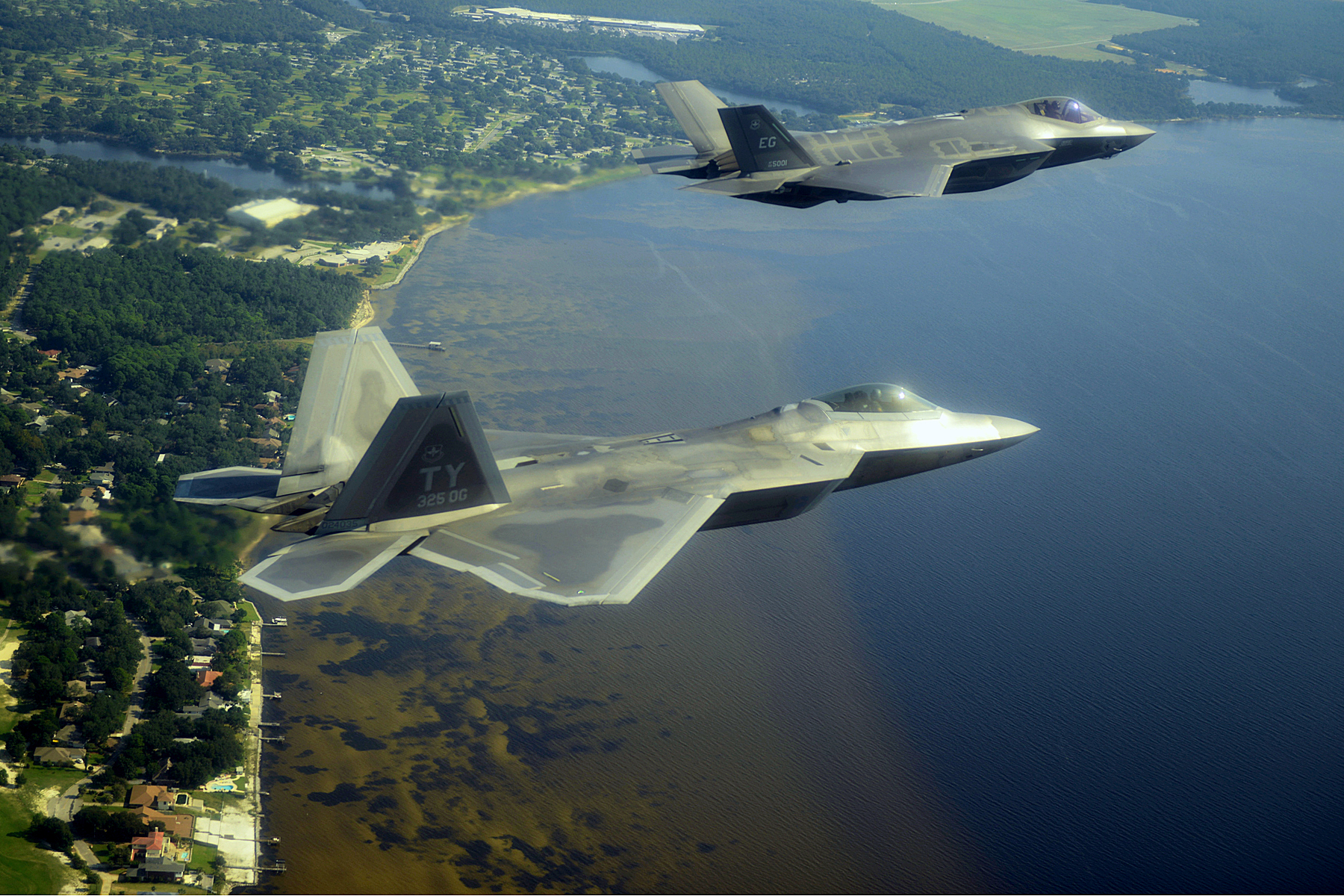
Ask ten pilots which fighter jet is the best in the world and you will get ten answers, most of them shaped by the badge on their flight suit. The honest answer is that there is no single “best” fighter. There are jets built for different jobs, budgets and eras, and the right choice depends on who you expect to fight and how.
In this article
In this guide we compare eleven of the most important fighters flying today: America’s F-35, F-22, F-16 and F/A-18; Russia’s Su-35 and Su-57; China’s J-20 and J-35; Europe’s Eurofighter Typhoon and Rafale; and the Sino-Pakistani JF-17. We cross-checked the key facts across multiple sources, and where numbers are estimates or claims, we say so.
First, what do “generations” mean?
Fighter jets are usually grouped into generations. Fourth-generation jets, like the F-16 and F/A-18, are agile, multirole aircraft from the 1970s and 1980s, heavily upgraded since. “4.5-generation” jets, like the Rafale, Typhoon and Su-35, add modern radars, sensors, weapons and some signature reduction, but are not truly stealthy. Fifth-generation jets, like the F-22, F-35, J-20 and Su-57, are designed from the start for stealth, sensor fusion and networked warfare. The labels are informal, but they are a useful shorthand.
At a glance: the comparison table
| Jet | Origin | Generation | First flight | Entered service | Engines | Stealth design |
|---|---|---|---|---|---|---|
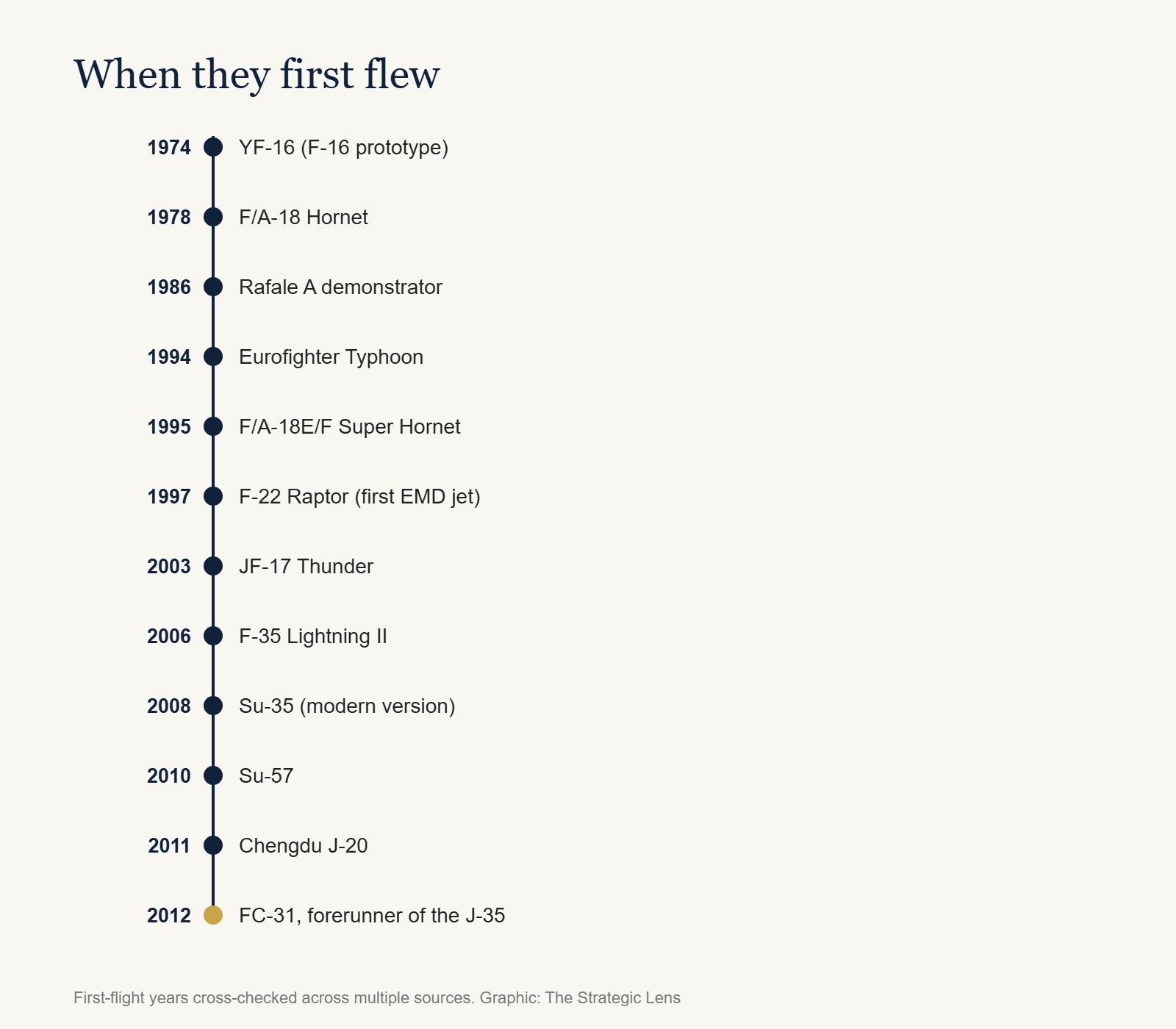
| F-35 Lightning II | USA (Lockheed Martin) | 5th | 2006 | 2015–16 | Single | Yes |
| F-22 Raptor | USA (Lockheed Martin, Boeing) | 5th | 1997 | 2005 | Twin | Yes |
| F-16 Fighting Falcon | USA (Lockheed Martin) | 4th | 1974 (prototype) | 1979 | Single | No |
| F/A-18E/F Super Hornet | USA (Boeing) | 4th / 4.5 | 1995 | 1999 | Twin | No (reduced frontal signature) |
| Su-35 | Russia (Sukhoi) | 4.5 | 2008 (modern version) | ~2014 | Twin, thrust vectoring | No |
| Su-57 | Russia (Sukhoi) | 5th | 2010 | 2020 | Twin, thrust vectoring | Partial |
| J-20 | China (Chengdu) | 5th | 2011 | 2017 | Twin | Yes |
| J-35 | China (Shenyang) | 5th | 2012 (FC-31 prototype) | ~2025 (announced) | Twin | Yes |
| Eurofighter Typhoon | UK, Germany, Italy, Spain | 4.5 | 1994 | 2003 | Twin | No |
| Rafale | France (Dassault) | 4.5 | 1986 (demonstrator) | 2001 (Navy) | Twin | No (reduced signature) |
| JF-17 Thunder | Pakistan & China | 4th | 2003 | 2007 | Single | No |
United States
F-35 Lightning II: the networked workhorse
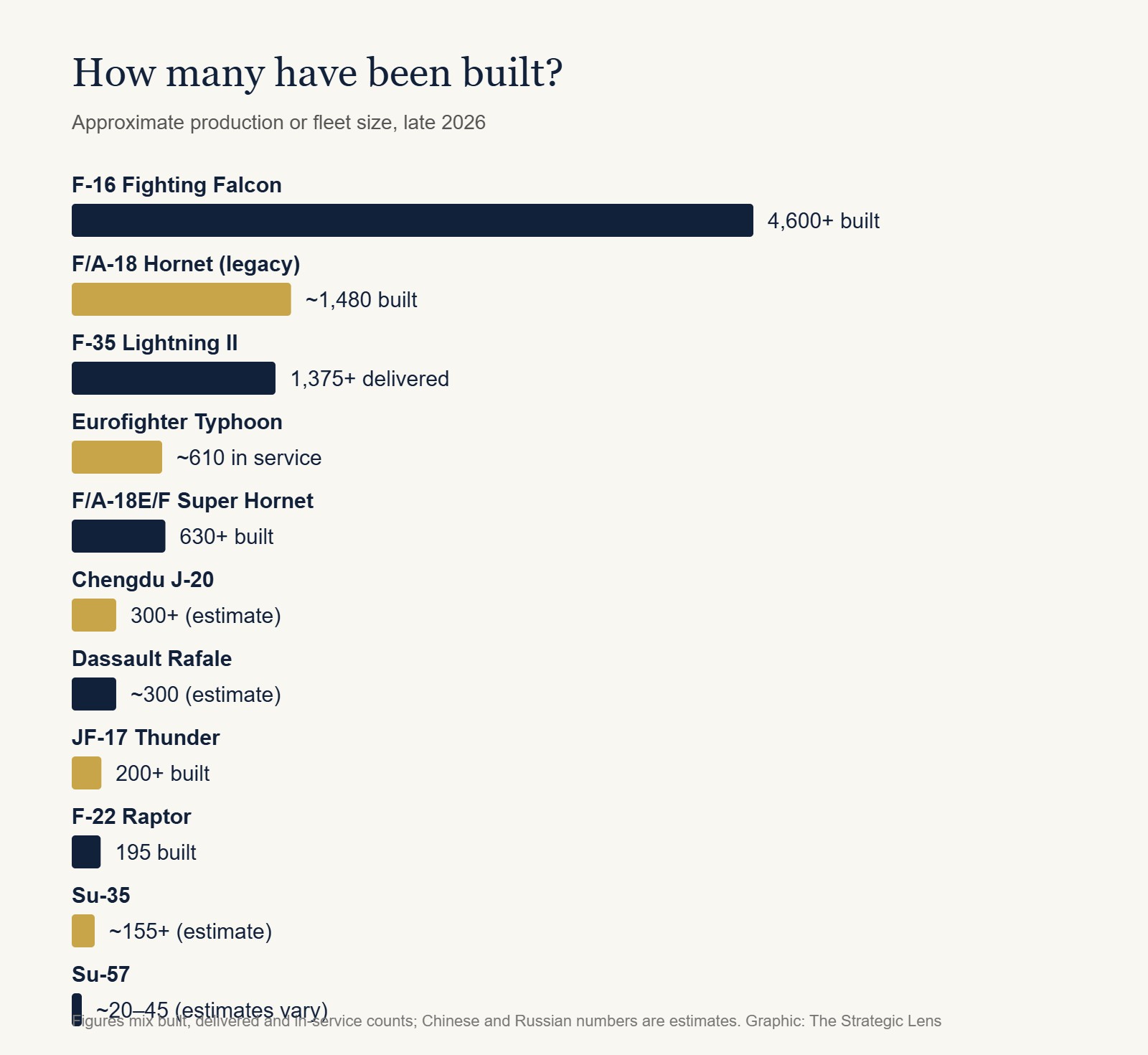
The F-35 is the most widely produced fifth-generation fighter in history. It first flew in December 2006 and comes in three versions: the conventional F-35A, the short-takeoff F-35B and the carrier-based F-35C. Lockheed Martin reported more than 1,375 deliveries by late September 2026, and the jet is now flown by over a dozen countries, from the UK, Japan and Israel to Poland and, since October 2026, Finland.
Its real strength is not speed or agility but information. Its sensors fuse data from radar, infrared cameras and electronic-warfare systems into a single picture, and share it with other aircraft. Israel used F-35s in combat as early as 2018, and they have since flown in strikes across the Middle East, including during the 2026 Iran war.
- Strengths: stealth, sensor fusion, a huge global user base that keeps costs down and makes allies interoperable.
- Weaknesses: the programme has run years late and far over budget; software upgrades have slipped, and readiness rates reported by US government auditors have been disappointing. Recent F-35A lots cost roughly $90 million or more per jet, before lifetime support costs.
F-22 Raptor: still the air-superiority benchmark
The F-22 first flew in September 1997 and reached initial operational capability in December 2005. Only 195 were built before production ended, and US law has long barred its export, so the US Air Force is its only operator. It combines stealth with the ability to cruise at supersonic speed without afterburners, and it is still widely regarded as the most capable air-to-air fighter ever fielded.
- Strengths: stealth plus speed and manoeuvrability; designed purely to win the air.
- Weaknesses: a small, ageing fleet that is expensive to maintain, and no production line. It will eventually be succeeded by the Boeing F-47, a sixth-generation fighter we cover in our sixth-generation explainer.
F-16 Fighting Falcon: the jet that never retires
The F-16’s prototype first flew in 1974, and more than 4,600 have been built, making it one of the most successful fighters ever. It is flown by the US and around two dozen other countries. Remarkably, it is still in production: the latest Block 70/72 “Viper” version, with a modern AESA radar, is built at Greenville, South Carolina, and Morocco’s first Block 72 flew in October 2026.
The F-16 has fought from Desert Storm to Syria. Since 2024 it has also flown in Ukraine, mostly shooting down Russian cruise missiles and drones, with several losses along the way.
- Strengths: cheap to buy and run by Western standards, Mach 2 performance, enormous support network and constant upgrades.
- Weaknesses: no stealth, single engine, and an airframe design that is now half a century old.
F/A-18 Hornet and Super Hornet: the carrier fighters
The original F/A-18 Hornet entered service in 1983, can reach about Mach 1.8, and around 1,480 were built. The US Navy retired its last legacy Hornets in 2019, though the Marine Corps and several foreign air forces still fly them. The larger F/A-18E/F Super Hornet first flew in 1995 and is flown by the US Navy, Australia and Kuwait. The latest Block III version adds better sensors and networking.
- Strengths: proven carrier performance, reliability and a deep weapons catalogue; the EA-18G Growler variant is the West’s premier electronic-attack aircraft.
- Weaknesses: not stealthy, limited range compared with newer designs, and production is expected to wind down around 2027.
Russia
Su-35: Russia’s real front-line fighter
The modern Su-35 first flew in 2008 and entered Russian service around 2014. It is the most advanced member of the Su-27 “Flanker” family, with powerful AL-41F1S engines whose nozzles can vector thrust for extreme manoeuvres, and an Irbis-E radar, a passive electronically scanned array. China bought 24 under a 2015 deal. It has been used heavily in Syria and Ukraine, where several have been lost to Ukrainian air defences. Reports of deliveries to Algeria, Iran and Ethiopia have surfaced, but are not all officially confirmed.
- Strengths: long range, heavy weapons load, superb low-speed agility.
- Weaknesses: a large radar signature and an older-style PESA radar, which put it at a disadvantage against stealth fighters with modern AESA radars.
Su-57: Russia’s troubled fifth-generation jet
The Su-57 first flew in 2010 and entered service in December 2020. Production has been slow: estimates of the fleet range from roughly 20 operational jets to around 40-plus built, including prototypes, against a 2019 order for 76. A new engine, the “izdeliye 177”, flew for the first time in December 2025, and a two-seat version flew in May 2026. Algeria is widely reported to be the first export customer, though neither side has officially confirmed it. Russia has also pitched the jet to India.
- Strengths: high agility with thrust vectoring, long range and big internal weapons bays.
- Weaknesses: analysts judge its stealth to be well short of the F-22 and F-35, production is tiny, and many of its combat claims in Ukraine cannot be independently verified.
China
J-20: China’s stealth fleet is now big
The J-20 first flew on 11 January 2011 and entered service in 2017. China does not publish fleet numbers, but by 2025 estimates had passed 300 aircraft, which would make it the second most numerous stealth fighter in the world after the F-35. A two-seat J-20S was unveiled in 2024, and newer jets are reported to fly with China’s home-grown WS-15 engines.
- Strengths: large fleet, long-range missiles, and a design suited to long-distance missions over the Pacific.
- Weaknesses: almost all performance data is unofficial, and it has no known combat record.
J-35: the carrier stealth fighter
The J-35 grew out of the FC-31 demonstrator, which first flew in 2012. In September 2025, China showed J-35s launching and landing on its new carrier Fujian, as we described in our look at China’s carriers. Chinese state media say land-based J-35As are also in air force service. Pakistan has announced its intention to buy the jet, but no contract or delivery had been confirmed by late 2026.
- Strengths: stealth for carrier operations, a likely export success with the right buyers.
- Weaknesses: limited public data and an engine programme still maturing.
Europe
Eurofighter Typhoon: Europe’s air-defence backbone
Built by a consortium of Airbus, BAE Systems and Leonardo, the Typhoon first flew on 27 March 1994 and entered service in 2003. Around 610 are in service across nine countries, including the UK, Germany, Italy, Spain, Austria, Saudi Arabia, Oman, Kuwait and Qatar. Turkey signed an £8 billion deal for 20 jets in October 2025, and Germany and Spain have ordered new batches.
- Strengths: excellent climb and high-altitude performance, Meteor long-range missile, strong European industrial base.
- Weaknesses: not stealthy, expensive to run, and slower to add ground-attack capabilities than rivals.
Rafale: the export star
Dassault’s Rafale demonstrator first flew in 1986; the jet entered French Navy service in 2001 and the Air Force’s first operational squadron formed in 2006. It is the most successful Western 4.5-generation export of the past decade: buyers include Egypt (54 jets), Qatar, India, Greece, Croatia, the UAE (80 ordered), Indonesia (42) and Serbia. India is now negotiating for 114 more, as we explain in our 114-Rafale analysis. The latest F4 standard is in service, with F5 planned.
India’s Rafales flew in combat during Operation Sindoor in May 2025. Pakistan claimed to have shot down several, including with Chinese-made J-10C fighters; India acknowledged losing aircraft without confirming numbers or types. Independent confirmation of specific Rafale losses remains limited.
- Strengths: true multirole flexibility, including nuclear strike and carrier operations; SPECTRA self-protection suite; strong combat record.
- Weaknesses: not stealthy, and per-unit costs are high once support and weapons are included.
Pakistan and China
JF-17 Thunder: affordable airpower
Co-developed by Pakistan Aeronautical Complex and China’s Chengdu, the JF-17 first flew in 2003 and entered Pakistani service in 2007. More than 200 have been built. It is the backbone of the Pakistan Air Force and has been exported to Myanmar, Nigeria and Azerbaijan. The latest Block III adds an AESA radar. It runs on a Russian-designed RD-93 engine and costs a fraction of Western jets; one estimate put the Block II at around $25 million. Read our full JF-17 Thunder explainer.
Pakistan used JF-17s in the May 2025 clashes with India, and made claims about their strikes that India rejected and that have not been independently verified.
- Strengths: low cost, simple to maintain, modern Chinese weapons.
- Weaknesses: limited range and payload, dependence on a Russian engine, and modest performance against top-tier fighters.
Fighter jets do not fight alone. The side with better radar coverage, missiles, training and networks usually wins, not the side with the “best” plane.
What recent wars have taught us
- Missiles and sensors matter more than dogfighting. In the May 2025 India–Pakistan clash, long-range missiles fired from well beyond visual range decided most engagements, with Pakistan’s J-10Cs and Chinese PL-15 missiles drawing particular attention.
- Air defences are deadly. In Ukraine, ground-based air defences on both sides have accounted for many of the fighter losses, forcing jets to fly low or fire from long range.
- Stealth buys access. In the 2025–26 strikes on Iran, US and Israeli stealth jets operated in airspace that older fighters could not safely enter.
- Claims are not facts. Every recent conflict has produced exaggerated kill claims. Treat any single government’s tally with caution until independent evidence emerges.
So which is the best?
- Best pure air-superiority fighter: F-22 Raptor.
- Best all-round modern fighter: F-35, because of its sensors, networking and numbers.
- Best 4.5-generation multirole jet: a close call between the Rafale and the Typhoon, with the Rafale more versatile and the Typhoon stronger in air defence.
- Best value: the F-16 Block 70 among Western jets, the JF-17 for budget air forces.
- Fastest-growing threat: China’s J-20 fleet.
What it means for India
India’s air force flies Rafales, Su-30MKIs and home-grown Tejas jets, and faces J-20s across the Himalaya and J-10Cs and JF-17s, possibly J-35s in future, across its western border. That is why the 114-Rafale deal and the AMCA stealth fighter, which we cover in our AMCA explainer, matter so much. Without a fifth-generation fighter of its own in the 2030s, India risks being outclassed in the air by China and, in time, Pakistan.
Frequently asked questions
Which is the most advanced fighter jet in the world?
The F-22 and F-35 are widely regarded as the most advanced operational fighters, with China’s J-20 the closest rival. Sixth-generation jets like the US F-47 are still in development.
Is the Rafale better than the F-35?
They are built for different things. The F-35 is a stealth fighter optimised for sensor fusion and penetrating defended airspace; the Rafale is a highly versatile 4.5-generation multirole jet that is easier to buy and integrate with non-US weapons.
How many J-20 fighters does China have?
China does not publish numbers, but estimates by 2025 put the J-20 fleet at more than 300 aircraft.
Is the Su-57 a true stealth fighter?
It has stealth features, but most analysts judge its radar signature to be much larger than that of the F-22 or F-35, and only a small number have been built.
More from Strategic Lens Defence: Air Force · Emerging Tech · Defence Industry & Deals
Sources and further reading
This is original analysis by Strategic Lens Defence. Key facts were cross-checked across multiple independent sources; where reports disagree or rest on a single source, we say so in the text. All wording and graphics are our own.
- Lockheed Martin — F-35 Fast Facts (Oct 2026)
- Lockheed Martin — F-16 Block 70/72
- US Air Force — F-16 Fighting Falcon fact sheet
- Boeing — F/A-18 Super Hornet
- GlobalSecurity — F-22, F-35, F-16, F/A-18, Su-35, Su-57, J-20, J-35, Rafale, JF-17 profiles
- The Aviationist — China’s 300th J-20 (Sep 2025)
- The Aviationist — J-35 operating from Fujian (Sep 2025)
- The Aviationist — Su-57 flies with izdeliye 177 engine (Dec 2025)
- The Aviationist — Algeria’s first Su-57E (Feb 2026)
- The Aviationist — Typhoon passes one million flight hours (Jan 2026)
- The Aviationist — Turkey signs for Eurofighter Typhoons (Oct 2025)
- The Aviationist — Indonesia’s Rafale first flight (Sep 2025)
- The War Zone — Chinese fighter jet exports set to grow (Dec 2025)
- Wikipedia — F-35, F-22, F-16, F/A-18, Su-35, Su-57, J-20, J-35, Typhoon, Rafale, JF-17 articles
- Wikimedia Commons — photo: F-22A and F-35A over Emerald Coast (public domain)


Leave a Reply