
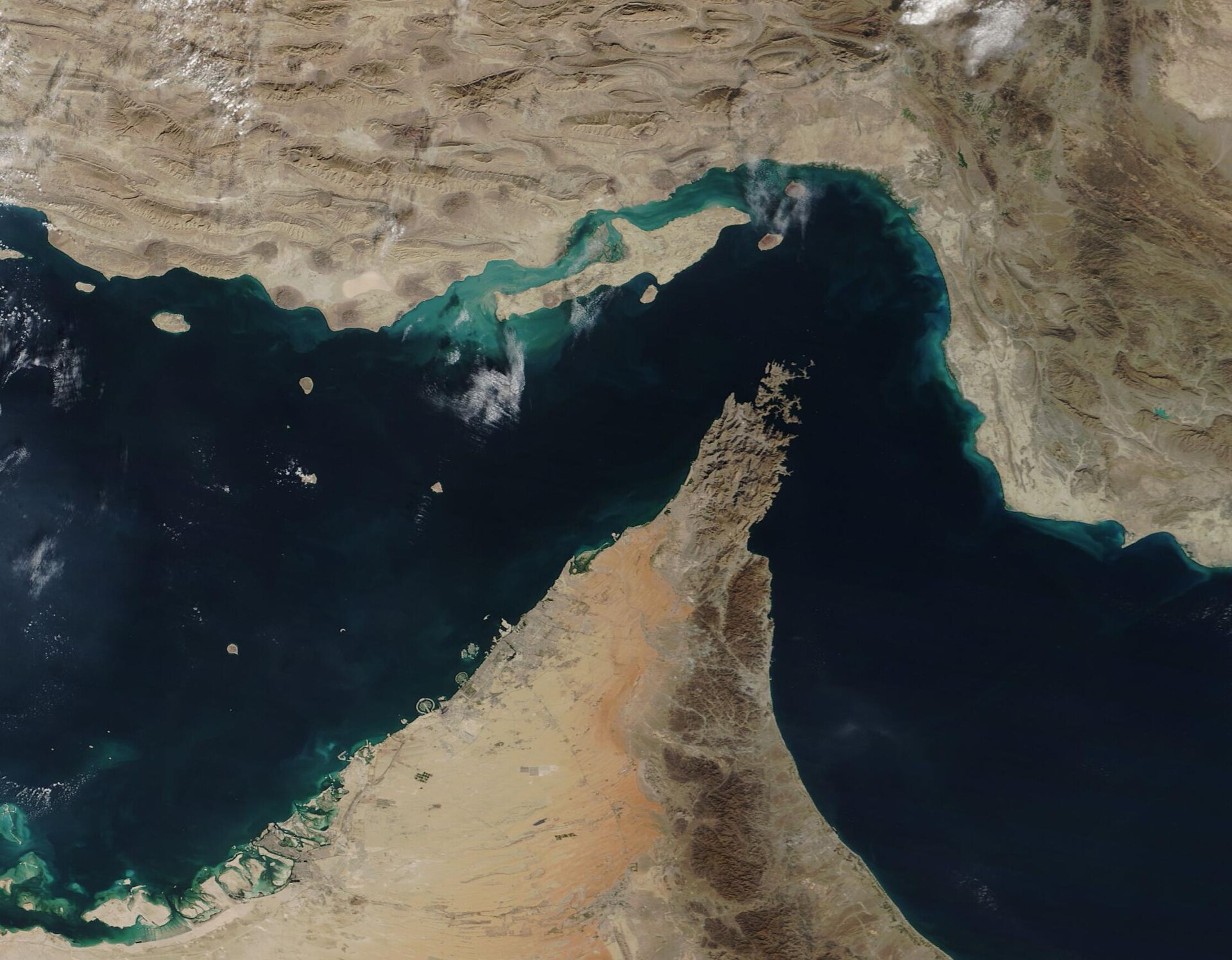
For decades, war planners have gamed out what would happen if the Strait of Hormuz were shut. In 2026, the world stopped having to imagine it. Eight months after the United States and Israel struck Iran, the narrow waterway between Iran and Oman is still the most dangerous stretch of sea on the planet, and every economy that runs on imported oil is paying for it.
In this article
This is our guide to how the war started, why Hormuz matters so much, and what it means for countries like India that sit at the far end of the supply chain.
How the war began
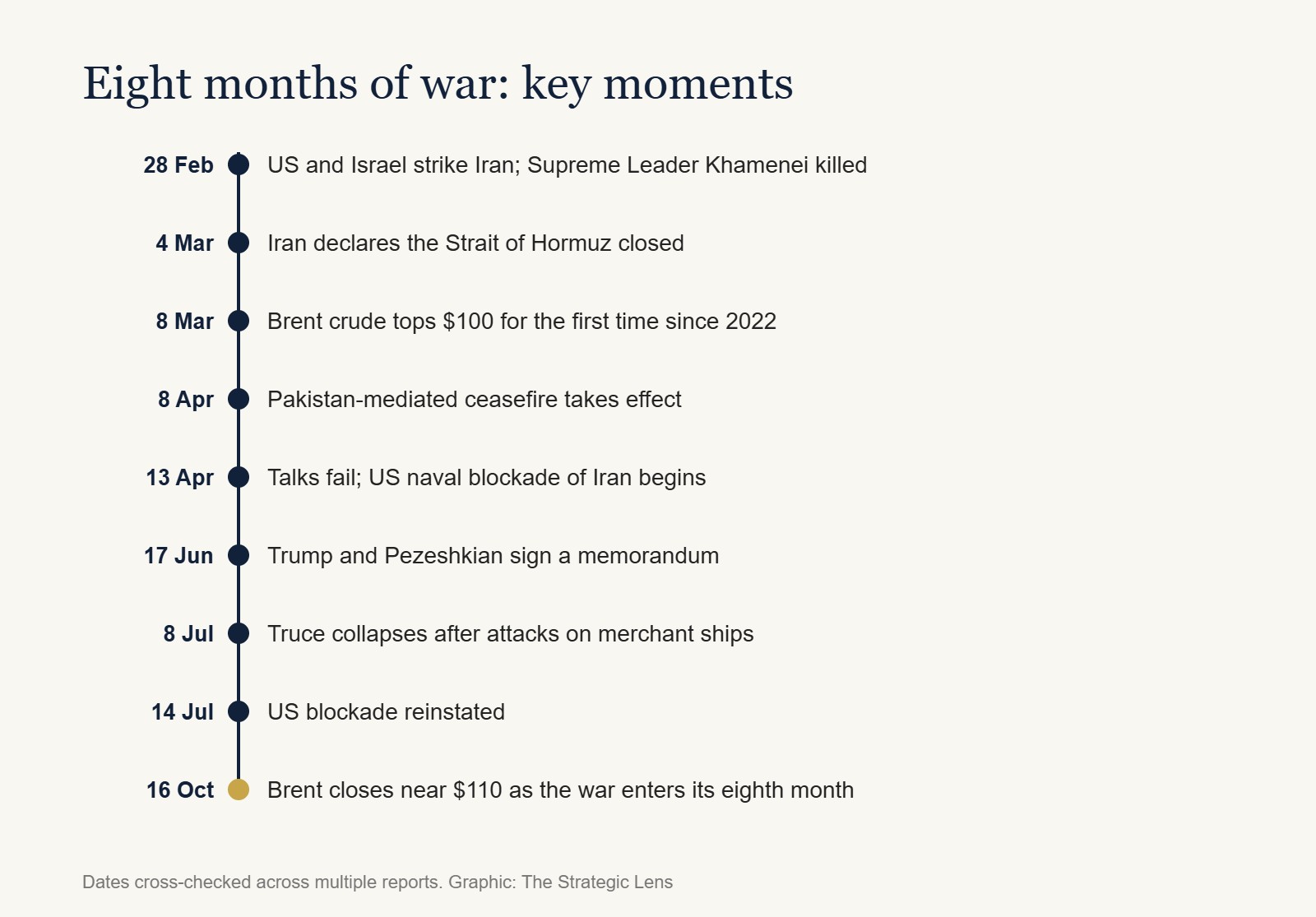
On 28 February 2026, in the middle of on-again, off-again nuclear negotiations, the United States and Israel launched coordinated strikes on Iran. The opening blows killed Iran’s Supreme Leader, Ayatollah Ali Khamenei. Washington framed the operation around Iran’s nuclear programme, its regional proxy network and its crackdown on protesters; critics, including many international lawyers, called it an illegal war of choice.
Iran answered the way strategists had long predicted. It fired missiles and drones at Israel, at US bases and at Gulf states that host American forces. And it went for the jugular of the global economy: shipping through Hormuz.
Why the Strait of Hormuz matters
Before the war, roughly a fifth of the world’s seaborne oil and around a fifth of its liquefied natural gas passed through the strait. There is no realistic alternative route for most of it. Saudi Arabia and the UAE have pipelines that bypass the strait, but nowhere near enough capacity to replace it.
Within days of the first strikes, tankers were being hit. On 4 March, Iran declared the strait closed. By late March, its Revolutionary Guard said ships linked to the United States, Israel and their allies could not pass at all. Thousands of vessels and their crews were left stranded in the Gulf, according to the International Maritime Organization, and reports say Iran began charging some ships huge sums for safe passage.
Ceasefire, blockade, collapse
The war has not been one continuous battle. It has moved in waves:
- A ceasefire on 8 April, brokered with Pakistan’s help, briefly reopened the strait and promised talks.
- Talks in Islamabad failed, and on 13 April the US Navy began a blockade of ships going to and from Iranian ports.
- A memorandum on 17 June, signed by President Trump and Iranian President Masoud Pezeshkian, raised hopes of a longer pause.
- The truce collapsed on 8 July after Iranian attacks on commercial shipping, and the US blockade was reinstated on 14 July.
Each swing has whipsawed energy markets. Brent crude broke $100 a barrel in early March for the first time since 2022. In mid-October, with the war in its eighth month, it was still trading near $110, and US diesel prices had climbed above $6 a gallon. Prices eased again in early November as traders bet on calmer days ahead, but they remain far above pre-war levels.
Hormuz is not just a shipping lane. It is a lever on the price of everything that moves by truck, ship or plane.
The human cost
Casualty figures are contested and incomplete. Iranian authorities and independent monitors each report more than 3,500 deaths inside Iran, while the US and Israel claim far higher numbers of Iranian military dead. Israel and the United States have also suffered losses, and seafarers have been killed in attacks on merchant ships, including Indian crew members aboard a tanker hit in the first days of the war. We will update these figures as more reliable data emerges.
Why India should care
Asia is the main customer for Gulf energy. In 2024, around 84% of the crude oil and condensate that moved through Hormuz went to Asian buyers. For India, which imports the large majority of its oil, a disrupted strait means higher fuel prices, a wider trade deficit, pressure on the rupee and higher inflation.
New Delhi has walked a careful line. It has welcomed every ceasefire, kept channels open with Tehran, and reportedly secured safe passage for some Indian-owned vessels. Indian refiners have also leaned on ship-to-ship transfers off the Gujarat coast to keep crude flowing. But none of that changes the basic exposure: as long as Hormuz is a war zone, India’s energy security is hostage to it.
What to watch next
- Shipping data. Some agencies say Gulf exports have recovered close to pre-crisis levels; others describe traffic as heavily restricted. The truth will decide oil prices.
- The blockade. Whether the US keeps squeezing Iranian ports, or trades it for a new deal.
- Mediators. Pakistan, Oman and Gulf states have all played go-between roles. A new round of talks would be the clearest signal of de-escalation.
- Iran’s new leadership. How the post-Khamenei power structure settles will shape whether Tehran can make and keep a deal.
Our take
The 2026 Iran war has proved two things at once. Military power can kill a leader and cripple a navy. But a weakened state that sits on a chokepoint can still impose enormous costs on the rest of the world. Until there is a settlement that gives Iran a reason to keep the strait open, Hormuz will remain the single biggest risk to the global economy, and to India’s.
Frequently asked questions
When did the 2026 Iran war start?
The war began on 28 February 2026, when the United States and Israel launched strikes on Iran that killed Supreme Leader Ali Khamenei.
Is the Strait of Hormuz closed?
Iran declared it closed in March 2026. Traffic has since fluctuated with ceasefires and the US blockade, and reports disagree on how much shipping has recovered.
How does the Iran war affect India?
India imports most of its oil, much of it from the Gulf. Disruption in Hormuz raises fuel prices, inflation and the import bill, and puts Indian seafarers at risk.
More from Strategic Lens Defence: Conflicts & Flashpoints · Geopolitics · Navy
Sources and further reading
This is original analysis by Strategic Lens Defence. Key facts were cross-checked across multiple independent sources; where reports disagree or rest on a single source, we say so in the text. All wording and graphics are our own.
- Wikipedia — 2026 Iran war
- Wikipedia — 2026 Strait of Hormuz crisis
- Wikipedia — 2026 Iran war ceasefire
- Wikipedia — 2026 US naval blockade of Iran
- The National — Oil touches $110 on Middle East supply concerns (16 Oct 2026)
- All India Radio — Oil prices cross $100 amid escalating Iran war (Mar 2026)
- Congressional Research Service — The Strait of Hormuz
- Tradingpedia — WTI retreats below $100 as risk premium eases (2 Nov 2026)
- Wikimedia Commons — photo: Strait of Hormuz (MODIS 2020-12-04) (public domain)


Leave a Reply