
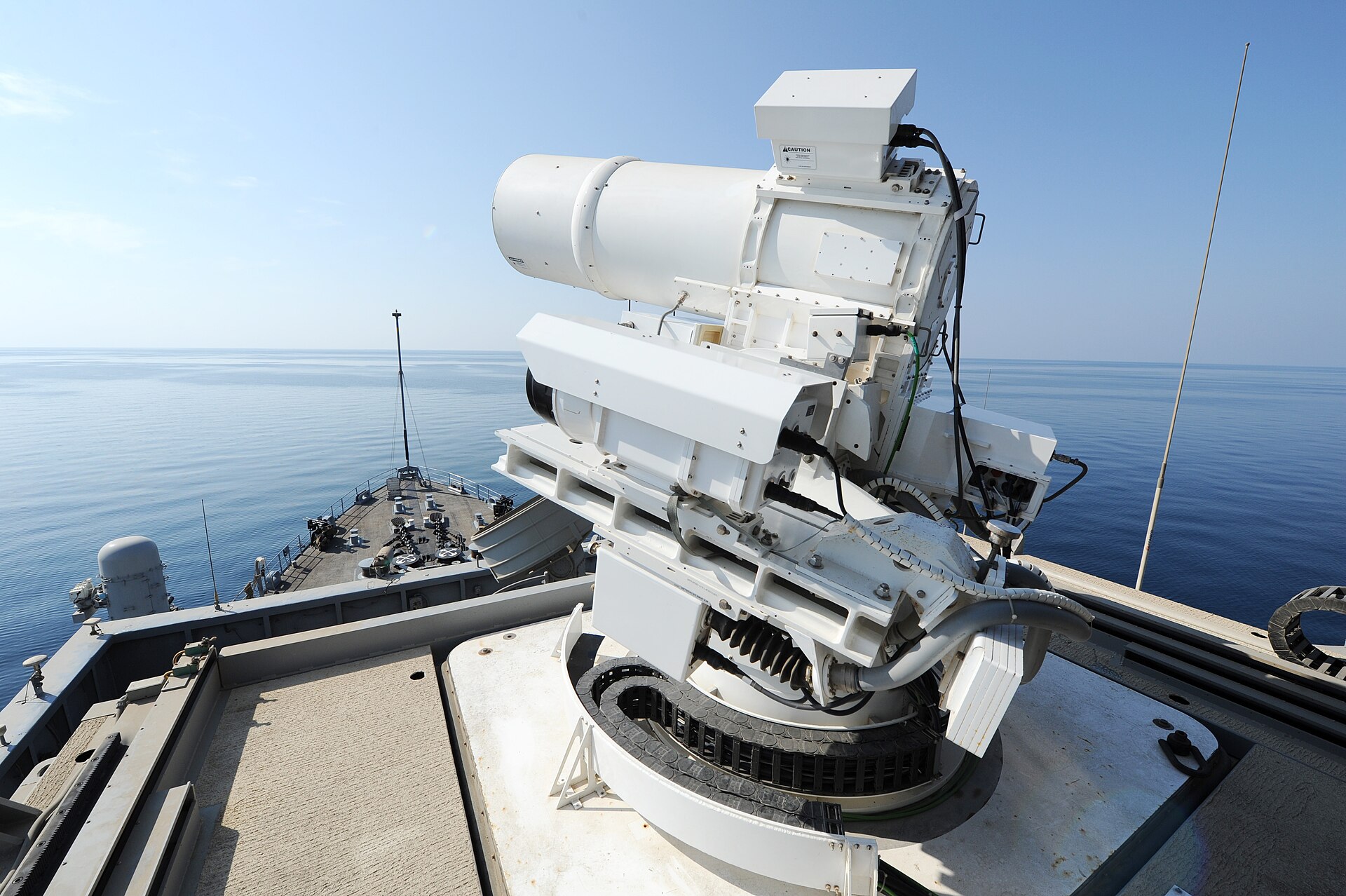
Laser weapons have been “five years away” for about fifty years. In late December 2025, that joke finally stopped working. Israel took delivery of Iron Beam, a 100-kilowatt laser designed to burn drones, rockets and mortar rounds out of the sky. Britain plans to put its DragonFire laser on warships from 2027. And India’s DRDO has tested a truck-mounted laser that can knock down drones several kilometres away.
In this article
With cheap drones now the most common weapon on modern battlefields, the promise is obvious: shoot them down for the price of electricity instead of a missile. Here is how close that promise is to reality.
How a laser kills a drone
A combat laser does not zap a target instantly like in the movies. It focuses intense energy on one small spot, heating it until something critical fails, such as a rotor, a control surface or the guidance electronics. That takes a few seconds of steady aim, known as dwell time. Small, slow drones are ideal targets because their parts are fragile. Fast rockets with heat-resistant skins are much harder.
Who has what
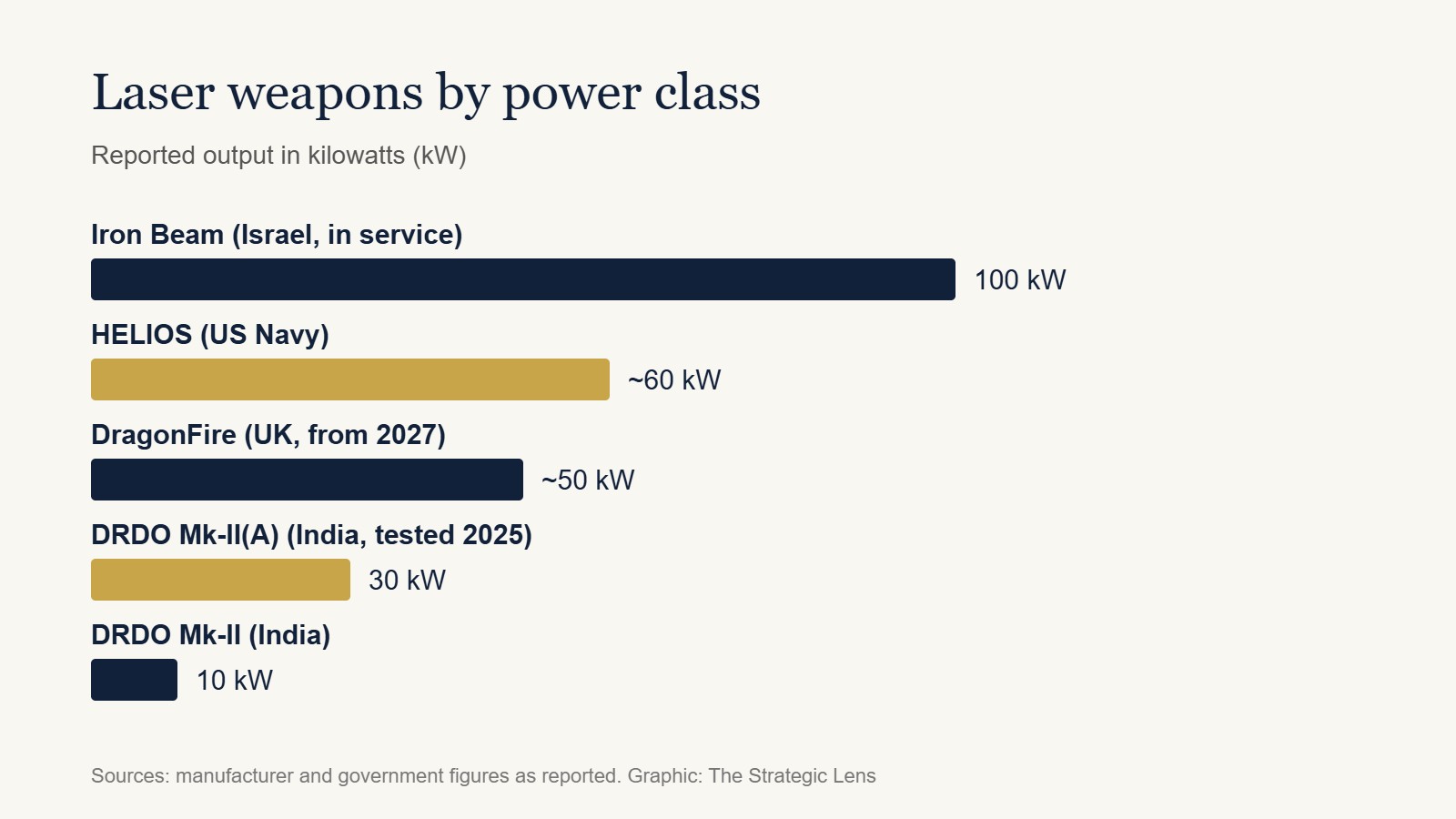
- Israel: Iron Beam. Built by Rafael and Elbit, this 100 kW laser was delivered to the Israel Defense Forces in December 2025, with a reported range of about 10 km. It is meant to work alongside Iron Dome, handling cheap threats so expensive interceptors are saved for bigger ones. Claims of its first combat use in 2026 have been disputed, so we treat them as unconfirmed.
- United Kingdom: DragonFire. A roughly 50 kW laser developed by a consortium including MBDA, Leonardo and QinetiQ. After successful trials, the Royal Navy plans to field it from 2027, years earlier than first planned.
- United States: the Navy’s roughly 60 kW HELIOS is fitted to a destroyer, the Army is fielding compact 20–50 kW lasers against small drones, and new contracts in 2026 aim at 150 kW prototypes.
- India: DRDO tested its 30 kW Mk-II(A) laser in April 2025, reportedly able to destroy drones at around 5 km. Smaller 10 kW versions are also on order.
The cost argument
This is where lasers shine, literally. The numbers below are approximate and exclude the cost of buying the system itself, but they show why militaries are so interested:
| Weapon | Approximate cost per shot |
|---|---|
| Iron Beam laser (energy only) | A few dollars |
| Iron Beam laser (all-in estimate) | Around $2,000 |
| DragonFire laser (UK government estimate) | About £10 for a 10-second shot |
| Iron Dome Tamir interceptor | $100,000–150,000 |
| Typical Shahed-type attack drone | Tens of thousands of dollars |
When an attacker can send a drone worth a few thousand dollars and force the defender to fire a missile worth a hundred times more, the defender loses even when it wins. Lasers flip that equation.
Lasers do not make air defence cheap. They make it sustainable.
The limits
- Weather. Rain, fog, dust and smoke scatter the beam and cut its range sharply.
- One at a time. A laser engages one target for several seconds. Against a large swarm or a salvo of rockets, it can be overwhelmed. None of the sources we reviewed reports a laser defeating a true multi-drone swarm.
- Line of sight. It cannot hit what it cannot see, so terrain and the curve of the Earth limit coverage.
- Power and heat. Generating and cooling high power is heavy. Iron Beam is not highly mobile partly for this reason.
- Countermeasures. Spinning, manoeuvring or shielding a target can reduce a laser’s effect.
What it means for India
India’s experience in Operation Sindoor, where drones played a major role, makes counter-drone defence a priority. Lasers will not replace guns and missiles, but a layered system where cheap lasers handle small drones and missiles handle the rest would make Indian bases and cities far more resilient. DRDO’s progress puts India among a small group of countries with home-grown laser weapons, as covered in our look at how armies are rebuilding around drones.
Our take
Laser weapons are no longer science fiction, but they are not magic either. They are best understood as a cheap, deep magazine for the bottom layer of air defence. The countries that integrate them well with radars, guns and missiles will have a real edge in the drone age.
Frequently asked questions
Are laser weapons operational?
Yes. Israel’s 100 kW Iron Beam was delivered to the IDF in December 2025, and the UK plans to field DragonFire on ships from 2027.
How much does a laser shot cost?
The energy cost is a few dollars per shot. Including maintenance and operation, estimates rise to around $2,000, still far cheaper than an interceptor missile.
Does India have laser weapons?
DRDO tested a 30 kW Mk-II(A) laser in April 2025 that can reportedly destroy drones at around 5 km, and smaller systems are being procured.
More from Strategic Lens Defence: Emerging Tech · Missiles & Nuclear
Sources and further reading
This is original analysis by Strategic Lens Defence. Key facts were cross-checked across multiple independent sources; where reports disagree or rest on a single source, we say so in the text. All wording and graphics are our own.
- National Security Journal — Israel now has fully operational 100 kW Iron Beam lasers (Mar 2026)
- Defense Magazine — The laser revolution in counter-UAS (Aug 2026)
- Breaking Defense — JIATF-401 widening counter-UAS options (Oct 2026)
- Wikipedia — Iron Beam
- Wikipedia — DragonFire (weapon)
- Wikipedia — Laser weapon
- Wikimedia Commons — photo: Laser Weapon System aboard USS Ponce (ASB(I)-15) in November 2014 (01) (public domain)


Leave a Reply