
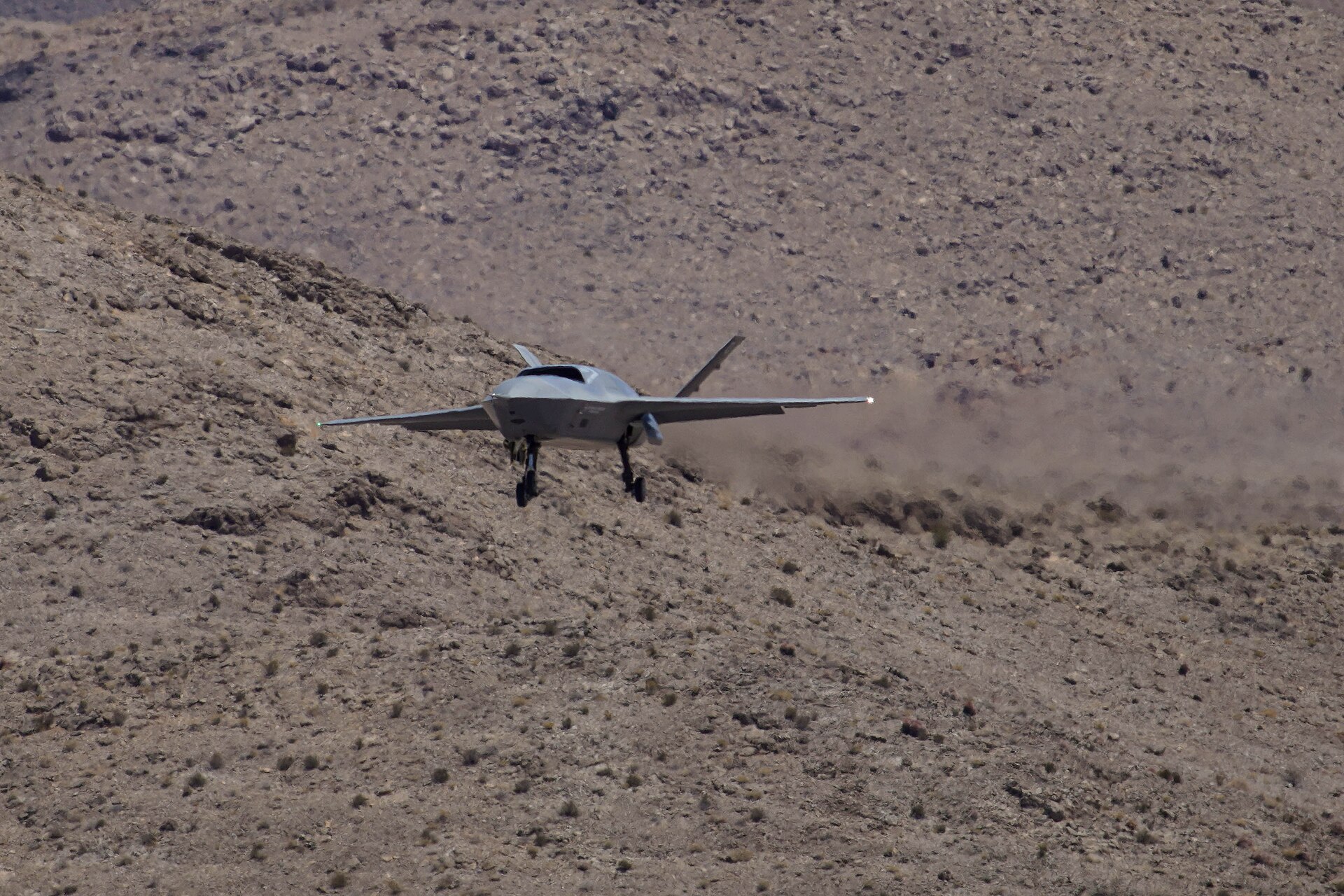
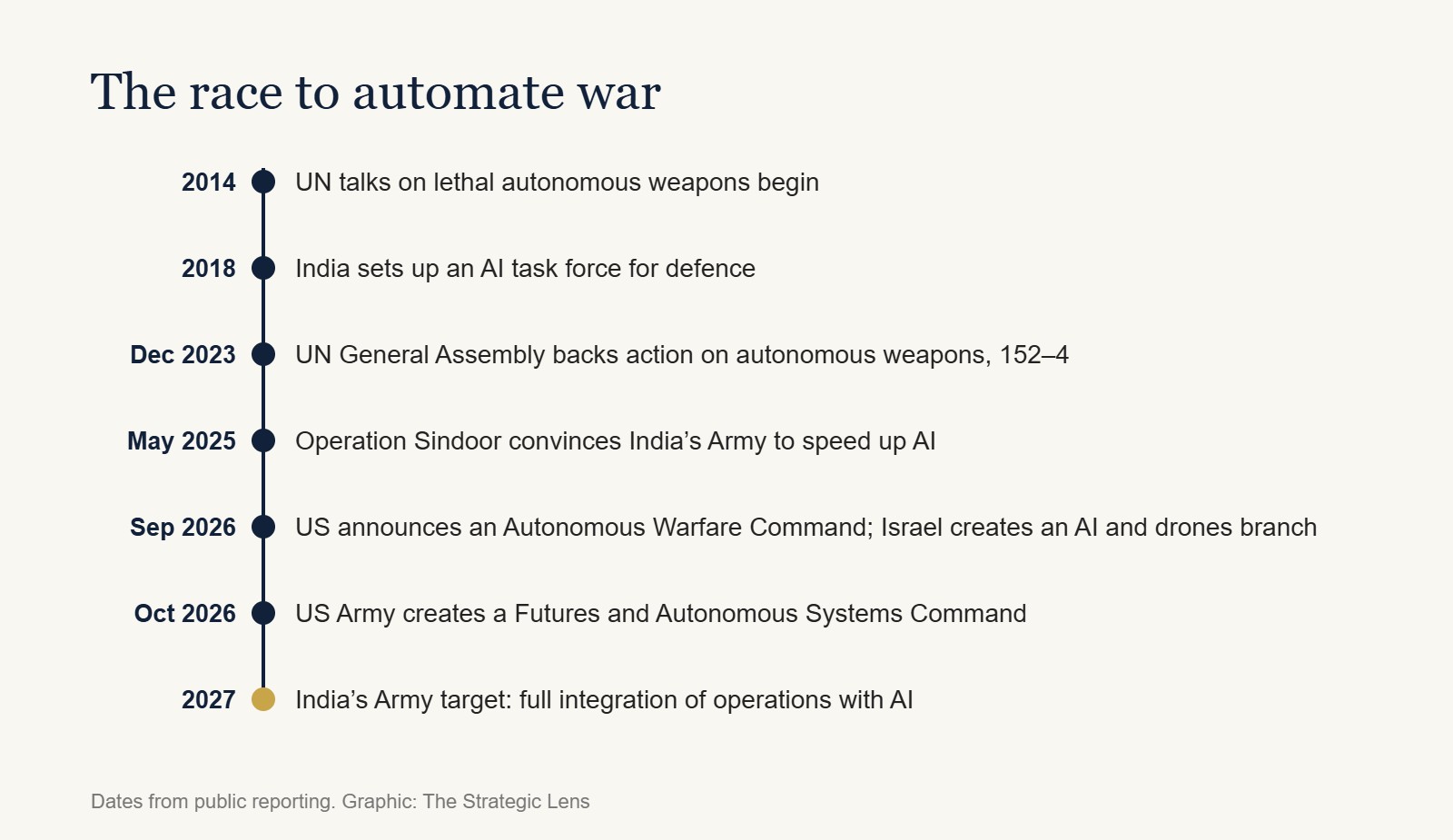
At the end of September 2026, US Defense Secretary Pete Hegseth announced a new four-star military command with one job: to scale up autonomous and robotic weapons across the entire US military. Within weeks, the Army had created its own command for autonomy, Israel had announced a new branch for drones and artificial intelligence, and India’s Army had laid out a plan to integrate AI into all its operations by 2027.
In this article
Artificial intelligence is no longer a side project for militaries. It is becoming the organising idea. Here is what is happening, why critics are worried, and where India fits in.
America’s Autonomous Warfare Command
The new US command, described by Hegseth as built to scale autonomous and robotic capabilities across the joint force, is expected to be formally established by October 2027, according to reporting by The Intercept, though Congress has to approve the plan. It will absorb existing efforts, including the drone programme that grew out of the Biden-era Replicator initiative. The Pentagon has laid out plans to spend tens of billions of dollars on autonomous systems, though how much Congress will actually approve is unclear.
One notable detail: in official messaging, the department increasingly refers to itself as the “Department of War” and its leader as the “War Secretary”, while many news outlets still use the older names.
Everyone is moving in the same direction
- US Army: a new Futures and Autonomous Systems Command, created in October 2026, is tasked with adding autonomy to aviation, armour, artillery, engineering and logistics, with fielding due by 2028.
- Israel: a new Unmanned Systems and Artificial Intelligence Branch, announced in September 2026.
- Ukraine: AI-assisted drones are already in combat, including for long-range strikes. Officials say humans remain in control, though there are unverified claims of fully autonomous attacks.
- China: a leading Chinese defence-industry executive predicted back in 2018 that future battlefields would have no people fighting. In 2021, China declined a US offer of talks on AI-enabled weapons.
India’s AI push
India’s Army has called 2023–2032 its “Decade of Transformation”. According to a November 2026 report, 2026 is the year of networking and data, and 2027 is meant to be the year operations are fully integrated with AI. The centrepiece is an indigenous Unified AI Platform, alongside an AI lab and a governance council to oversee how AI is deployed.
The driver was Operation Sindoor in May 2025. The Army’s conclusion was that the side that saw, decided and communicated first had the advantage. That is the promise of military AI: faster sensing, faster decisions, faster action. It connects directly to the Army’s wider reorganisation, which we covered in our guide to Indian Army restructuring.
The question is no longer whether militaries will use AI. It is how much they will let it decide.
The worries
- Who decides to kill? US policy (DoD Directive 3000.09) requires autonomous weapons to allow “appropriate levels of human judgment” over the use of force. Critics say that standard is vague and does not ban fully autonomous weapons, it only requires them to be certified.
- Oversight. Watchdog groups argue that the new US command’s fast-track buying powers are designed to bypass normal checks, risking costly and untested systems in combat.
- Mistakes at machine speed. AI targeting tools have been linked by some reporting to strikes that killed civilians. When errors happen faster than humans can check them, accountability becomes blurred.
- No global rules. UN talks on lethal autonomous weapons have run since 2014. A 2023 General Assembly resolution passed 152 to 4, but there is still no binding treaty, and major military powers including the US and Russia have opposed a ban.
Our take
AI will make militaries faster and, in many ways, more effective. It can also make war faster than human judgment can keep up with. The countries that get this right will be the ones that invest as much in testing, rules and accountability as in algorithms. For India, building its own AI rather than importing it is the right instinct. Building strong human control into it from day one is just as important.
Frequently asked questions
What is the US Autonomous Warfare Command?
It is a new four-star US military command announced in September 2026 to scale autonomous and robotic weapons across all services, expected to be formally established by October 2027.
Are fully autonomous weapons legal?
There is no binding international ban. US policy requires appropriate human judgment over the use of force, and UN talks on new rules have continued since 2014 without a treaty.
How is India using AI in its military?
India’s Army is building a Unified AI Platform and aims to integrate AI across operations by 2027, as part of its Decade of Transformation.
More from Strategic Lens Defence: Emerging Tech · Armed Forces
Sources and further reading
This is original analysis by Strategic Lens Defence. Key facts were cross-checked across multiple independent sources; where reports disagree or rest on a single source, we say so in the text. All wording and graphics are our own.
- Breaking Defense — Hegseth uses AUSA spotlight to push autonomy (Oct 2026)
- The Intercept — Hegseth’s military of the future (Oct 2026)
- Stars and Stripes — Leadership discusses Autonomous Warfare Command (Oct 2026)
- US Army — Army announces Futures and Autonomous Systems Command (Oct 2026)
- IDRW — Operation Sindoor lessons drive Indian Army’s push for data and AI (Nov 2026)
- Breaking Defense — Israeli military creates new AI and drones branch (Sep 2026)
- Wikipedia — Lethal autonomous weapon
- Wikimedia Commons — photo: A USAF YFQ-42A Dark Merlin descends before landing at Creech AFB 260722-F-HX125-1082 (public domain)


Leave a Reply