
Fifth-generation fighters like the F-35 and J-20 were built around one idea: stealth. The sixth generation is being built around a different one: the fighter as the quarterback of a network. Here is what that means, and where every major program stands at the end of 2026.
In this article
What makes a fighter “sixth-generation”?
There is no official definition, but most programs share the same wish list:
- Broadband stealth, often in tailless designs that are harder to detect across more radar bands
- Adaptive or variable-cycle engines that trade between fuel efficiency and thrust, giving much longer range
- Collaborative drones — “loyal wingmen” that fly ahead to sense, jam or shoot
- AI and sensor fusion that turn data from many platforms into one picture for the pilot
- Optional manning and virtual, helmet-based cockpits
- Digital engineering, so the aircraft can be upgraded through software rather than redesigns
Sixth-generation programmes at a glance
| Country | Programme | Status (late 2026) | Target |
|---|---|---|---|
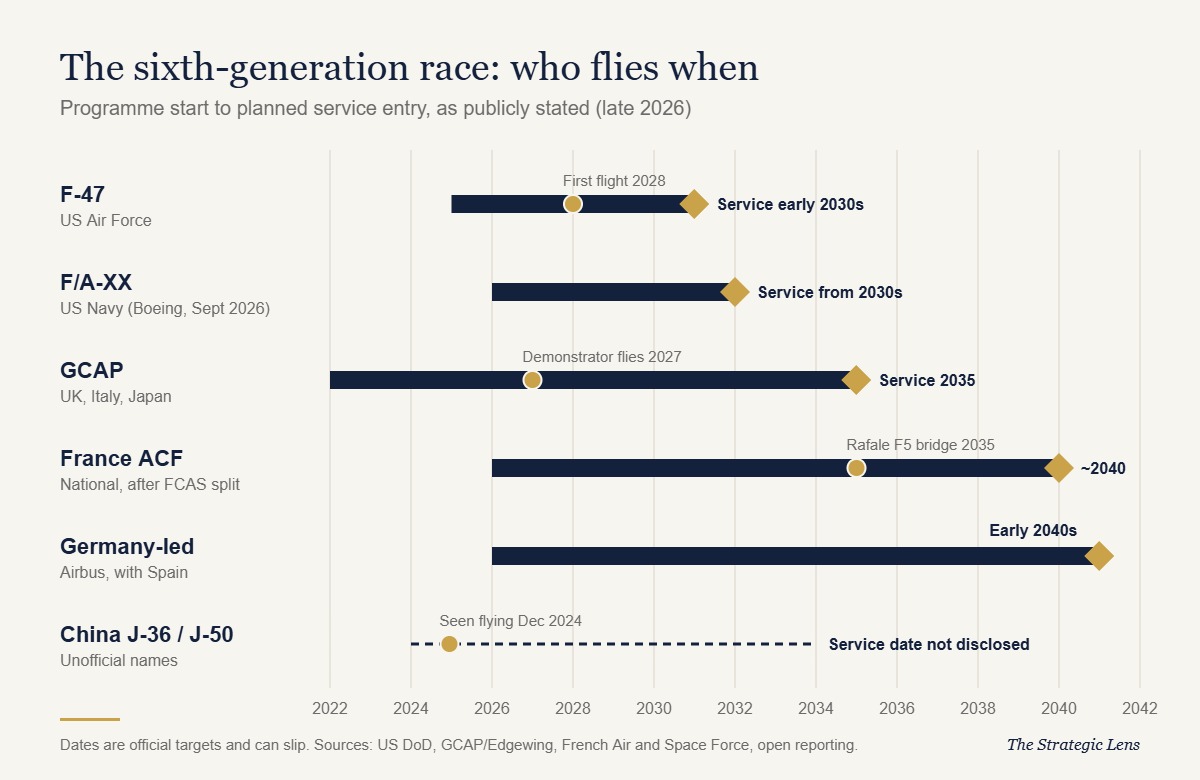
| United States | F-47 (Air Force) | First aircraft being built; Boeing chosen 2025 | First flight 2028 |
| United States | F/A-XX (Navy) | Boeing selected Sept 2026; about $20bn development deal | Service from the 2030s |
| UK, Italy, Japan | GCAP | £4.6bn design contract to Edgewing, July 2026 | Demonstrator ~2027, service 2035 |
| France, Germany, Spain | FCAS/SCAF, now split | Joint fighter abandoned June 2026; France going alone | France ~2040; Germany early 2040s |
| China | J-36 / J-50 (unofficial names) | Prototypes seen flying since Dec 2024 | Not disclosed |
| Russia | PAK DP | Concept stage | Not disclosed |
The shift is from close-in dogfighting toward range, persistence and stand-off weapons, which matters most over the vast distances of the Indo-Pacific.
Program by program
United States: F-47 (Air Force) and F/A-XX (Navy)
Boeing won the Air Force’s Next Generation Air Dominance contract in March 2025, and the jet was named the F-47. Boeing is already building the first aircraft. A first flight is targeted for 2028, with service in the early 2030s. The Navy’s carrier-based counterpart, F/A-XX, finally got a winner on 29 September 2026: Boeing beat Northrop Grumman for a full-scale development contract worth about $20 billion. The jet is meant to replace the Navy’s Super Hornets and Growlers from the 2030s, which makes Boeing the builder of both of America’s crewed sixth-generation fighters.
UK, Italy and Japan: GCAP
The Global Combat Air Programme merged Britain’s Tempest, Italy’s effort and Japan’s F-X in 2022. A joint industrial company, Edgewing — BAE Systems, Leonardo and Japan’s JAIEC — was formed in 2025 as the prime contractor. In July 2026 the three governments gave Edgewing a £4.6 billion (about $6.1 billion) contract to take the fighter into detailed design through 2027. Separately, a crewed demonstrator is in final assembly in Lancashire and is due to fly before the end of 2027. Service entry is planned for 2035. Sweden is an observer, and other countries have shown interest.
France, Germany and Spain: FCAS/SCAF
The Franco-German-Spanish program has been the cautionary tale. Dassault and Airbus spent years fighting over work share and leadership; in early 2026 France reportedly sought around 80% of the work. In June 2026, after mediation collapsed, Berlin and Paris abandoned the shared fighter, nine years in and with no prototype; only the networked “combat cloud” survives as a joint effort. In October, France’s air chief told parliament that France will build its own Avion de Combat du Futur on its own, aiming for service around 2040, with an upgraded Rafale F5 as a bridge from 2035. Germany is expected to pursue an Airbus-led fighter, likely with Spain, for the early 2040s.
China: J-36 and J-50
China surprised everyone in December 2024 when two tailless aircraft appeared in social-media imagery: a large trijet from Chengdu, widely called the J-36, and a smaller Shenyang design, often called the J-50. Neither name is official, and a third tailless type was reported in August 2025. China has not confirmed timelines, but these are the first sixth-generation prototypes to be seen flying anywhere.
Everyone else
Russia’s PAK DP remains a concept. Sweden is still studying what should follow the Gripen and has kept its options open. India has no sixth-generation program of its own; its focus remains the fifth-generation AMCA.
Why it matters
These aircraft will cost far more than their predecessors, and only a few countries can build them. That makes the sixth generation as much about alliances as about engineering: who partners with whom, who gets the technology, and who is left buying from others. Europe’s split, and China’s early lead in flying prototypes, are the two stories to watch.
What it means for India
India is not in any sixth-generation club. Its fighter roadmap runs through the Tejas Mk1A and Mk2, the 114-jet MRFA purchase now centred on the Rafale, and the fifth-generation AMCA, which is not expected in squadron service until the mid-2030s.
That timing is the problem. China’s tailless prototypes are already flying while the PLA Air Force keeps adding J-20s. If Beijing gets a sixth-generation jet into service in the 2030s while India is still inducting its first fifth-generation squadrons, the air-power gap across the Himalayas widens rather than closes. And because Pakistan buys most of its combat aircraft from China, Chinese advances tend to show up on India’s western front as well.
India’s realistic options are to make AMCA a success and design it with room to grow, invest early in drone wingmen such as HAL’s CATS Warrior concept so the sixth-generation idea of a fighter leading drones is not entirely missed, and keep a door open to a future partner. France has said it remains open to cooperation “within different frameworks”, and India’s growing Rafale fleet makes Paris an obvious conversation, though nothing of the kind has been announced.
Our take
The sixth generation is splitting into two models. The United States is paying for everything itself, twice over, with separate Air Force and Navy jets. Everyone else is discovering that a fighter this expensive needs partners, and that partners are hard to keep: GCAP is holding together because each country brings something the others need, while FCAS fell apart because France and Germany wanted different aircraft. Expect at least one of these programmes to slip, and expect the drones flying alongside the fighter to matter as much as the fighter itself.
Frequently asked questions
Has any sixth-generation fighter entered service?
No. Chinese tailless prototypes have been seen flying since December 2024, and the US F-47 is aiming for a first flight in 2028. No sixth-generation fighter is expected in squadron service before the 2030s.
Who won the US Navy F/A-XX contract?
Boeing, announced on 29 September 2026, beating Northrop Grumman. The full-scale development deal is worth about $20 billion, and the jet is meant to replace Super Hornets and Growlers from the 2030s.
Is India part of a sixth-generation programme?
No. India is focused on the fifth-generation AMCA and is not a partner in GCAP, the US programmes or France’s new national fighter.
More from Strategic Lens Defence: AMCA Explained · The 114-Rafale Deal · Air Force · Emerging Tech
Sources
This is original analysis by Strategic Lens Defence. Key facts were cross-checked across multiple independent sources; where reports disagree or rest on a single source, we say so in the text. All wording and graphics are our own.
- Defense News — US Navy selects Boeing to build next-generation F/A-XX fighter (29 Sep 2026)
- Defense News — France to go it alone on next-gen combat aircraft after FCAS collapse (15 Oct 2026)
- AeroTime — Germany, France abandon joint FCAS fighter (8 Jun 2026)
- Aerospace Testing International — Tempest demonstrator in final assembly (4 Aug 2026)
- Defense One — F-47 first flight expected in 2028 (Sep 2025)
- Aviation A2Z — F-47 leads new 6th-gen fighter race (Apr 2026)
- MiGFlug — Every sixth-generation fighter program explained (Aug 2026)
- Wikimedia Commons — photo: F-47 Rendering (public domain)


Leave a Reply