
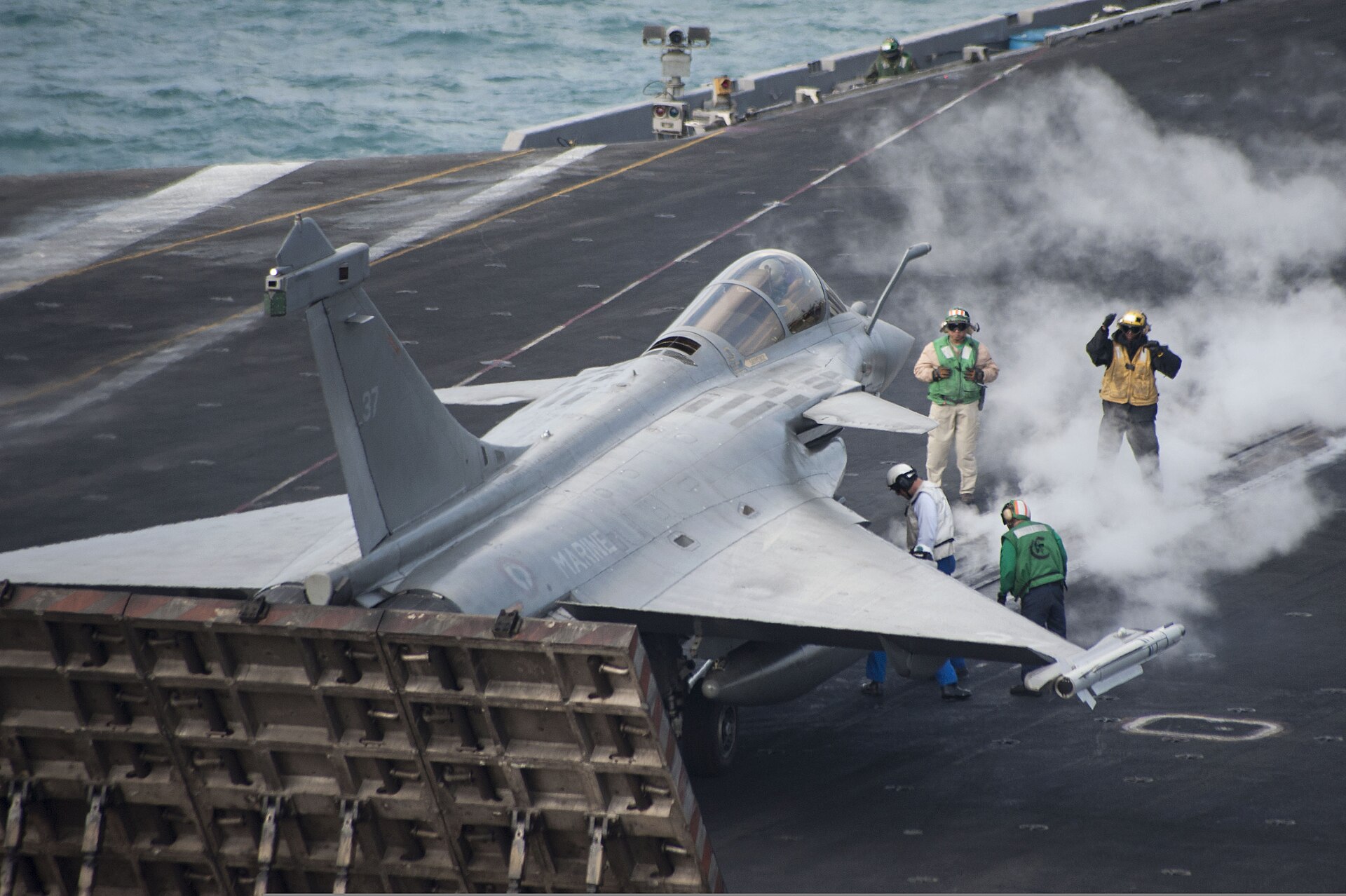
On 29 October 2026, a Rafale M touched down on INS Vikrant and caught the wire on its first attempt. The Indian Navy announced the landing a day later, calling the trials “the first steps towards operationalisation.” It is a short clip of an arrested landing, but it marks real progress in a decade-long search for a fighter that can keep India’s carriers relevant.
In this article
What actually happened
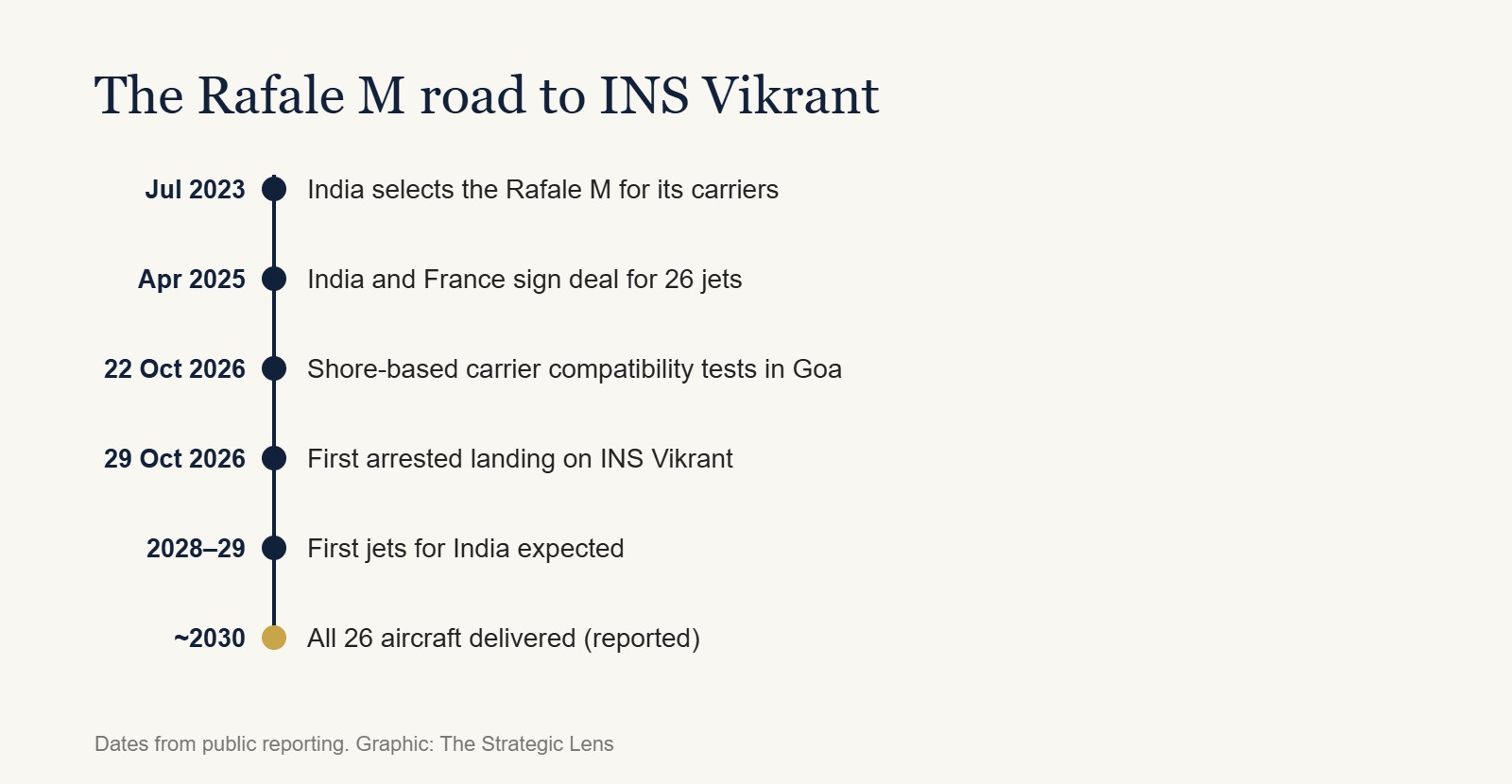
The landing followed carrier-compatibility testing at the Navy’s Shore Based Test Facility at INS Hansa in Goa, reported around 22 October. The jet then flew out to Vikrant, landed, and took off again. Reporting suggests the aircraft came from the French Navy’s own fleet, so this was a compatibility trial, not the arrival of India’s own jets.
Vikrant is a STOBAR carrier: aircraft launch off a ski-jump under their own power and land with arrester wires. That is a different regime from the catapult launches the Rafale M flies from France’s Charles de Gaulle, which is why these trials matter. They test whether the jet, and any India-specific modifications, work on India’s deck.
Vikrant’s layout also forces some changes to the jet. The Rafale’s delta wings do not fold, and its span is wider than the carrier’s aircraft lifts allow, so India’s jets are reported to get detachable wingtip missile rails, alongside small modifications to the lifts. Similar work will be needed on INS Vikramaditya.
The deal behind the landing
- Selected: July 2023
- Signed: intergovernmental agreement with France, April 2025
- Order: 26 jets — 22 single-seat Rafale M and 4 twin-seat trainers (the trainers are not carrier-capable)
- Value: about ₹63,000 crore (roughly $7.5 billion)
- Deliveries: scheduled to begin in 2029, with the full order following over the next few years
Why the Navy needed it
The Rafale M replaces the MiG-29K/KUB fleet that has flown from INS Vikramaditya and Vikrant. The MiG-29K has been dogged by availability problems; media reports have cited large numbers of Russian-supplied engines being rejected or withdrawn. Around 40 MiG-29K/KUBs remain in service, and the type was always meant as a bridge.
The Rafale M brings a Thales RBE2 AESA radar, the SPECTRA electronic-warfare suite, and commonality with the Indian Air Force’s 36 Rafales, which already gives India a pipeline for weapons, spares and training. Rafale M will operate from both carriers, though Vikramaditya will need similar modifications.
The indigenous question
The long-term plan is India’s own Twin Engine Deck Based Fighter (TEDBF). But its first flight has reportedly slipped from 2026 to 2029–2030, and some reporting says the proposal is not progressing. The Navy’s original requirement was 57 carrier fighters before it was trimmed to 26. If TEDBF keeps slipping, a follow-on order for more Rafale M becomes likely.
What to watch
- Whether India confirms the wingtip and weapons modifications reported for its jets
- The firm date for first delivery to India
- Progress, or further delay, on TEDBF
- Any move toward a second Rafale M batch
Our take
One landing does not make an air wing. But it removes a big technical question, and it shows India has, for now, chosen a proven Western jet over waiting for a home-grown one.
The harder questions now are about numbers and time. Twenty-two carrier-capable jets is a thin force for two carriers once maintenance, training and refits are counted, and the troubled MiG-29K has to keep flying until the Rafales arrive. If the TEDBF keeps slipping, a second Rafale M batch starts to look less like an option and more like a necessity.
Frequently asked questions
Has India received its Rafale M jets?
Not yet. The jet that landed on INS Vikrant in October 2026 was reported to be a French Navy aircraft flying compatibility trials. Deliveries of India’s own jets are scheduled to begin in 2029.
How many Rafale M is India buying?
Twenty-six: 22 single-seat Rafale M and four twin-seat trainers, under an agreement with France signed in April 2025 and worth about ₹63,000 crore. The trainers cannot operate from the carrier.
Will the Rafale M also fly from INS Vikramaditya?
Yes. It is planned to operate from both carriers, though Vikramaditya will need modifications similar to Vikrant’s.
More from Strategic Lens Defence: The 114-Rafale Deal · China’s Carrier Leap · Navy · Defence Industry & Deals
Sources
This is original analysis by Strategic Lens Defence. Key facts were cross-checked across multiple independent sources; where reports disagree or rest on a single source, we say so in the text. All wording and graphics are our own.
- The Aviationist — Rafale M conducts trials aboard INS Vikrant (31 Oct 2026)
- Naval News — Rafale M conducts maiden trials onboard INS Vikrant (2 Nov 2026)
- The Week — Indian Navy begins crucial trials for INS Vikrant (22 Oct 2026)
- Wikimedia Commons — photo: U.S. Sailors prepare a French navy F1 Rafale aircraft assigned to the aircraft carrier Charles de Gaulle to launch from the aircraft carrier USS Harry S. Truman (CVN 75) during carrier qualification integration 140113-N-ZG705-373 (public domain)


Leave a Reply