
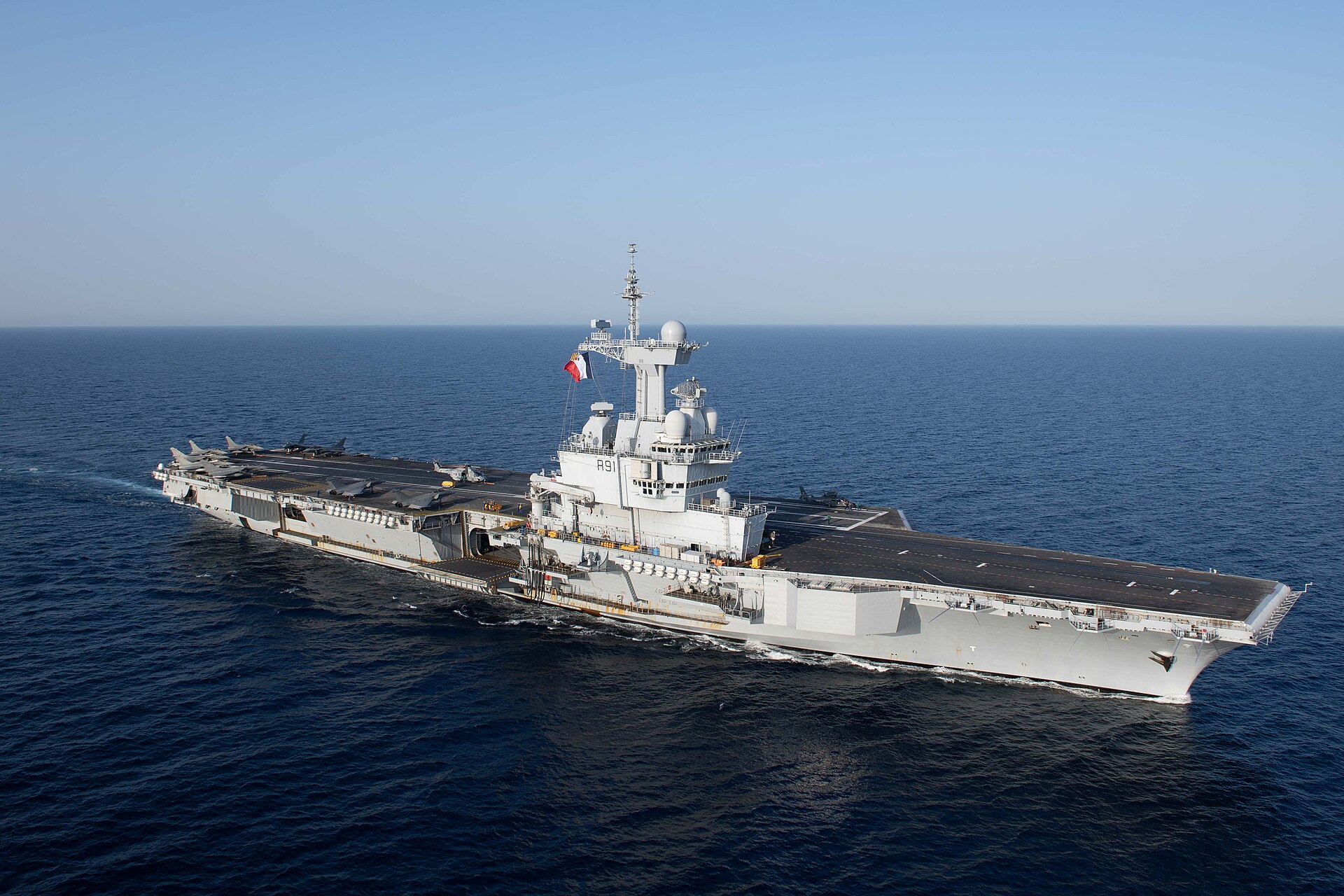
France likes to describe itself as a “balancing power”: a country with nuclear weapons, an aircraft carrier, troops on several continents and an arms industry that sells around the world. With Britain outside the EU and Germany only now rearming at scale, France is the European Union’s leading military power.
But French power is under strain. Its budget is doubling, yet its public debt is one of the highest in Europe and its governments keep falling. This guide explains France’s military power in 2026: what it has, what it is buying, how it compares, and whether it can afford its ambitions.
Quick answer: France has the EU’s most capable armed forces: about 200,000 active personnel, an independent nuclear deterrent, a nuclear-powered aircraft carrier, Rafale fighters and global bases. Its defence budget is set to reach €64 billion in 2027, double the 2017 level, under a €413 billion military programming law for 2024–2030. High debt and political instability are the main risks to those plans.
French armed forces at a glance
| Active personnel | About 200,000 |
| Defence budget | About €57 billion (2026); €64 billion target for 2027 |
| Programming law | €413 billion for 2024–2030 |
| Nuclear forces | About 290 warheads on submarines and Rafales (increase ordered 2026) |
| Navy | Carrier Charles de Gaulle, 4 SSBNs, Suffren-class attack submarines, FREMM and FDI frigates |
| Air force | Rafale fleet with F4/F5 upgrades, Mirage 2000D, A400M |
| Arms exports | World’s second-largest exporter (SIPRI, 2020–24) |
| Key risk | Public debt around 113% of GDP and political instability |
In this article
- The money: doubling in a decade
- What France is prioritising
- The nuclear deterrent
- The Navy: a carrier and nuclear submarines
- The Air and Space Force: built around the Rafale
- The Army: modernising for high-intensity war
- People: a new voluntary service
- Global presence
- The arms industry: Europe’s export champion
- How France compares in Europe
- The problem: money and politics
- Common misconceptions
- Our take
- Frequently asked questions
- Sources and further reading
The money: doubling in a decade
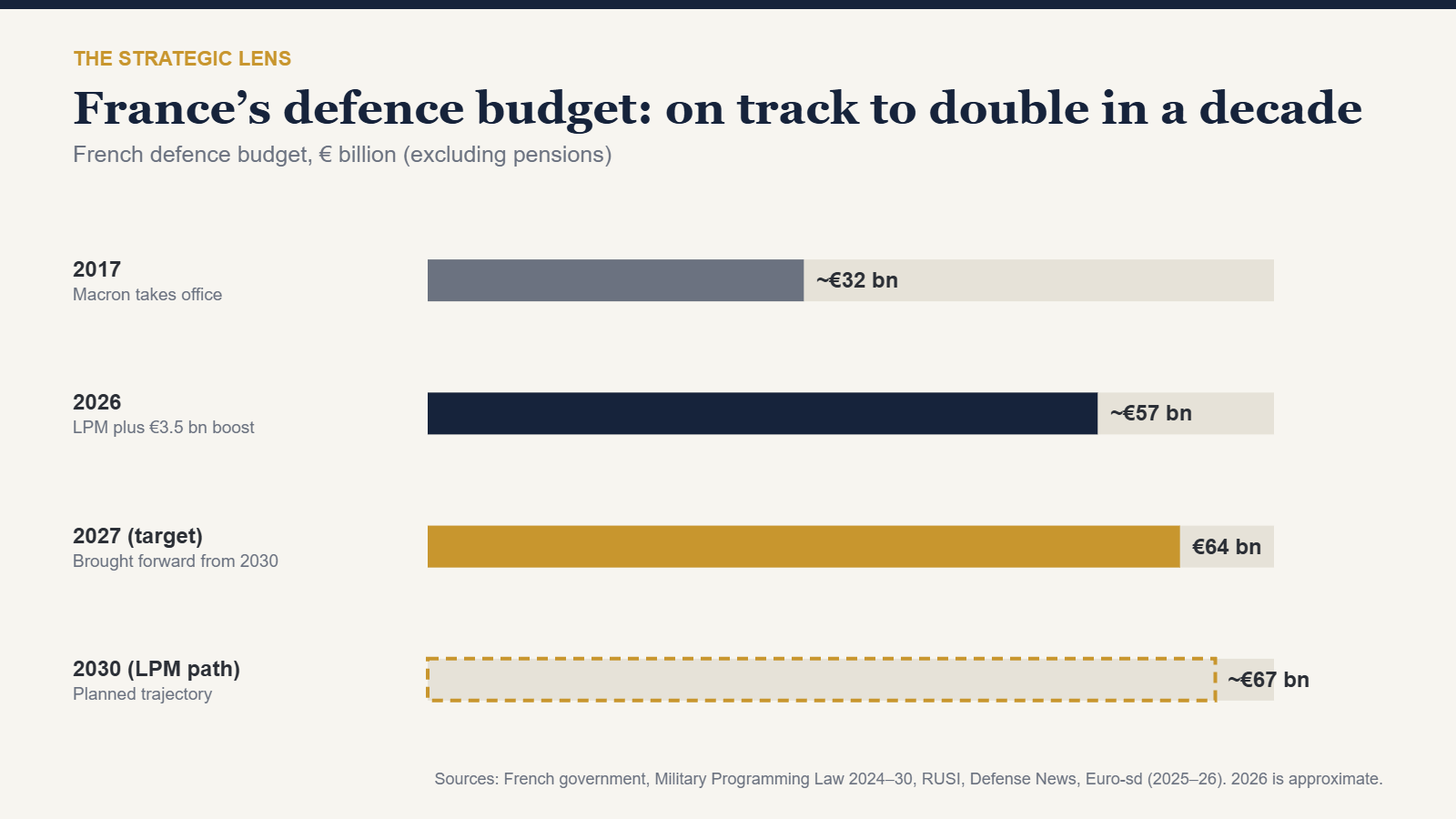
When Macron took office in 2017, France spent about €32 billion a year on defence. In July 2025, he announced an extra €3.5 billion for 2026 and €3 billion for 2027, bringing forward to 2027 the €64 billion target originally planned for 2030. That would double the 2017 budget. The wider 2024–2030 military programming law (LPM) commits €413 billion, and the government has said it aims for about €67 billion by 2030.
France spent roughly 2.3 percent of GDP on defence in 2025, according to analyst François Heisbourg, above NATO’s old 2 percent target. Allies agreed in The Hague in June 2025 to aim for 3.5 percent on core defence by 2035; France has not yet said when it will get there.
What France is prioritising
A National Strategic Review published in July 2025 told the armed forces to prepare for high-intensity war in Europe by 2030. Macron’s stated priorities are drones, ammunition, electronic warfare, air defence and space. The army is expected to be able to deploy a 19,000-strong division within 30 days by 2027, and France leads the land component of NATO’s Allied Reaction Force in 2026.
The nuclear deterrent
France’s independent nuclear force underpins everything else. It has about 290 warheads on submarine-launched missiles and Rafale-carried cruise missiles, and in March 2026 Macron ordered an increase and offered to deploy nuclear-capable aircraft temporarily to European allies. The submarine force alone takes about 13 percent of the defence budget. See our full explainer on France’s nuclear deterrent.
The Navy: a carrier and nuclear submarines
- Charles de Gaulle: France’s nuclear-powered carrier, the only one operated by a navy other than the US Navy. It carries Rafale Marine fighters. Macron announced in late 2025 that a new, larger carrier will be built to replace it around 2038.
- Submarines: four Triomphant-class ballistic missile submarines and the new Suffren-class nuclear attack submarines.
- Frigates: FREMM frigates and the new FDI frigates; the first FDI, Amiral Ronarc’h, was delivered in September 2025.
- Global reach: naval bases and territories in the Indian Ocean, Pacific and Caribbean.
The Air and Space Force: built around the Rafale
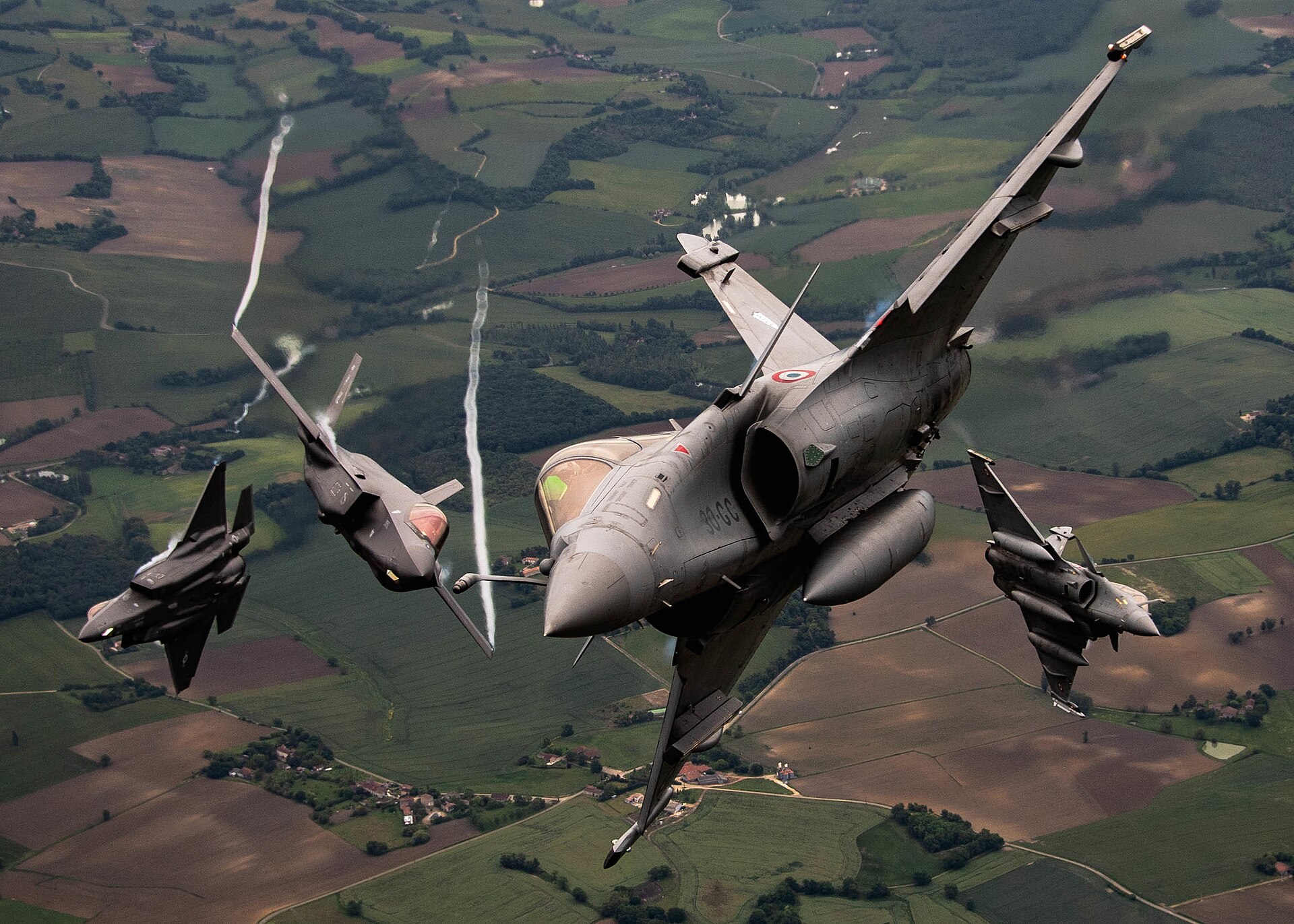
The Rafale is France’s only frontline combat jet, used for air defence, strike, reconnaissance and the airborne nuclear mission. France ordered 42 more in a fifth tranche in December 2023, and the upgraded F5 standard is due around 2030. The fleet also includes Mirage 2000D strike jets and A400M transports. Parliamentary reports have warned that the air force has too few Rafales for its missions. France’s next fighter, after the collapse of the joint FCAS fighter, will now be developed largely by Dassault.
The Army: modernising for high-intensity war
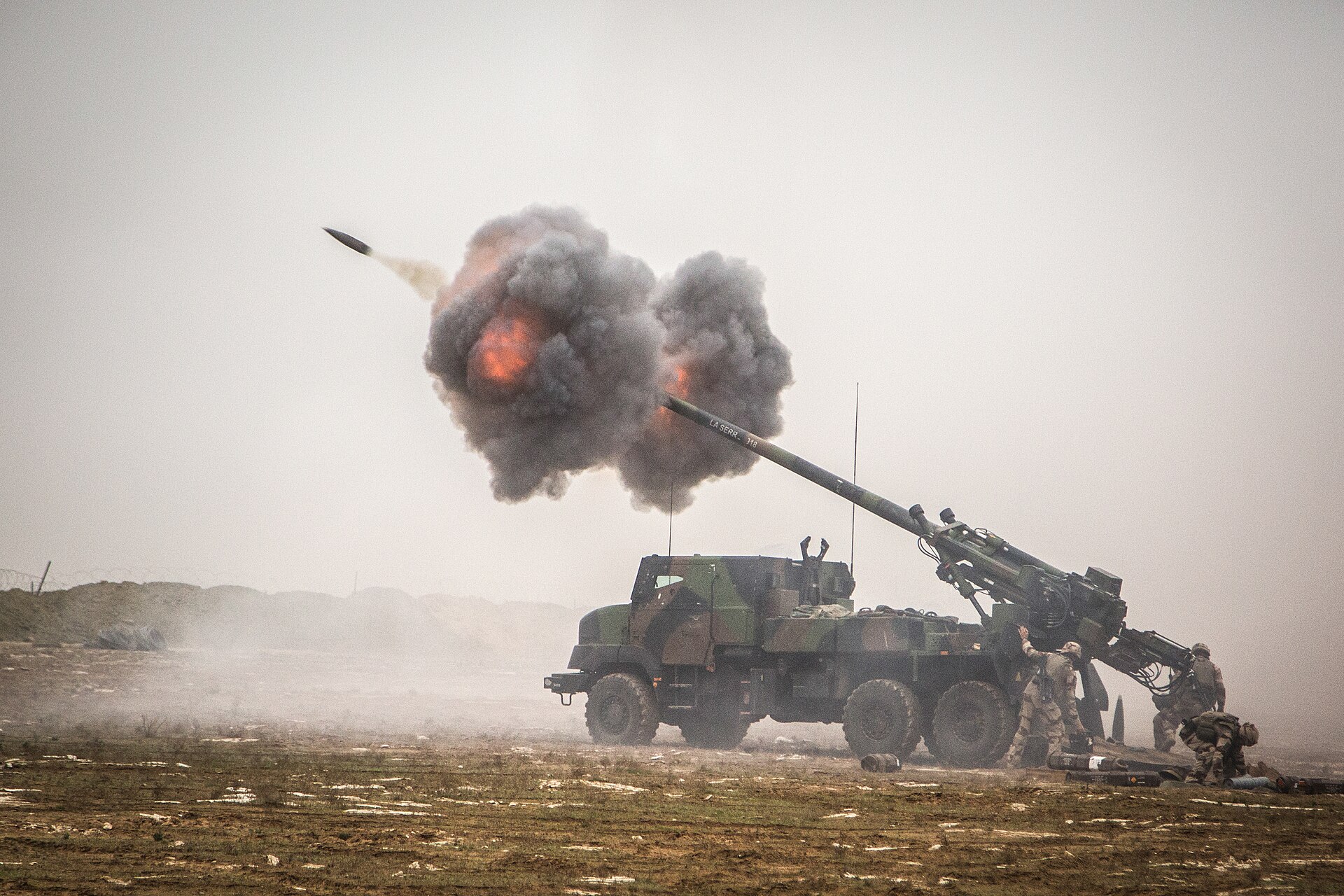
- Artillery: the CAESAR truck-mounted howitzer, proven in Ukraine and widely exported, and a new long-range rocket launcher (FLP-T), with 26 planned by 2035.
- Armour: Leclerc tanks and the Scorpion family of new armoured vehicles (Griffon, Jaguar, Serval), including anti-drone variants.
- Future tank: the Franco-German MGCS programme, whose future is uncertain.
- Air defence: the SAMP/T system, which won an export order from Denmark in 2025.
People: a new voluntary service
France’s armed forces have about 200,000 active personnel. In November 2025, Macron announced a new voluntary military service for young people, starting in 2026, aimed at building a larger trained reserve. Recruitment and retention remain challenges, as they are across Europe.
Global presence
France keeps forces in its overseas territories, from Réunion in the Indian Ocean to New Caledonia in the Pacific, and bases in Djibouti and the UAE. In Europe it leads a NATO battlegroup in Romania and contributes troops to Estonia. Its long-standing presence in West Africa has largely ended, as our explainer on Europe’s rearmament notes and our coming piece on France in Africa explains.
The arms industry: Europe’s export champion
France is the world’s second-largest arms exporter after the United States, according to SIPRI data for 2020–24. Companies such as Dassault, Naval Group, Safran, Thales, MBDA and KNDS sell fighters, submarines, missiles and artillery worldwide. Arms orders reached about €18 billion in 2024, driven by Rafales, submarines and CAESAR. India is one of the biggest customers, as covered in our guide to the India–France partnership. In November 2025, Ukraine and France signed a letter of intent covering up to 100 Rafales over the coming years.
How France compares in Europe
| France | United Kingdom | Germany | |
|---|---|---|---|
| Nuclear weapons | Yes, independent | Yes (US-linked missiles) | No |
| Aircraft carrier | 1 nuclear-powered | 2 conventional | None |
| Global bases | Yes, several | Yes, several | Very few |
| Defence spending trend | Doubling to €64bn by 2027 | Rising | Rapid rise, aiming for ~3.5% of GDP by 2029–30 |
| Combat experience | Africa, Middle East | Middle East, Afghanistan | Limited |
Germany is spending faster and may soon have Europe’s largest conventional army, but France keeps unique advantages: nuclear weapons, a carrier, a global footprint and recent combat experience.
The problem: money and politics
- Debt: French public debt was about 113 percent of GDP in 2024, among the highest in the EU, with annual interest costs above €50 billion.
- Deficits: the 2026 budget aims to cut the deficit to 5 percent of GDP.
- Political instability: Macron has no parliamentary majority. Prime Minister François Bayrou was forced out in 2025, and Sébastien Lecornu became prime minister. The 2026 budget passed only after surviving no-confidence votes.
- 2027 election: Macron’s term ends in May 2027, and his successor could change priorities.
Parliamentary committees have questioned whether the programming law is fully funded. The real test is whether France can keep raising defence spending while cutting deficits.
Common misconceptions
- “France has the strongest military in Europe.” It has the most complete set of capabilities in the EU, including nuclear weapons, but Germany may soon outspend it, and Britain and Poland have their own strengths.
- “France is still a big military player in Africa.” Most of its African bases have closed since 2022.
- “France spends far less than NATO asks.” It exceeded 2 percent of GDP, but like most allies it is still far from the new 3.5 percent core target.
Our take
France remains Europe’s most complete military power, the only EU state with nuclear weapons, a nuclear carrier and genuine global reach. Its rearmament plan is real and its industry is booming on exports. But the gap between ambition and money is wide, and French politics makes long-term commitments fragile.
Watch three things: whether the 2027 budget actually reaches €64 billion, what the 2027 presidential election does to defence policy, and how France’s go-it-alone next-generation fighter is funded. Those will decide whether France leads Europe’s rearmament or struggles to keep pace with Germany.
Frequently asked questions
How strong is the French military?
France has the European Union’s most complete armed forces, with about 200,000 active personnel, nuclear weapons, a nuclear-powered aircraft carrier, Rafale fighters and bases worldwide.
What is France’s defence budget?
About €57 billion in 2026, with a target of €64 billion in 2027, double the 2017 level. The 2024–2030 programming law commits €413 billion.
How many aircraft carriers does France have?
One, the nuclear-powered Charles de Gaulle. A new, larger carrier is planned to replace it around 2038.
Is France the world’s second-largest arms exporter?
Yes. SIPRI data for 2020–24 rank France second after the United States.
Does France have military bases in Africa?
Very few now. It left Mali, Burkina Faso, Niger, Chad, Ivory Coast and Senegal between 2022 and 2025, keeping a base in Djibouti and a small presence in Gabon.
Does France have conscription?
No. France ended conscription in the 1990s. In November 2025, Macron announced a new voluntary military service starting in 2026.
Sources and further reading
Researched using official statements and published reporting up to 6 November 2026.


Leave a Reply