
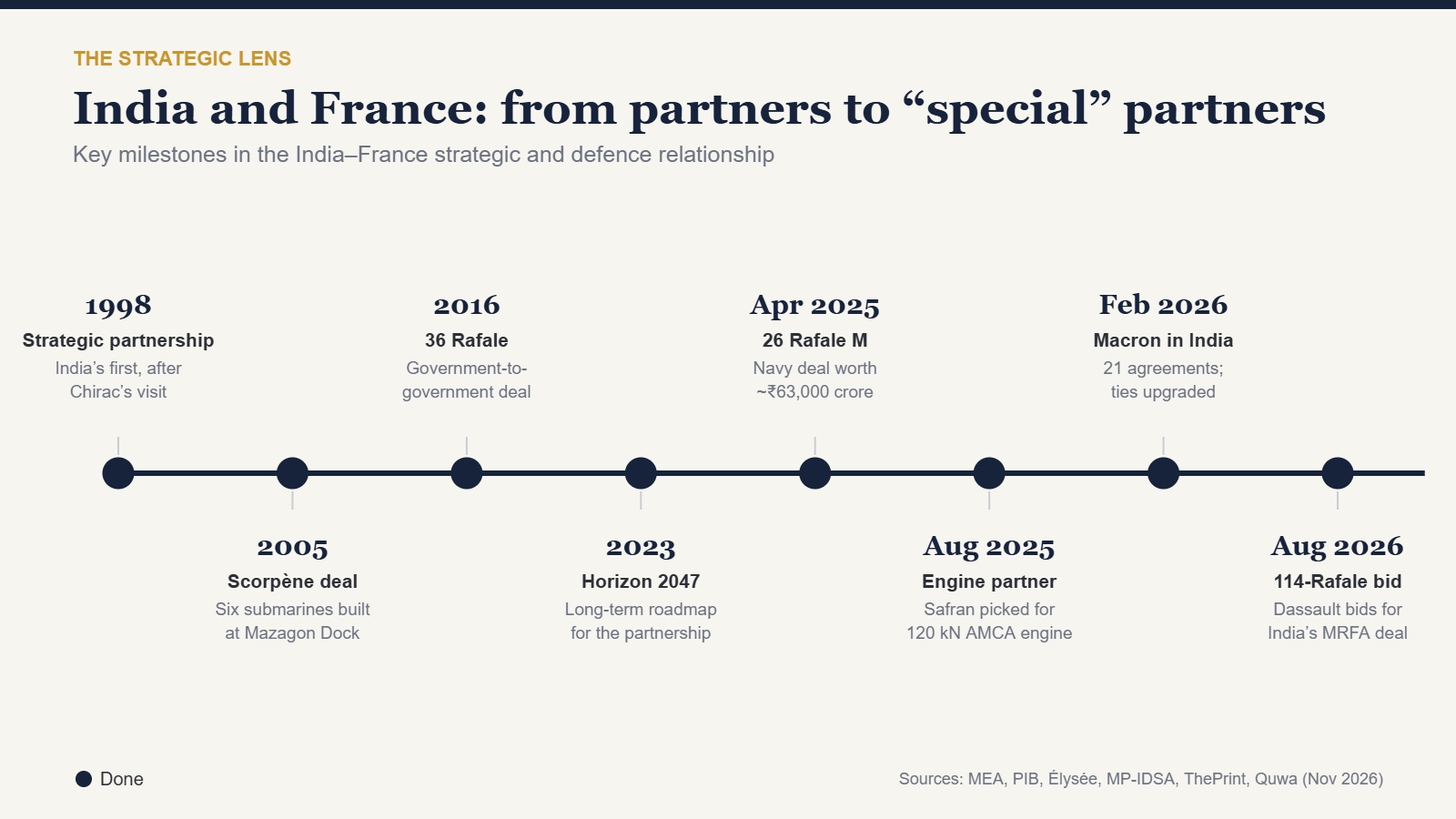
When India needed a partner it could rely on after its 1998 nuclear tests, when much of the world imposed sanctions, France chose not to condemn it. That same year, the two countries signed India’s first-ever strategic partnership. Nearly three decades later, France flies alongside the Indian Air Force in the Rafale, sails beneath the Indian Ocean in Scorpène submarines and is set to help build the engine for India’s stealth fighter.
In 2026, the India–France strategic partnership may be India’s most important defence relationship after Russia, and arguably its most trusted. This guide explains what India buys from France, the big deals in the pipeline, why the relationship works, and where it could stumble.
Quick answer: India and France have had a strategic partnership since 1998, upgraded in February 2026. France supplied about 28% of India’s arms imports in 2020–24, making it India’s second-largest supplier. Key programmes include 36 Rafales for the Air Force, 26 Rafale Marines for the Navy (signed April 2025), six Scorpène submarines, a planned Safran–DRDO jet engine for the AMCA and a bid for 114 more Rafales.
India–France ties at a glance
| Partnership | Strategic partnership since 1998; upgraded in February 2026 |
| Roadmap | Horizon 2047 (2023) |
| Share of India’s arms imports | About 28% (2020–24, SIPRI), second after Russia |
| Air Force | 36 Rafales (2016 deal, all delivered) |
| Navy | 26 Rafale Marines (April 2025, ~₹63,000 crore); six Scorpène submarines |
| Engine | Safran–GTRE 120 kN engine for the AMCA, awaiting final approval |
| Pending | 114-Rafale MRFA bid (2026); three more Scorpènes |
| Exercises | Shakti (army), Varuna (navy), Garuda (air force) |
In this article
- Why the partnership works
- The Rafale: the heart of the relationship
- Building it in India
- Submarines: the Scorpène story
- The jet engine: the most strategic deal of all
- A seat at Europe’s next fighter?
- Summits and the 2026 upgrade
- Beyond defence: nuclear, space and the ocean
- How France compares with India’s other partners
- Challenges
- Common misconceptions
- Our take
- Frequently asked questions
- Sources and further reading
Why the partnership works
Three things set France apart for Indian planners. First, it respects India’s strategic autonomy: it does not demand that India choose sides and rarely attaches political conditions. Second, it has been willing to transfer technology and build in India, from submarines to engines. Third, it has been consistent: France backed India’s bid for a permanent UN Security Council seat and was the first country to sign a civil nuclear deal with India after the 2008 waiver.
France is also an Indian Ocean power in its own right, through its overseas territories of Réunion and Mayotte, which gives the two countries shared interests in maritime security.
The Rafale: the heart of the relationship
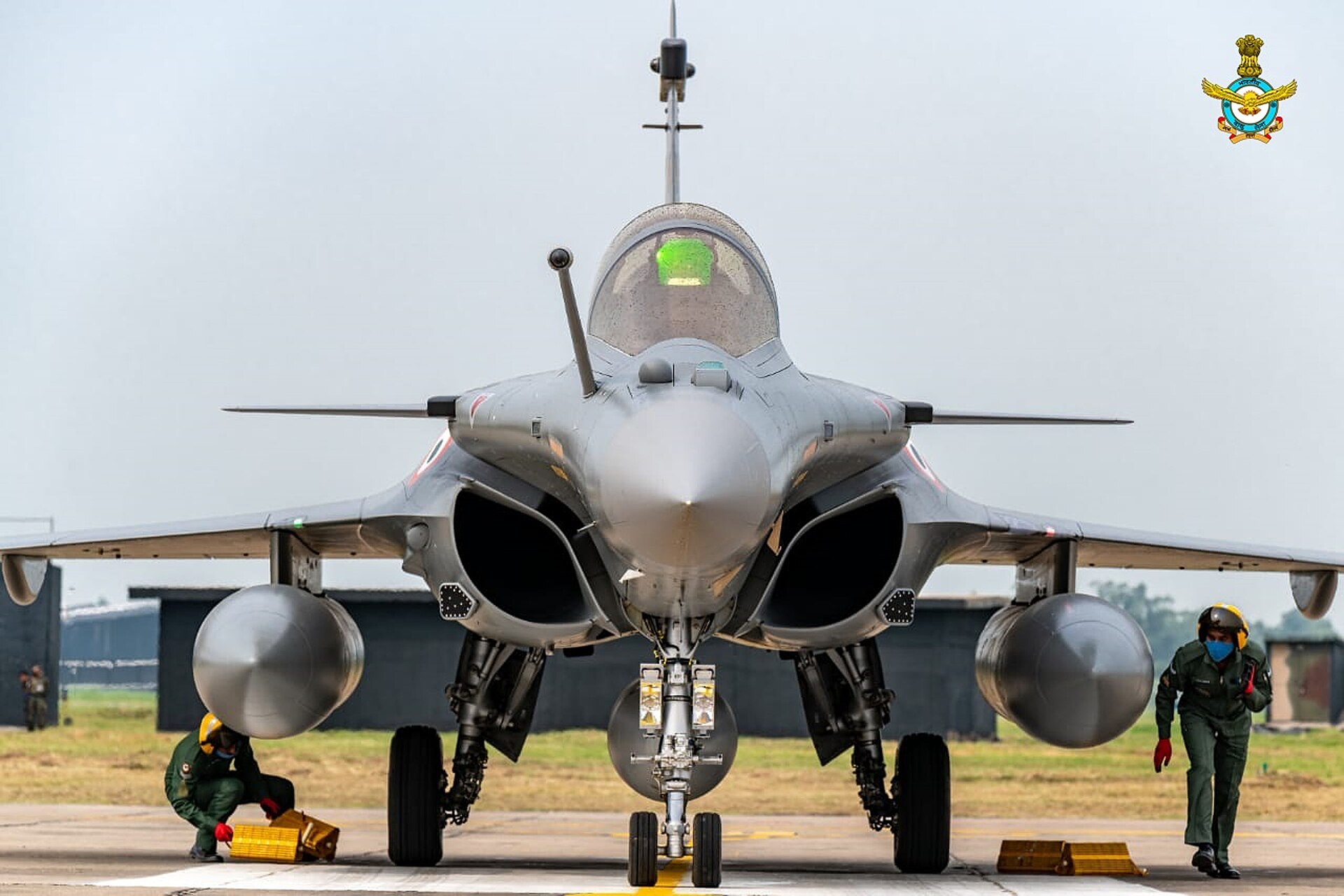
India signed a government-to-government deal for 36 Rafale fighters on 23 September 2016, worth about ₹59,000 crore, and all have been delivered. The Rafale played a central role in Operation Sindoor in May 2025. After that conflict, India’s Air Force faced a disinformation campaign alleging a rift with Dassault; a US congressional commission later said China was behind it.
26 Rafale Marines for the Navy
On 28 April 2025, India signed a deal worth about ₹63,000 crore for 26 Rafale Marine jets, 22 single-seat and four twin-seat, to fly from the carrier INS Vikrant, along with weapons, simulators and support. Deliveries are scheduled from about 2028 to 2030. Our explainer on the Rafale M and INS Vikrant covers the trials.
The 114-Rafale bid
The biggest prize is the Air Force’s requirement for 114 more fighters. India’s Defence Acquisition Council approved the need in February 2026, and Dassault reportedly submitted its bid in August 2026: about 20 jets built in France and 94 in India, with 55–60 percent local content, worth around ₹3.25 lakh crore. A sticking point is access to the jet’s radar and electronic warfare software, which France has reportedly offered only through controlled interfaces. A contract is targeted for late 2026 or early 2027. See our explainer on the 114-Rafale deal.
Building it in India
- Rafale fuselages: in June 2025, Dassault and Tata Advanced Systems signed agreements to manufacture Rafale fuselages in India.
- Engine maintenance: Safran is setting up a facility in Hyderabad to maintain the Rafale’s M88 engine modules, its first outside France.
- Weapons: a joint venture between BEL and Safran will make HAMMER precision-guided bombs in India.
- Helicopters: Safran works with HAL on engines for Indian helicopters, and an Airbus–Tata final assembly line for H125 helicopters opened in Karnataka in February 2026.
Submarines: the Scorpène story
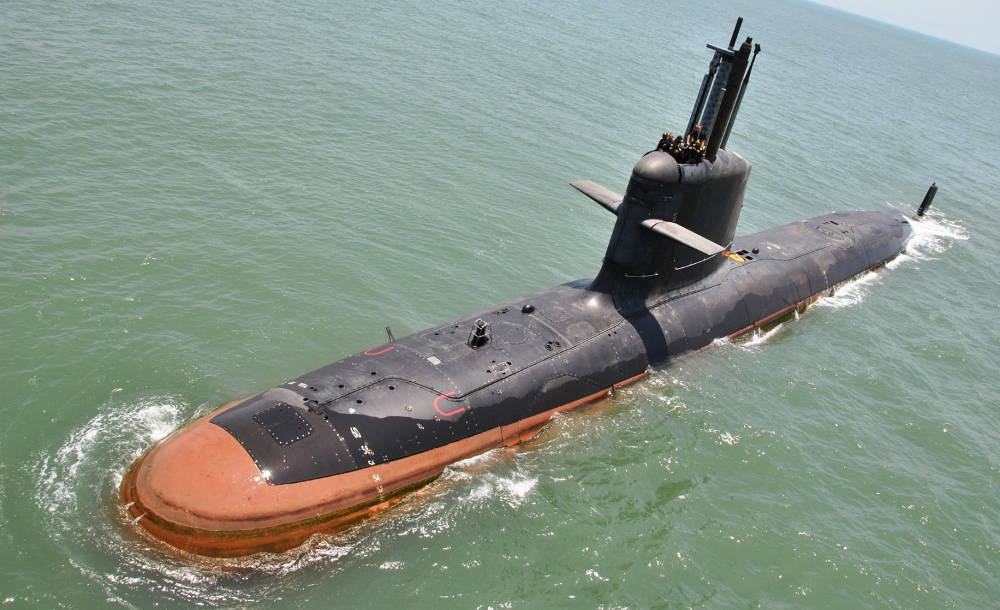
India ordered six Scorpène-class submarines in 2005. Known as the Kalvari class, they were built at Mazagon Dock in Mumbai with French technology transfer; the sixth was delivered in January 2025. A deal for three more, worth about ₹33,500 crore with higher Indian content, has been discussed but was still awaiting final government approval in the sources we reviewed. India’s wider submarine gap is explained in our piece on Project 75I.
The jet engine: the most strategic deal of all
In August 2025, India confirmed it would co-develop a 120 kN fighter engine with France’s Safran and DRDO’s Gas Turbine Research Establishment, to power the second batch of the AMCA stealth fighter and grow later to 140 kN. India would hold full intellectual property, a first for a fighter engine. Reports in August 2026 said the joint venture was before the Cabinet Committee on Security for final approval. If approved, it could end India’s decades-long dependence on foreign fighter engines.
A seat at Europe’s next fighter?
In 2026, India also expressed interest in joining a France-led next-generation fighter effort. India’s Defence Ministry told a parliamentary committee in August 2026 that it was in active talks, after the Franco-German FCAS project split. This would give India access to sixth-generation technology alongside its own AMCA.
Summits and the 2026 upgrade
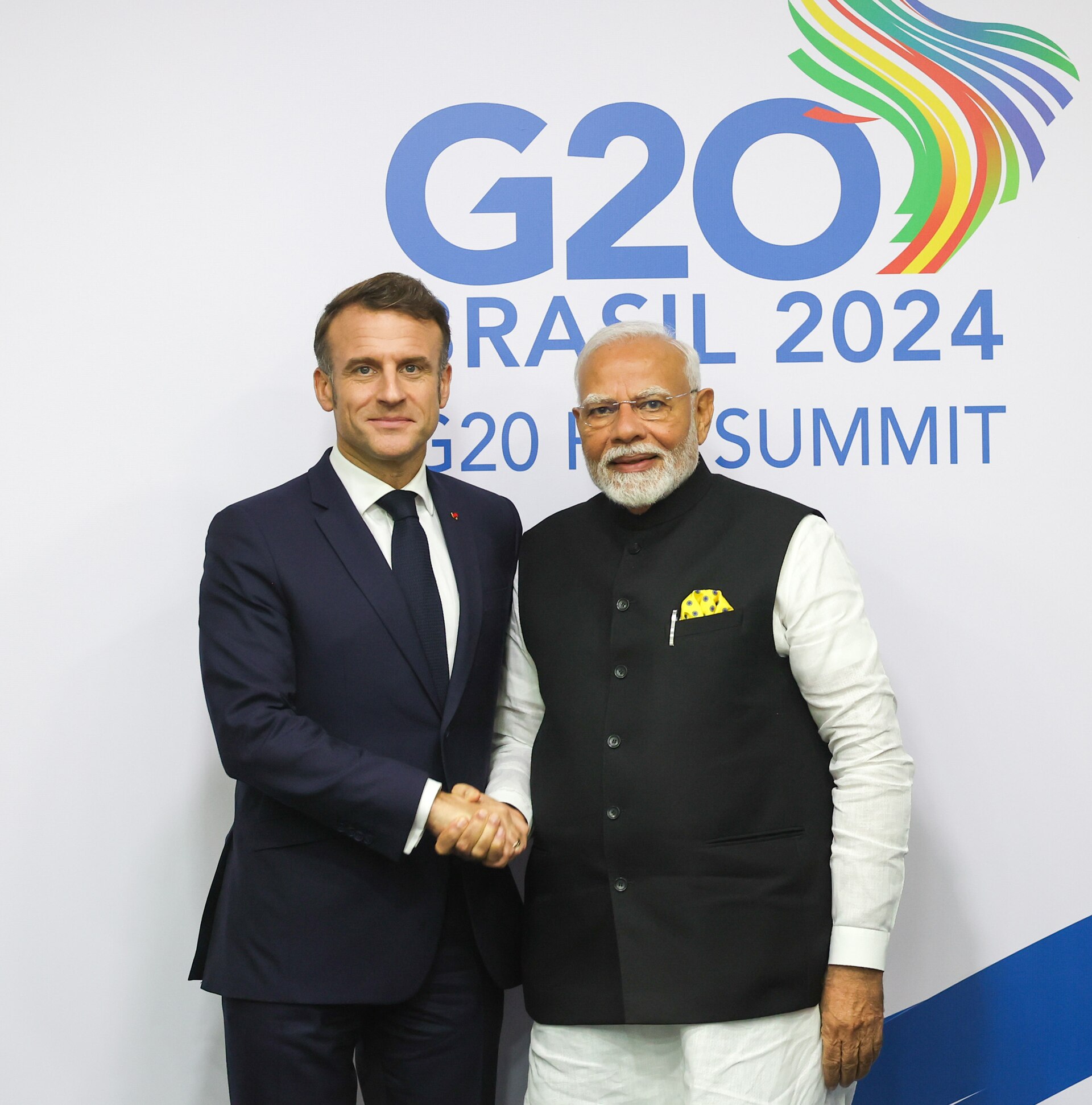
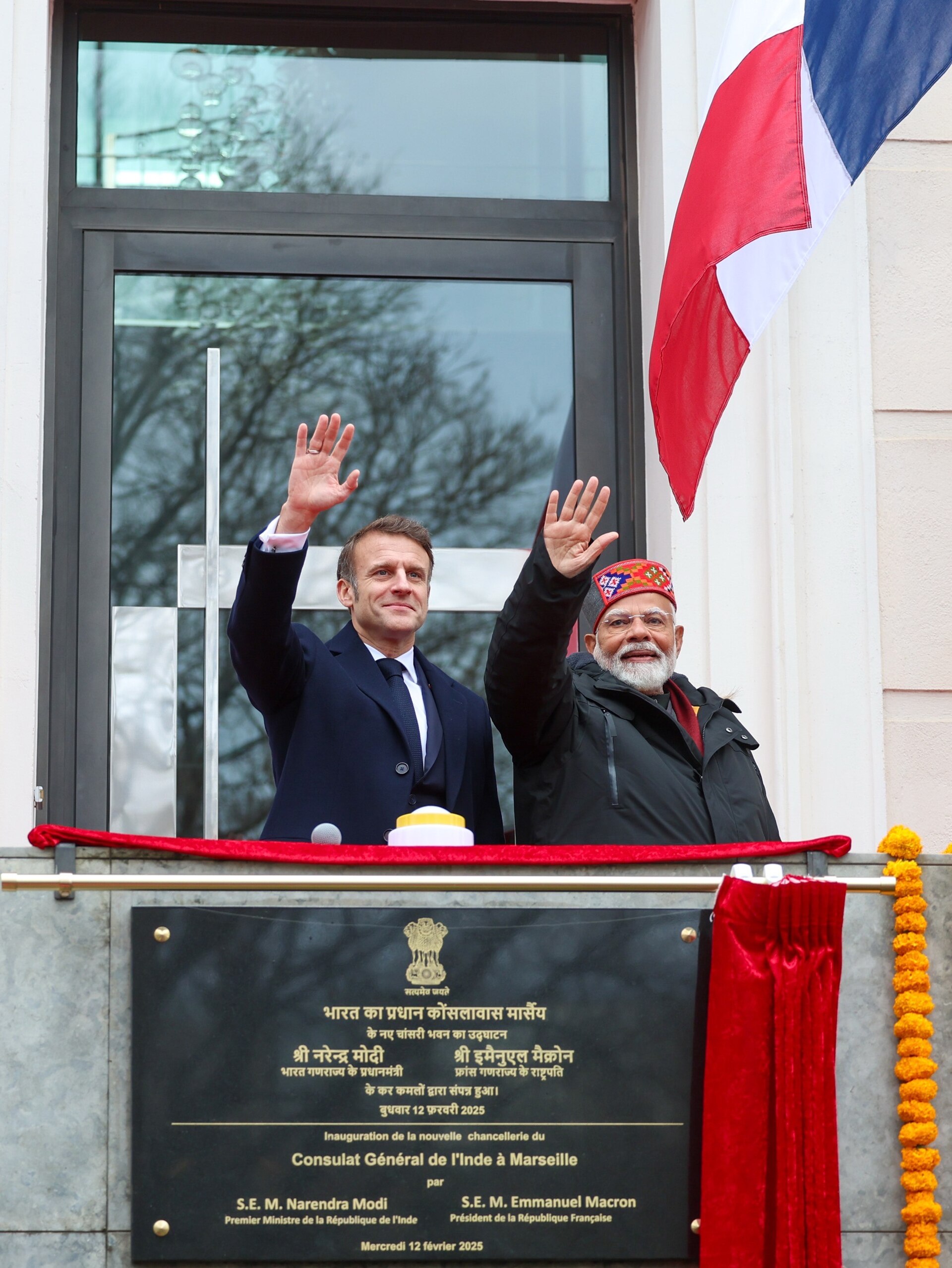
Modi visited France in February 2025 for the AI Action Summit in Paris, which he co-chaired, and opened a consulate in Marseille. Macron visited India from 17 to 19 February 2026, when the two sides signed 21 agreements and elevated their relationship to a “special” strategic partnership. Modi returned to France in June 2026. In November 2025, DRDO and France’s defence procurement agency signed a technical arrangement covering AI, cyber, propulsion, quantum and underwater systems.
Beyond defence: nuclear, space and the ocean
- Civil nuclear: France was the first country to sign a nuclear energy deal with India after the 2008 waiver, though the planned Jaitapur nuclear plant has faced long delays.
- Space: ISRO and France’s CNES cooperate on Earth observation and other missions, including the planned TRISHNA thermal-imaging satellite.
- Indian Ocean: the two navies cooperate on maritime awareness, anti-piracy and patrols, and France’s Réunion base gives it a natural stake in the region.
How France compares with India’s other partners
| Partner | Strength | Limitation |
|---|---|---|
| Russia | Largest legacy supplier, low cost, deep ties | Sanctions, delays, closeness to China |
| France | Tech transfer, reliability, few political strings | High prices, limited production capacity |
| United States | Cutting-edge tech, scale | Export controls, political volatility |
| Israel | Fast delivery, niche systems | Smaller range of platforms |
For more on the other relationships, see our guides to India–Russia relations and the US–India defence partnership.
Challenges
- Cost: Rafales and French systems are expensive, and price negotiations are tough.
- Software access: India wants control over source codes; France guards them closely.
- Approvals and pace: big deals like the engine and extra Scorpènes move slowly through India’s system.
- French politics: France’s fiscal troubles and the 2027 presidential election could affect priorities.
- Capacity: Dassault and Safran must balance Indian orders with demand from France and other buyers.
Common misconceptions
- “France just sells India weapons.” Increasingly, it co-produces them in India and is set to co-develop an engine with full Indian ownership of the design.
- “There was a dispute between India and Dassault after Sindoor.” That claim was part of a disinformation campaign attributed to China by a US congressional commission.
- “France has replaced Russia as India’s top supplier.” Not yet. Russia is still the largest single supplier, though France is closing in.
Our take
The India–France partnership is unusual in being both deep and low-drama. France gives India what it most wants, technology, production at home and respect for its independence, and India gives France a large, long-term customer and a strategic partner in the Indo-Pacific.
The next year could define the relationship for decades. Watch for three signatures: the Safran–GTRE engine deal, the 114-Rafale contract, and any decision on India joining a French next-generation fighter. If all three come through, France will have moved from supplier to co-developer of India’s air power.
Frequently asked questions
When did India and France become strategic partners?
In 1998, making France India’s first strategic partner. The partnership was elevated in February 2026 during President Macron’s visit to India.
How many Rafales does India have?
The Air Force has 36 Rafales from a 2016 deal. The Navy ordered 26 Rafale Marines in April 2025, with deliveries from about 2028, and a bid for 114 more for the Air Force is under negotiation.
What is the India–France jet engine deal?
A plan for France’s Safran and DRDO’s GTRE to co-develop a 120 kN engine for the AMCA stealth fighter, growing to 140 kN, with India owning the intellectual property. It was awaiting final Cabinet approval in 2026.
What is Horizon 2047?
A long-term roadmap for India–France cooperation, adopted in 2023, covering defence, space, nuclear energy, technology and other areas up to India’s centenary in 2047.
Is France India’s biggest arms supplier?
No, Russia still is. But France supplied about 28% of India’s arms imports in 2020–24, according to SIPRI, making it the second-largest.
What submarines has France supplied to India?
Six Scorpène-class (Kalvari-class) submarines, built at Mazagon Dock in Mumbai with French technology. Three more have been proposed.
Sources and further reading
Researched using official statements and published reporting up to 6 November 2026.


Leave a Reply