
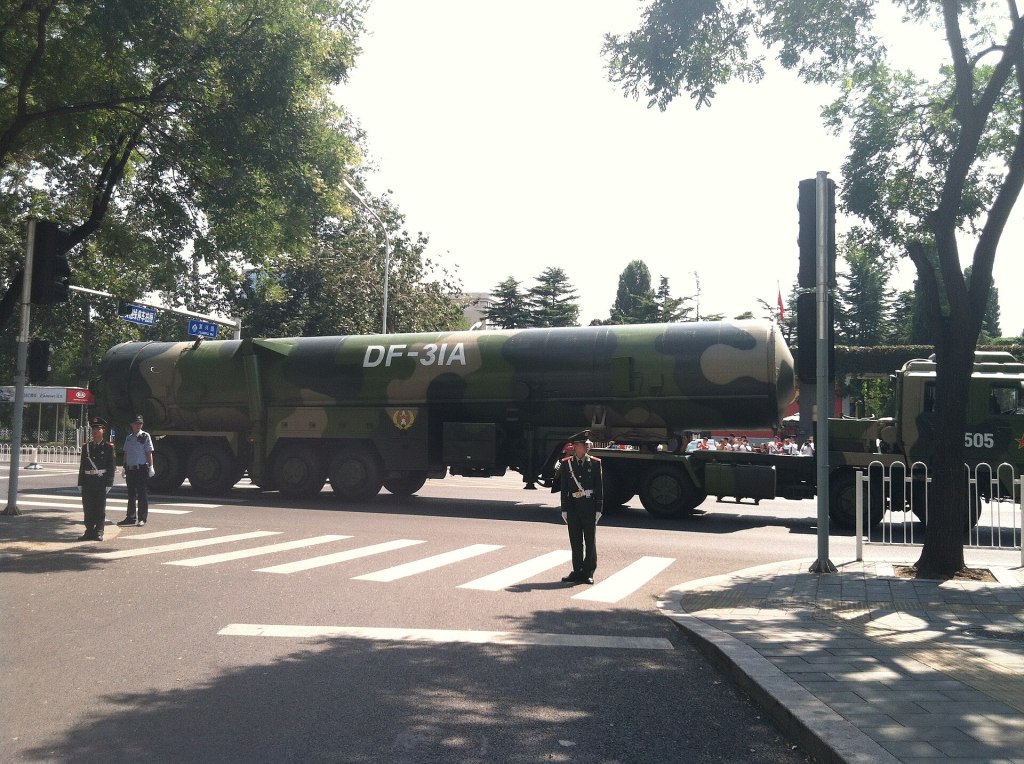
For most of the Cold War and long after it, China kept a surprisingly small nuclear arsenal. A few hundred warheads, mostly stored separately from their missiles, were enough for a doctrine built on one idea: survive a first strike and retaliate. That restraint is now over.
China is building nuclear weapons faster than any other country on Earth. It has dug hundreds of missile silos in its northern deserts, paraded all three legs of a nuclear triad for the first time, and, according to the Pentagon, is moving towards a launch-on-warning posture that looks a lot more like America’s and Russia’s. This article explains China’s nuclear weapons buildup: how many warheads it has, the missiles that carry them, why Beijing is doing it, and what it means for India and the wider world.
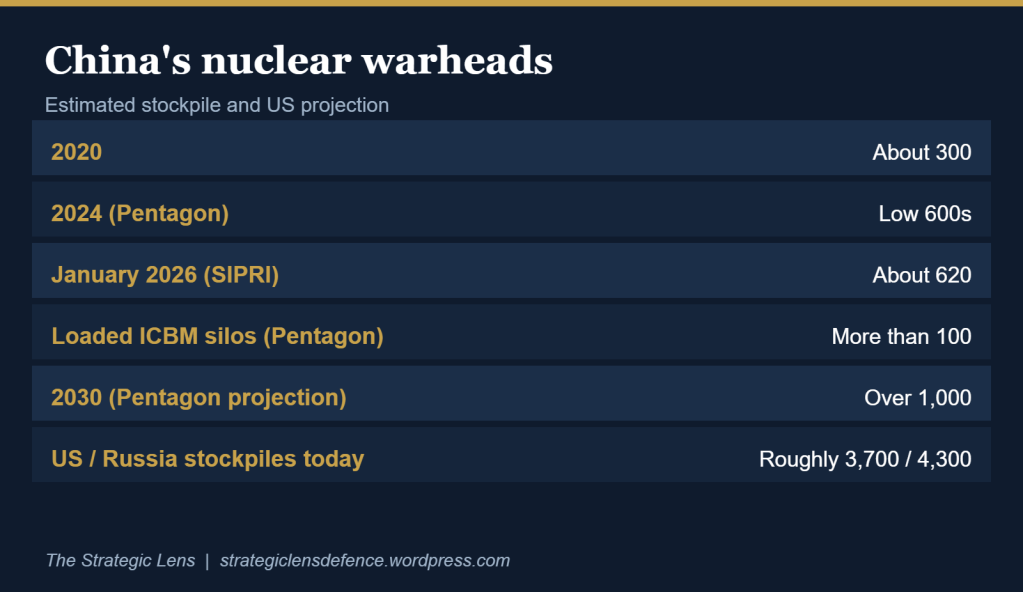
Quick answer: China had about 620 nuclear warheads in January 2026, according to SIPRI, up from roughly 300 in 2020. The Pentagon expects more than 1,000 by 2030. More than 100 new silos have been loaded with DF-31-class ICBMs, and China now fields land-, sea- and air-launched nuclear weapons. It is still far behind the US and Russia in total numbers, but the gap is closing quickly.
In this article
- How many nuclear warheads does China have?
- The silo fields
- The missiles: DF-41, DF-5C, DF-61 and more
- A full nuclear triad
- From minimum deterrence to launch-on-warning
- Why is China building so fast?
- Arms control: why Beijing says no
- What it means for India
- Common misconceptions
- Our take
- Frequently asked questions
- Sources and further reading
How many nuclear warheads does China have?
The best public estimate comes from the Stockholm International Peace Research Institute. Its 2026 Yearbook, released in June, puts China at around 620 warheads as of January 2026. SIPRI says China is expanding its arsenal “faster than any other country”.
The US Department of Defense tells a similar story. Its annual China Military Power Report, released on 23 December 2025, said Chinese operational warheads stayed “in the low 600s through 2024” and that the People’s Liberation Army (PLA) is on track for over 1,000 by 2030. Back in 2022, the Pentagon projected roughly 1,500 by 2035 if the pace held.
To put the growth in perspective: the Center for Strategic and International Studies (CSIS) estimates China had about 300 weapons in 2020. In six years the stockpile has roughly doubled. Few nuclear powers have grown this quickly since the 1960s.
| Year | Estimated warheads | Source |
|---|---|---|
| 2020 | About 300 | CSIS |
| 2024 | Low 600s (operational) | Pentagon |
| January 2026 | About 620 | SIPRI Yearbook 2026 |
| 2030 (projected) | Over 1,000 | Pentagon |
| 2035 (older projection) | About 1,500 | Pentagon, 2022 report |
Even 1,000 warheads would still be only about a quarter of what the United States or Russia holds, as SIPRI points out. But China does not need parity to change the strategic picture. It only needs enough survivable weapons to make any nuclear threat against it unthinkable, and enough to put pressure on US allies in Asia.
The silo fields
The clearest sign of change came in 2021, when open-source researchers using commercial satellite imagery found three vast silo fields under construction in western and northern China: about 120 silos near Yumen in Gansu, about 110 near Hami in Xinjiang, and about 90 near Ordos in Inner Mongolia. Analysts called it the most significant expansion of the Chinese arsenal ever.
Five years later, those holes in the desert are being filled. The Pentagon says China has loaded more than 100 solid-fuel ICBM silos with DF-31-class missiles. SIPRI adds that work continues on about 30 more silos in three mountainous areas in the east. China also keeps around 20 older silos for its liquid-fuelled DF-5 missiles.
Why silos, when road-mobile launchers are harder to find? Silos are cheap to build in large numbers, and they complicate an enemy’s targeting. An attacker would have to spend at least one warhead on every silo, whether it holds a missile or not. That is the same logic the US used for its Minuteman fields.
The missiles: DF-41, DF-5C, DF-61 and more
China’s land-based force is now a family of missiles rather than a handful. At the September 2025 Victory Day parade in Beijing, the Federation of American Scientists counted nine ICBM versions shown or named. The main ones are below.
| Missile | Type | What we know |
|---|---|---|
| DF-41 | Road-mobile solid-fuel ICBM | About 44 launchers. Silo and rail versions under development. May carry multiple warheads (estimates range from 3 to 10). |
| DF-61 | Road-mobile ICBM | First shown in September 2025. Launcher looks almost identical to the DF-41’s. |
| DF-31AG / DF-31A | Road-mobile ICBM | About 56 DF-31AG and 24 DF-31A launchers. |
| DF-31BJ | Silo-based ICBM | Believed to be the missile filling the new silo fields. |
| DF-5C | Liquid-fuel silo ICBM | Carries a “multi-megaton” warhead, according to the Pentagon. |
| DF-27 | Conventional and anti-ship ICBM-range missile | 5,000–8,000 km. Not shown at the parade. |
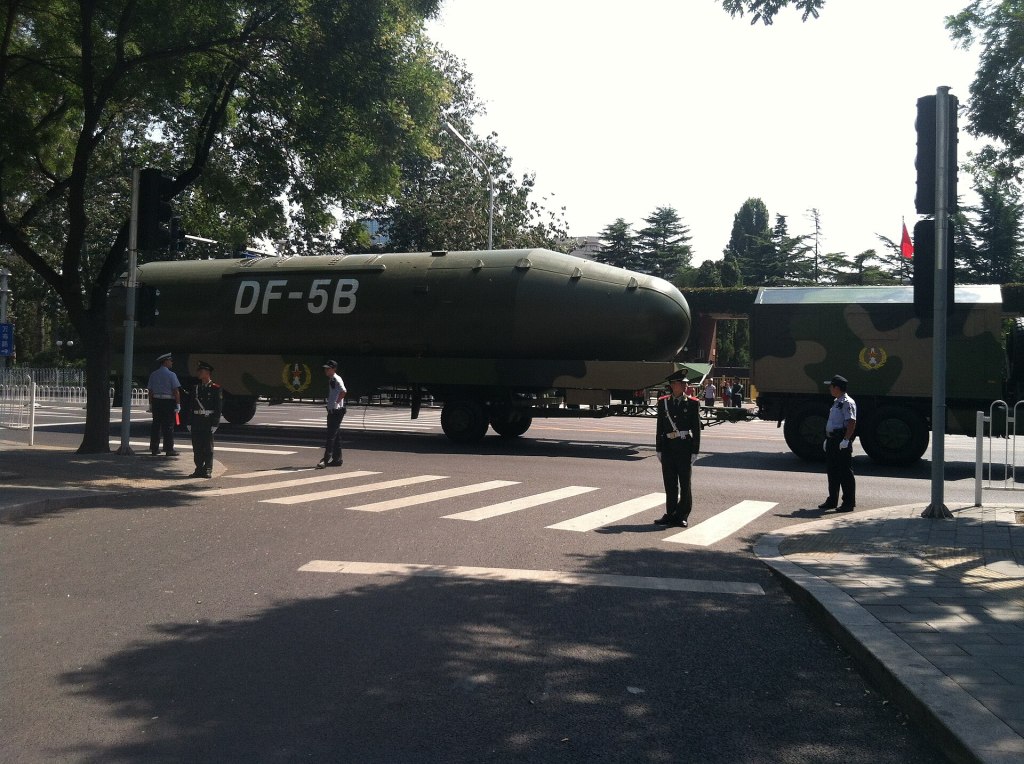
Beyond these, China tested a fractional orbital bombardment system in 2021, sending a hypersonic glide vehicle partway around the Earth. In September 2024 it fired an ICBM into the Pacific Ocean, landing about 11,000 km away near French Polynesia. It was the first open-sea ICBM test China had announced since 1980. We explain glide vehicles in more detail in our guide to hypersonic missiles.
A full nuclear triad
For decades China’s deterrent was mostly land-based. That is no longer true. The September 2025 parade was the first time China put all three legs of its triad on public display.
- Land: the ICBMs above, plus the dual-capable DF-26 intermediate-range missile, which the Pentagon says is well suited to carrying a low-yield nuclear warhead.
- Sea: six Type 094 (Jin-class) ballistic missile submarines, now being armed with the JL-3 missile, which has a range of about 10,000 km according to the US. The next-generation Type 096 is expected in the 2030s. In July 2026 China’s navy test-fired a submarine-launched missile into the Pacific with a dummy warhead.
- Air: the H-6N bomber, which can be refuelled in flight, armed with the JL-1 air-launched ballistic missile. The JL-1 was shown publicly for the first time in 2025. A stealth bomber, the H-20, is under development.
A triad matters because it makes a deterrent very hard to destroy in one blow. Submarines hidden at sea and bombers that can be scrambled give China second-strike options that do not depend on land-based missiles surviving.
From minimum deterrence to launch-on-warning
Numbers are only part of the story. The bigger shift may be in how China plans to use its weapons.
China officially keeps a no-first-use policy, which it has held since its first nuclear test in 1964. But the Pentagon reports that the PLA is building an “early warning counterstrike” capability. Early-warning satellites can reportedly detect an ICBM launch in about 90 seconds, with an alert reaching commanders within three to four minutes. In a December 2024 exercise, the PLA practised rapidly launching multiple silo-based ICBMs.
In plain terms, China wants to be able to fire back before incoming warheads land. China scholar Andrew Erickson describes this as “essentially launch-on-warning”. SIPRI also notes that China, like India, may now occasionally keep a small number of warheads mounted on missiles in peacetime, a break from the old practice of storing them separately.
Launch-on-warning makes a disarming first strike against China much harder. It also shortens decision times and raises the risk that a false alarm or a misread radar track could start a nuclear war. Both Washington and Moscow have lived with that danger for decades. Asia now has to as well.
Why is China building so fast?
Beijing rarely explains itself, but analysts point to several overlapping reasons:
- Fear of a US first strike. American missile defences, including the planned Golden Dome shield, and precise conventional weapons make Chinese planners worry that a small arsenal could be destroyed or intercepted.
- Taiwan. A larger, more survivable arsenal could make Washington think harder before intervening in a crisis over Taiwan. See our explainer on the 2027 Taiwan window.
- Great-power status. Xi Jinping wants a “world-class” military by mid-century. A nuclear force in the same league as America’s and Russia’s fits that ambition.
- Collapse of arms control. With New START gone and no limits on the US or Russia, China sees no reason to hold back.
Arms control: why Beijing says no
Washington has repeatedly invited China to join nuclear talks. Beijing has consistently refused, arguing that its arsenal is far smaller than those of the US and Russia, which should cut first. The global picture is not encouraging: the 2026 Review Conference of the Non-Proliferation Treaty ended on 22 May without an agreed outcome document, and there is no successor to New START.
The Federation of American Scientists has urged China to freeze its arsenal and work with other nuclear states on transparency. For now, there is no sign of that. China’s closer military ties with Russia, which we cover in our Russia–China partnership explainer, make any three-way deal even harder.
What it means for India
India has around 180 warheads, according to SIPRI, and builds its deterrent mainly with Pakistan and China in mind. China’s buildup creates three problems for New Delhi.
- A widening gap. China’s stockpile is now more than three times India’s, and growing faster.
- Range. India needs missiles that can reach all of China from Indian territory. That is why the Agni-V with multiple warheads and India’s SSBN programme matter so much.
- Collusion risk. China and Pakistan are close military partners. Planners in Delhi must think about a two-front crisis under a nuclear shadow.
India does not need to match China warhead for warhead. Its doctrine is credible minimum deterrence. But “minimum” is a moving target when the adversary is tripling its forces, and Indian planners will be watching the silo fields closely.
Common misconceptions
- “China has as many nukes as the US.” No. China has about 620; the US and Russia each have several thousand.
- “All 300-plus silos are full.” No. The Pentagon says more than 100 are loaded. The rest may be empty or used as decoys.
- “China has abandoned no-first-use.” Not officially. The declared policy remains, but launch-on-warning blurs the line in practice.
Our take
China is not racing to match America missile for missile. It is building enough to make its nuclear deterrent impossible to disarm and to give it more room for coercion below the nuclear threshold, especially over Taiwan. The real danger is not the number 1,000. It is a world with three nuclear peers, no arms control, and shrinking decision times. For India, the lesson is to keep investing in survivability, especially submarines, rather than chasing numbers.
Frequently asked questions
How many nuclear weapons does China have in 2026?
About 620 warheads as of January 2026, according to SIPRI. The Pentagon says China had operational warheads in the low 600s through 2024.
How many nuclear weapons will China have by 2030?
The Pentagon expects China to have more than 1,000 warheads by 2030 if the current pace continues.
What is China’s most powerful nuclear missile?
The DF-41 road-mobile ICBM and the liquid-fuelled DF-5C, which the Pentagon says carries a multi-megaton warhead, are China’s most powerful land-based missiles.
Does China have a nuclear triad?
Yes. China showed land-, sea- and air-launched nuclear weapons together for the first time at its September 2025 parade: ICBMs, the JL-3 submarine-launched missile and the JL-1 air-launched ballistic missile.
Does China still have a no-first-use policy?
Yes, officially. However, the Pentagon reports China is building an early-warning counterstrike posture that would let it launch on warning of an attack.
How does China’s arsenal compare with India’s?
China has about 620 warheads; India has around 180, according to SIPRI. China’s arsenal is growing much faster.
Sources and further reading
Researched using official statements and published reporting up to 6 November 2026.
- SIPRI: Yearbook 2026 press release, June 2026
- Andrew Erickson: The Pentagon’s new China report, 29 December 2025
- Federation of American Scientists: Nuclear weapons at China’s 2025 Victory Day parade
- CSIS: Parading China’s nuclear arsenal out of the shadows, September 2025
- The War Zone: A guide to China’s growing long-range nuclear missile arsenal, July 2026
- South China Morning Post: China to increase nuclear warheads to 1,500, US military warns


Leave a Reply