
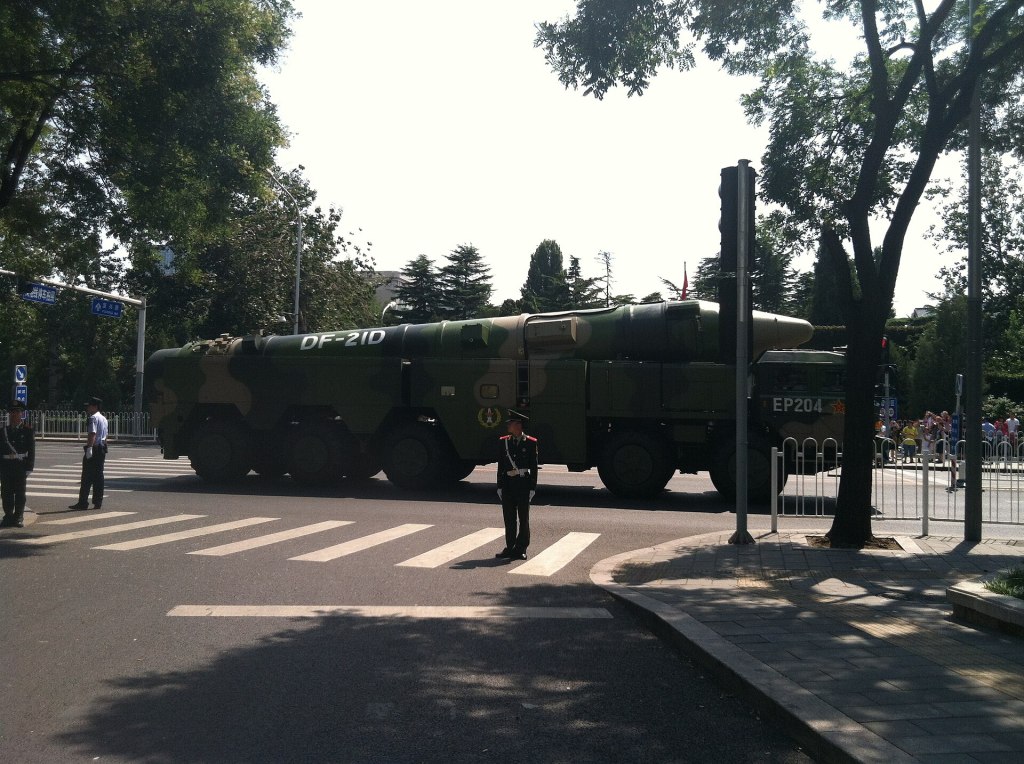
An American aircraft carrier is about 100,000 tonnes of steel, aircraft and sailors, and it costs over $13 billion. China has spent the past two decades building a cheaper answer: ballistic and hypersonic missiles that can, at least in theory, hit a moving ship from more than a thousand kilometres away.
These weapons belong to the PLA Rocket Force, the branch of China’s military that controls both its nuclear and its conventional missiles. This article explains the PLA Rocket Force and its “carrier-killer” missiles: the DF-21D, DF-26, DF-17 and DF-27, how they find their targets, whether they actually work, and what the US Navy is doing about them.
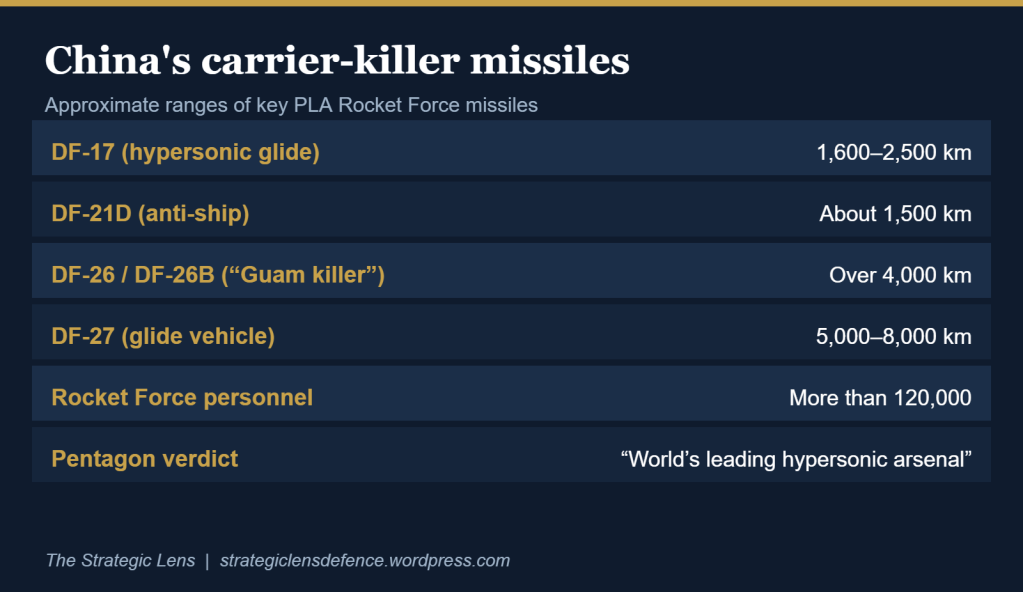
Quick answer: China fields the world’s largest arsenal of land-based conventional missiles and, according to the Pentagon, “the world’s leading hypersonic missile arsenal”. The DF-21D (about 1,500 km) and DF-26 (over 4,000 km) are built to hit warships, and the DF-27 may reach as far as Hawaii. Their biggest weakness is not the missiles themselves but the long chain of satellites and radars needed to find and track a moving carrier.
In this article
- What is the PLA Rocket Force?
- How many missiles does China have?
- DF-21D: the original carrier killer
- DF-26: the “Guam killer”
- DF-17 and DF-27: hypersonic glide
- The kill chain: finding a carrier at sea
- Do they actually work?
- Purges inside the Rocket Force
- How the US Navy is responding
- What it means for India
- Our take
- Frequently asked questions
- Sources and further reading
What is the PLA Rocket Force?
The Rocket Force began life in 1966 as the Second Artillery Corps and was renamed and upgraded to a full service in 2015. It has more than 120,000 personnel, six operational bases and three support bases, according to public reference sources. Each base controls several missile brigades spread across China, from Hainan in the south to Shandong and Xinjiang.
Unusually, it controls both nuclear and conventional missiles, sometimes on the same type of launcher. That creates a serious risk of confusion in a war: a radar operator cannot easily tell whether an incoming DF-26 carries a conventional or a nuclear warhead. We look at the nuclear side in our explainer on China’s nuclear weapons buildup.
How many missiles does China have?
Exact numbers are secret, but US Defense Department estimates published in reference sources suggest roughly 900 conventional short-range ballistic missiles, 1,300 medium-range missiles, 500 intermediate-range missiles and 400 ground-launched cruise missiles. An open-source tally puts the DF-26 fleet alone at about 250 launchers.
No other country has anything like this. Until 2019 the United States was banned from fielding ground-launched missiles with ranges between 500 and 5,500 km by the INF Treaty with Russia. China never signed it, and spent those decades building exactly the class of weapons Washington had given up.
DF-21D: the original carrier killer
The DF-21D is a road-mobile, solid-fuel medium-range ballistic missile with a range of about 1,500 km and a conventional warhead of around 600 kg. In 2010 the US Defense Department reported that it had reached initial operating capability, making it the first land-based missile designed to hit a moving carrier group from long range.
The warhead is believed to manoeuvre as it comes back into the atmosphere and to use radar and optical sensors to home in during the final seconds. That manoeuvring is what separates it from older ballistic missiles, which simply fell on a fixed point. Known DF-21D brigades are based on Hainan Island and in Shandong province, covering the South China Sea and the approaches to Korea and Japan.
DF-26: the “Guam killer”
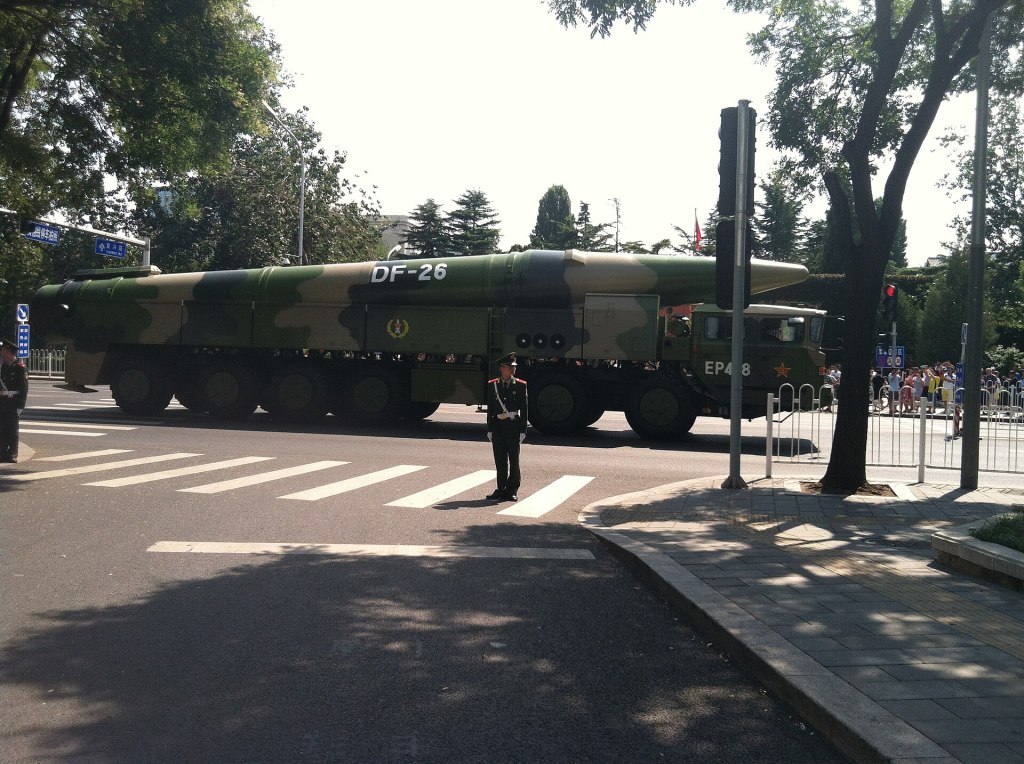
Revealed at the 2015 parade and confirmed in service in 2018, the DF-26 has a range of over 4,000 km, with some Chinese sources claiming more than 5,000 km. That puts the US base at Guam within reach from mainland China, which is why it earned the nickname “Guam Express” or “Guam killer”.
The DF-26 is modular: the same launcher can carry a conventional land-attack warhead, an anti-ship warhead (the DF-26B) or a nuclear warhead. In August 2020, during a US carrier exercise, China fired four medium-range missiles into the South China Sea, including at least one DF-26B. A new version, the DF-26D, was unveiled at the September 2025 parade.
DF-17 and DF-27: hypersonic glide
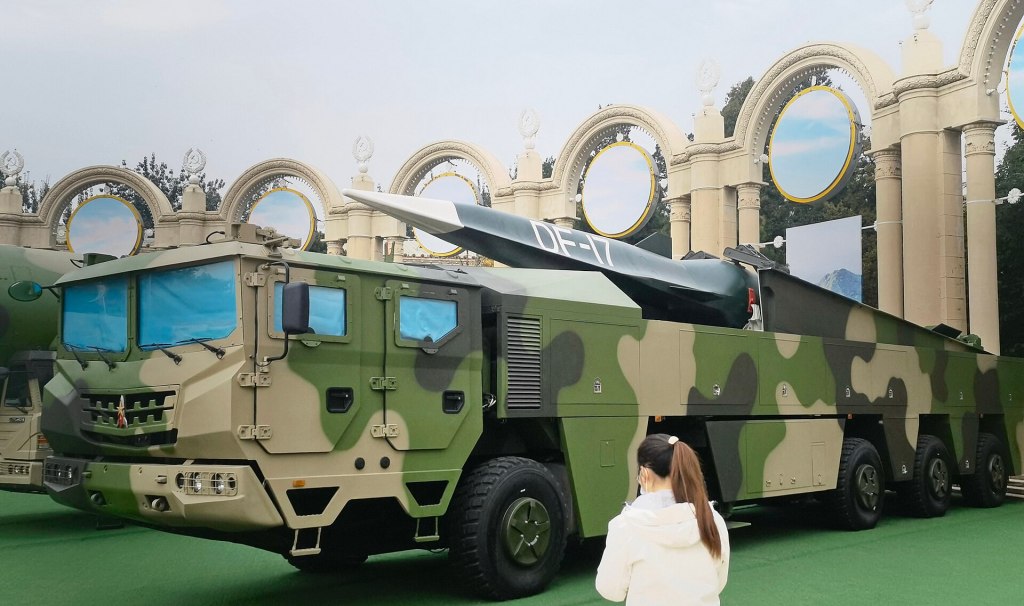
The DF-17 was the first operational missile in the world built around a hypersonic glide vehicle. A booster lifts the DF-ZF glider to high altitude, where it separates and glides towards its target at up to Mach 10, steering as it goes. It entered service in 2019 with a range of 1,600–2,500 km. Analysts quoted by the Wall Street Journal in December 2025 believe it would be used against US forces on Okinawa early in a conflict.
The DF-27 goes much further. The Pentagon’s December 2025 report says a DF-27 variant is now a fielded conventionally armed ICBM with a range of 5,000–8,000 km, and that an anti-ship version is also operational. At its maximum range it could strike Guam, Hawaii and Alaska. In April 2026 footage circulated online of a convoy of what appeared to be DF-27 launchers moving through a Chinese city. Our hypersonic missiles explainer covers how glide vehicles work.
The kill chain: finding a carrier at sea
A missile is useless if you cannot find the target. A carrier moving at 30 knots can be more than 20 km from its last known position by the time a missile launched 15 minutes earlier arrives. So China has built what military planners call a “kill chain”:
- Satellites. Since 2009 China has launched dozens of Yaogan reconnaissance satellites, including radar imaging satellites and groups of three that listen for ship radio signals.
- Over-the-horizon radar. Skywave radars bounce signals off the ionosphere to detect ships far beyond the horizon. The Pentagon says they can probably detect ships and aircraft between the first and second island chains.
- Drones and aircraft. Long-range drones and maritime patrol planes confirm the target.
- Terminal seekers. The warhead’s own sensors make final corrections.
The Pentagon judges that PLA strikes would probably be effective within 1,500–2,000 nautical miles of the Chinese mainland, while noting “challenges in effective coordination” of complex strikes involving several services. Every link in that chain can be jammed, blinded or destroyed, and that is where the US focuses its counter-strategy.
Do they actually work?
This is the honest answer: nobody outside China knows for sure. China has built full-size mock-ups of a Gerald R. Ford-class carrier and Arleigh Burke-class destroyers in the Taklamakan Desert of Xinjiang, and some are mounted on rails to simulate movement. Satellite images show craters near them.
But hitting a target on rails in the desert is not the same as hitting a real ship at sea that is manoeuvring, jamming and shooting back. Public sources found no confirmed test against a moving ship at sea as of 2019, and none has been confirmed since. The missiles are real and fast. Whether the whole system works under wartime pressure is the open question.
Purges inside the Rocket Force
In July 2023 the Rocket Force’s commander, Li Yuchao, and his political commissar were abruptly removed and replaced by officers from the navy and air force, an unprecedented step. Several other senior officers disappeared from public view, amid reports of corruption investigations. The new commander, Wang Houbin, was himself replaced in 2025, with Lei Kai named acting commander in December 2025.
The Pentagon’s 2025 report says these removals “may be raising questions among leadership about force readiness”. Corruption in a force that buys missiles, fuel and silo construction is not a small matter. Xi Jinping visited a Rocket Force brigade in October 2024, his first visit after the scandal, a sign of how seriously Beijing takes it.
How the US Navy is responding
- Interceptors. The SM-6 missile can intercept ballistic missiles in their final phase, and the US has moved most of its missile-defence ships to the Pacific.
- Breaking the kill chain. Jamming, decoys, cyber attacks and anti-satellite options aim to stop China from finding the carrier in the first place.
- Distance and dispersal. Operating carriers further out, and spreading firepower across more, smaller ships and land-based missile units, so there is no single high-value target. See our piece on the US–China shipbuilding race.
- Missiles of its own. Since leaving the INF Treaty, the US has deployed land-based Typhon and NMESIS launchers to the Philippines and Japan.
What it means for India
India is not the main target of China’s anti-ship missiles, but it cannot ignore them. Chinese missiles based in Tibet and Xinjiang can reach most of India, and the anti-ship versions could threaten Indian carriers like INS Vikrant if the Indian Navy operated close to China. Equally important, China is exporting the idea. Pakistan already fields Chinese anti-ship missiles, and long-range anti-ship weapons could appear in the Indian Ocean.
India’s own answer is to build its own long-range missiles, such as BrahMos, and a layered air and missile defence network.
Our take
The carrier-killer missile is less a silver bullet than a tax. Even if it never sinks a carrier, it forces the US Navy to keep its carriers further away, spend billions on defences and rethink how it fights. That is already a strategic win for Beijing. The weak points are the sensors and the people: the kill chain is fragile, and the purges suggest the Rocket Force’s leadership problems run deep.
Frequently asked questions
What is a carrier-killer missile?
A missile designed to strike and disable an aircraft carrier at long range. China’s best-known examples are the DF-21D and DF-26B anti-ship ballistic missiles.
What is the range of the DF-21D?
About 1,500 km, according to most public sources.
Can the DF-26 reach Guam?
Yes. With a range of over 4,000 km, the DF-26 can reach the US base on Guam from mainland China, which is why it is nicknamed the “Guam killer”.
Has China ever hit a moving ship with a ballistic missile?
No such test has been publicly confirmed. China has tested against mock-up ships in the desert, some mounted on rails to simulate movement.
What is the DF-27?
A long-range missile carrying a hypersonic glide vehicle. The Pentagon says a version is a fielded conventionally armed ICBM with a range of 5,000–8,000 km, with an anti-ship variant also operational.
Who commands the PLA Rocket Force?
Lei Kai was named acting commander in December 2025, after a series of leadership removals that began in 2023.
Sources and further reading
Researched using official statements and published reporting up to 6 November 2026.


Leave a Reply