
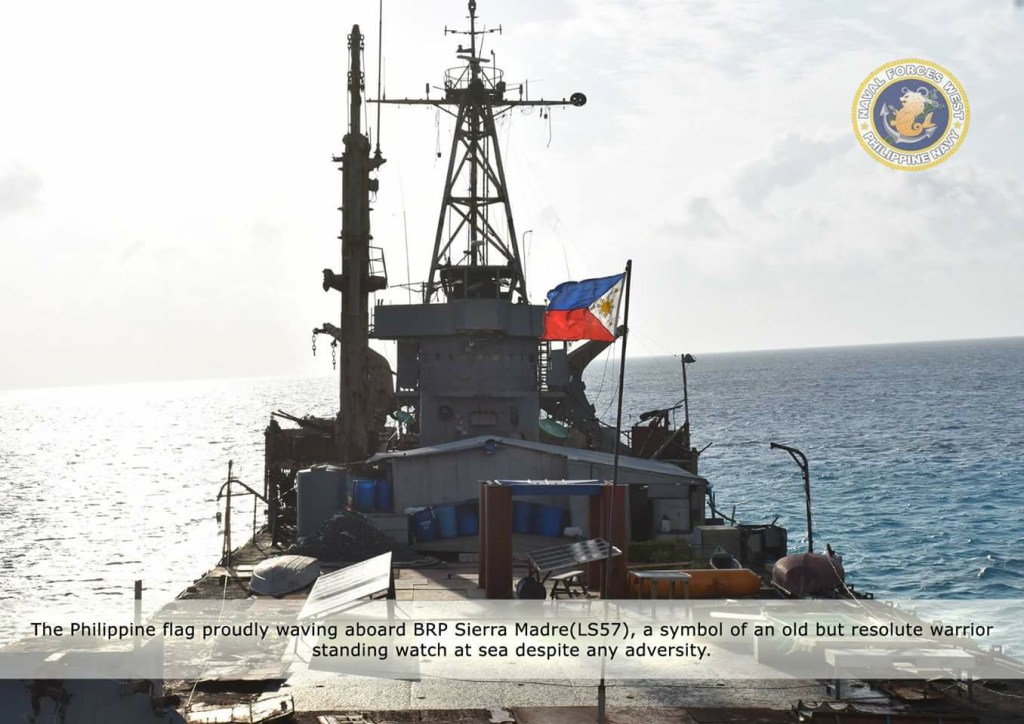
On 20 July 2026, a China Coast Guard boat rammed a small Philippine Navy craft near Second Thomas Shoal. Chinese personnel struck Filipino sailors with batons, and one took a blow to the head, the worst injury in the dispute so far. Two months later, Chinese coast guard cutters and warships blocked a Philippine resupply mission to the same reef for the first time since 2024.
The South China Sea has become the most dangerous place in Asia where a US treaty ally is in daily physical contact with Chinese forces. This article explains the China–Philippines dispute in the South China Sea: what is being fought over, the key flashpoints at Second Thomas Shoal and Scarborough Shoal, what happened in 2025 and 2026, and how a war could start.
Quick answer: China claims almost the entire South China Sea, including areas a 2016 international tribunal ruled belong to the Philippines’ exclusive economic zone. Beijing rejects that ruling and uses its coast guard, maritime militia and navy to push Philippine ships out. The two hottest spots are Second Thomas Shoal, where a handful of Filipino marines live on a grounded ship, and Scarborough Shoal, which China has controlled since 2012 and declared a “nature reserve” in 2025.
In this article
- Why the South China Sea matters
- The 2016 arbitral ruling
- Second Thomas Shoal and the Sierra Madre
- Scarborough Shoal
- China’s grey-zone playbook
- How the Philippines is responding
- The US and the Mutual Defense Treaty
- Could it lead to war?
- Why it matters to India
- Our take
- Frequently asked questions
- Sources and further reading
Why the South China Sea matters
Roughly a third of global shipping passes through the South China Sea. Its waters hold rich fisheries and possibly significant oil and gas. Strategically, it sits between China’s southern coast and the open Pacific and Indian Oceans, which makes it vital for China’s navy and submarines.
China’s claim is marked by the so-called nine-dash line, which loops down to near Malaysia and Indonesia. It overlaps the claims of the Philippines, Vietnam, Malaysia, Brunei, Indonesia’s EEZ and Taiwan. China has built and militarised seven artificial islands in the Spratly Islands since 2013, three of them with full-length runways.
The 2016 arbitral ruling
In 2013 the Philippines took China to an arbitral tribunal under the UN Convention on the Law of the Sea (UNCLOS). On 12 July 2016 the tribunal ruled that there was no legal basis for China to claim historic rights within the nine-dash line. It found that Scarborough Shoal is a “rock” that generates only a 12-nautical-mile territorial sea, and that Second Thomas Shoal lies within the Philippines’ exclusive economic zone.
China did not take part and calls the ruling null and void. The United States says the decision is “final and legally binding on both China and the Philippines”, as the State Department repeated in July 2026. Manila now calls the waters inside its EEZ the West Philippine Sea.
Second Thomas Shoal and the Sierra Madre
Second Thomas Shoal (Ayungin Shoal to the Philippines, Ren’ai Jiao to China) is a submerged reef about 200 km from the Philippine island of Palawan and more than 1,000 km from China’s Hainan Island. In 1999 the Philippines deliberately ran an old navy landing ship, the BRP Sierra Madre, aground there. A small detachment of marines has lived aboard the rusting hull ever since.
China wants the ship gone; the Philippines needs to resupply its marines with food, water and repair materials. That makes every resupply run a potential confrontation. Key moments:
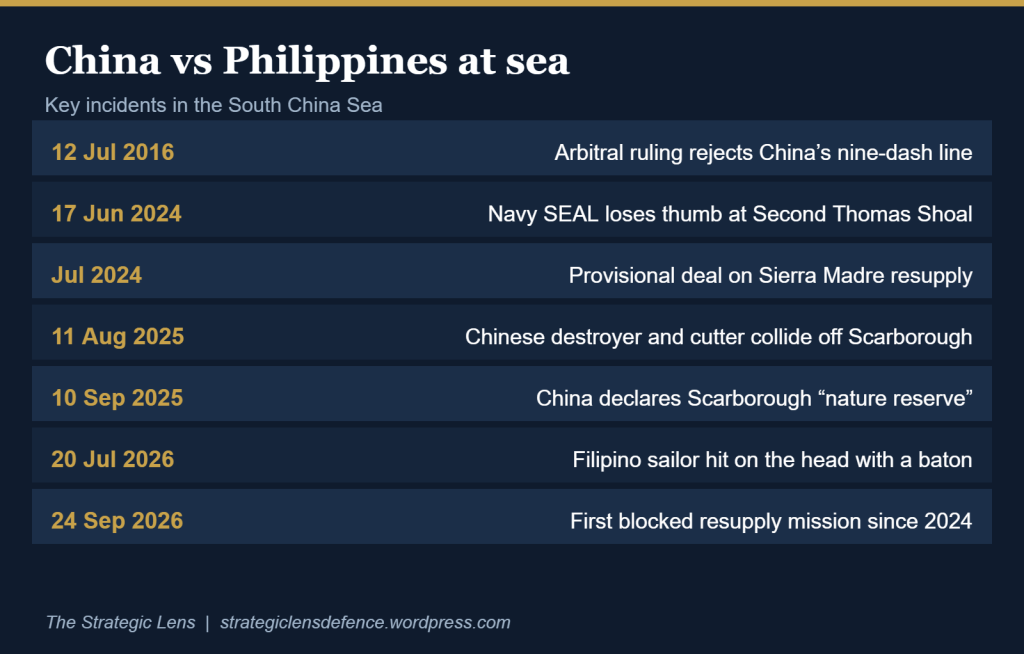
- 17 June 2024: China Coast Guard personnel armed with knives and axes rammed and boarded Philippine boats. A Philippine Navy SEAL lost his thumb.
- July 2024: Manila and Beijing reached a “provisional arrangement” on resupply missions. A Philippine official said in August 2026 that 15 missions had since been completed without incident.
- 20 July 2026: A China Coast Guard boat rammed a Philippine rigid-hulled inflatable boat near the Sierra Madre. Chinese personnel used a wooden baton and other blunt instruments, and a Filipino service member was hit on the head. The US State Department condemned China’s “dangerous and aggressive actions”.
- 24 September 2026: China Coast Guard and PLA Navy ships obstructed a rotation and resupply mission, the first blocked mission since 2024. The Philippine Coast Guard said Chinese ships came within close range and carried out “dangerous maneuvers”. No one was hurt, but the mission was not completed.
Scarborough Shoal
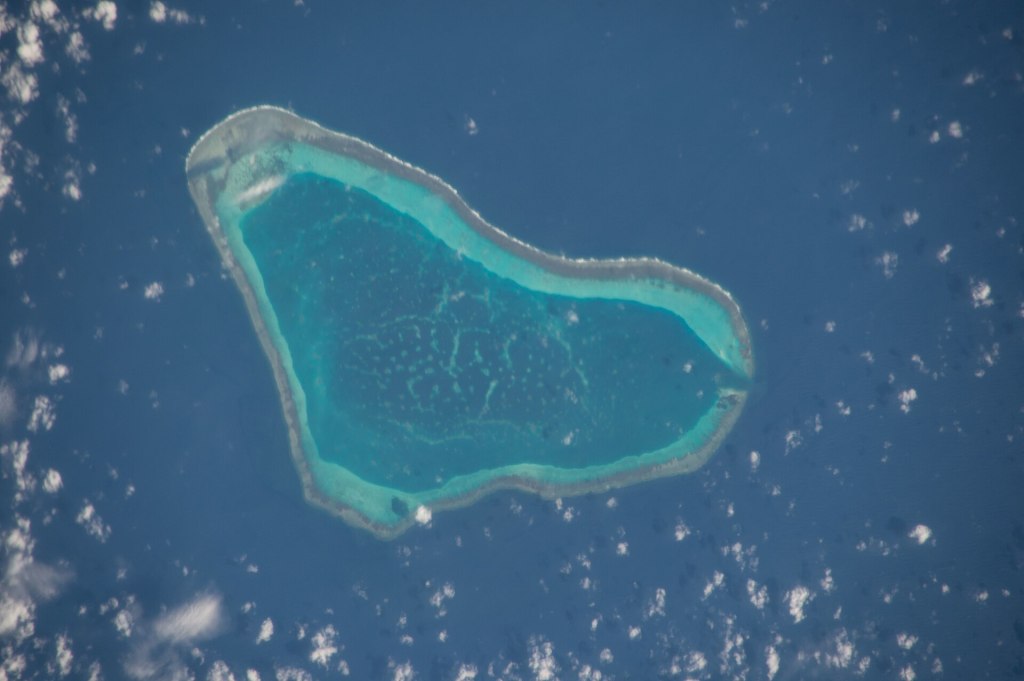
Scarborough Shoal (Bajo de Masinloc to the Philippines, Huangyan Dao to China) is a triangular coral atoll about 220 km west of Luzon. It was a traditional fishing ground for Filipino fishermen until China took control after a standoff in 2012. Since then, China Coast Guard ships have kept Philippine vessels out, often using water cannon.
- 11 August 2025: While chasing the Philippine Coast Guard ship BRP Suluan, a China Coast Guard cutter and the PLA Navy destroyer Guilin collided, crumpling the cutter’s bow. A Philippine senator said two Chinese coast guard personnel died; China did not confirm casualties.
- 10 September 2025: China’s State Council approved a “Huangyan Island National Nature Reserve” at the shoal. Philippine officials called it a “clear pretext for occupation”.
- 16 September 2025: Chinese ships fired water cannon at the Philippine fisheries vessel BRP Datu Gumbay Piang for about 29 minutes, shattering a window and injuring a crew member.
- April 2026: Satellite imagery showed Chinese fishing boats anchored across the lagoon entrance and a floating barrier of about 352 metres, with around ten Chinese coast guard ships nearby.
- July 2026: Manila accused the China Coast Guard of firing water cannon at Philippine government vessels near the shoal.
Many analysts fear China could eventually start land reclamation at Scarborough. Because it is so close to Luzon and the US-used bases there, a militarised Scarborough would be a much bigger strategic shift than the Spratly islands.
China’s grey-zone playbook
China rarely uses its navy directly. Instead it applies pressure in the “grey zone” between peace and war:
- Coast guard first. The China Coast Guard is the world’s largest, with ships bigger than many navies’ frigates. Using it lets Beijing call confrontations “law enforcement”.
- Maritime militia. Fishing boats crewed by trained militia swarm reefs and block access.
- Water cannon, ramming, blocking and lasers. Painful and dangerous, but designed to stay below the level that would trigger a military response.
- Legal claims. Measures like the Scarborough nature reserve dress up control as administration.
- Navy in the background. PLA Navy warships increasingly shadow operations, as in the September 2026 blockade.
Russia uses a similar playbook against Europe, as we describe in Russia vs NATO: the grey-zone war.
How the Philippines is responding
Under President Ferdinand Marcos Jr., Manila has abandoned the more China-friendly approach of his predecessor. Its main tool has been transparency: the Philippine Coast Guard invites journalists on missions and quickly publishes videos of Chinese actions. It has also strengthened alliances and its own forces, including coastal missiles. We cover these in our Philippines series, including BrahMos in the Philippines, the US–Philippines alliance and the Re-Horizon 3 modernisation plan.
The US and the Mutual Defense Treaty
The 1951 US–Philippines Mutual Defense Treaty commits each side to help the other if attacked. Washington has said repeatedly that the treaty covers armed attacks on Philippine armed forces, public vessels and aircraft, including those of the coast guard, anywhere in the South China Sea. That is why China has carefully kept its actions non-lethal and used its coast guard rather than its navy. A death caused by Chinese action would put that commitment to its hardest test.
Could it lead to war?
Neither Manila nor Beijing wants a shooting war. But the space for accidents is shrinking: bigger ships, closer manoeuvres, warships involved, and injuries becoming more serious. The 2025 Chinese collision showed how easily things can go wrong even without intent. The most likely triggers are a death at Second Thomas Shoal, a Chinese move to build on Scarborough, or a crisis over Taiwan, which lies just north of the Philippines across the Luzon Strait. See our explainer on the 2027 Taiwan window.
| Flashpoint | Distance from Philippines | Who controls it | Main risk |
|---|---|---|---|
| Second Thomas Shoal | About 200 km from Palawan | Philippines (via Sierra Madre) | Clash during resupply |
| Scarborough Shoal | About 220 km from Luzon | China (since 2012) | Chinese land reclamation |
| Spratly artificial islands | Varies | China (seven features) | Military bases close to Philippine waters |
Why it matters to India
India is not a claimant, but it has big stakes. A large share of India’s trade with East Asia passes through the South China Sea, and Indian state oil company ONGC Videsh has worked in Vietnamese blocks there. India has backed the 2016 ruling, sold BrahMos missiles to the Philippines, and joined naval exercises with Manila. How China behaves in the South China Sea is also a preview of how it may behave in disputes closer to India, including the LAC.
Our take
China is winning the slow game at Scarborough and testing the limits at Second Thomas Shoal. The Philippines cannot match China’s fleet, so it is betting on alliances, transparency and coastal missiles to raise the cost of escalation. The September 2026 blockade suggests Beijing is willing to test whether the 2024 arrangement still holds. The danger is that each side believes the other will back down.
Frequently asked questions
What is the China–Philippines dispute about?
Control of reefs, shoals and waters in the South China Sea that both claim. A 2016 tribunal ruled most of China’s claims have no legal basis, but China rejects the ruling.
What is the BRP Sierra Madre?
A Second World War-era ship the Philippine Navy deliberately grounded on Second Thomas Shoal in 1999. A small group of marines lives aboard to assert the Philippine claim.
Who controls Scarborough Shoal?
China has controlled access to Scarborough Shoal since 2012. In September 2025 it declared the shoal a national nature reserve.
What happened at Second Thomas Shoal in 2026?
On 20 July 2026 a Filipino sailor was hit on the head during a clash with the China Coast Guard. On 24 September 2026 Chinese ships blocked a Philippine resupply mission, the first since 2024.
Does the US defence treaty cover the South China Sea?
Washington says the 1951 Mutual Defense Treaty covers armed attacks on Philippine armed forces, public vessels and aircraft, including the coast guard, anywhere in the South China Sea.
What did the 2016 arbitral ruling say?
It found no legal basis for China’s historic-rights claim within the nine-dash line, ruled Scarborough Shoal a “rock”, and placed Second Thomas Shoal within the Philippines’ exclusive economic zone.
Sources and further reading
Researched using official statements and published reporting up to 6 November 2026.
- US State Department: China’s actions against Philippine Navy personnel at Second Thomas Shoal, 20 July 2026
- USNI News: Philippine sailor injured in violent clash with China Coast Guard, 20 July 2026
- gCaptain / Bloomberg: Philippines says China blocked sea mission, first since 2024, September 2026
- Interaksyon / Reuters: Philippines accuses China of obstructing resupply mission, 25 September 2026
- Radio Free Asia: Chinese, Philippine ships collide near Scarborough, 16 September 2025
- Washington Times: Two Chinese ships collide during harassment operation, 11 August 2025
- Scarborough Shoal (reference overview)


Leave a Reply