

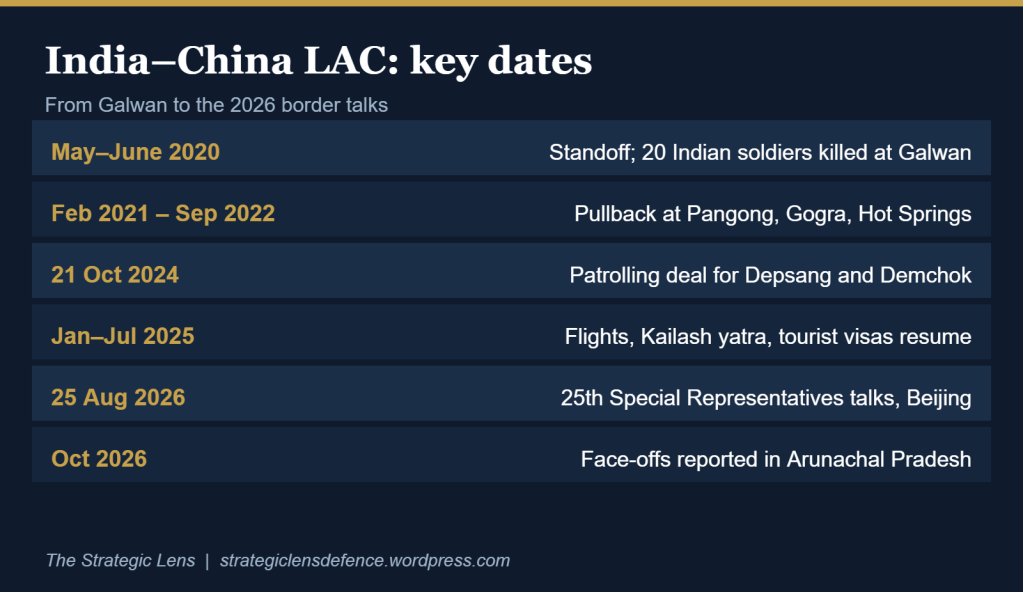
Six years after soldiers fought with clubs and stones in the Galwan Valley, the India–China border is quieter, but it is not at peace. Patrols have resumed in places that were blocked for years, direct flights are back, and the two countries’ top security officials now meet regularly. Yet tens of thousands of troops remain deployed on both sides, and in October 2026 India’s border police confirmed fresh face-offs in Arunachal Pradesh.
This article explains the India–China LAC situation in 2026: what the Line of Actual Control is, what was agreed in 2024 and 2026, what has not been solved, and what to watch next.
Quick answer: The LAC is stable but militarised. The October 2024 agreement restored patrolling at Depsang and Demchok, the last two friction points in Ladakh, and the August 2026 Special Representatives talks created new hotlines and an expert group on boundary delimitation. But no troops have been pulled back from the border, buffer zones created after 2020 remain, and face-offs continue in Arunachal Pradesh.
In this article
- What is the LAC?
- What happened in 2020
- The October 2024 patrolling agreement
- The diplomatic thaw of 2025
- The August 2026 border talks
- Arunachal Pradesh: the new pressure point
- The infrastructure race
- Who has the edge?
- What to watch next
- Our take
- Frequently asked questions
- Sources and further reading
What is the LAC?
The Line of Actual Control is the de facto border between India and China. It runs for roughly 3,488 km, according to India, across three sectors: the Western sector (Ladakh), the Middle sector (Himachal Pradesh and Uttarakhand) and the Eastern sector (Sikkim and Arunachal Pradesh). China claims a shorter line.
The core problem is that the LAC has never been agreed on a map. Each side has its own idea of where it runs, and in many places those ideas overlap. Patrols from both armies walk into areas the other considers its own. For decades, agreements signed in 1993, 1996 and 2005 kept this from turning violent, partly by banning firearms near the line.
What happened in 2020
In April and May 2020, Chinese troops moved into several areas of eastern Ladakh that Indian patrols had previously reached, including the north bank of Pangong Tso. On 15 June 2020, a clash in the Galwan Valley killed 20 Indian soldiers. China later acknowledged four deaths; independent estimates are higher. It was the first deadly fighting on the border since 1975.
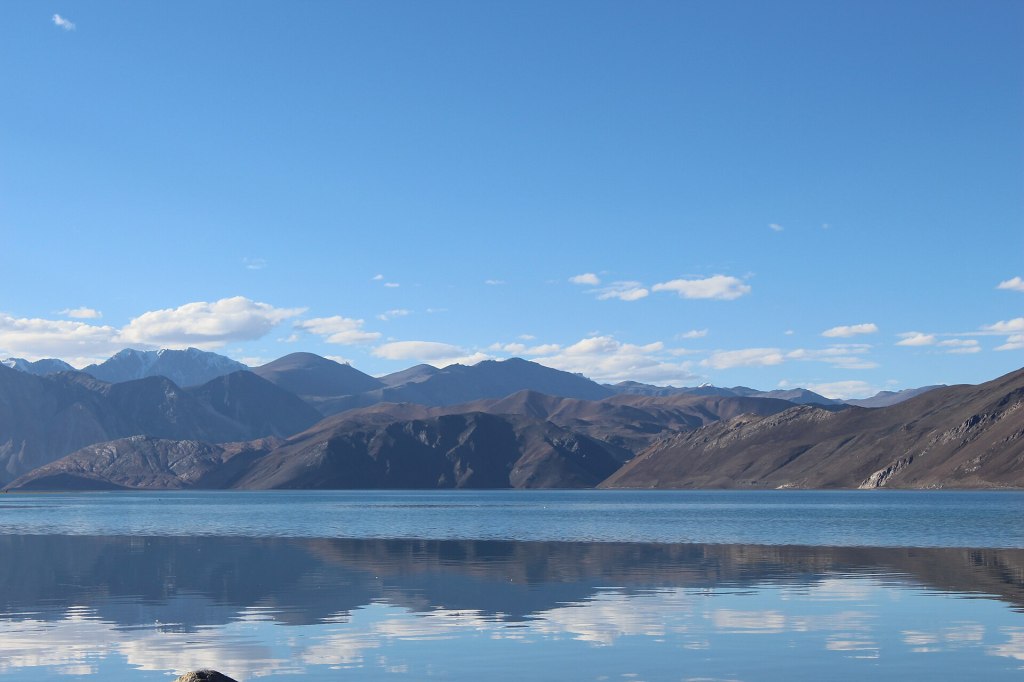
Over the next two years, rounds of military talks produced pullbacks at Galwan, Pangong Tso (February 2021), Gogra and Hot Springs. But these came with “buffer zones” where neither side patrols, and many Indian analysts argue they mostly lie on land India used to patrol. Two areas, Depsang and Demchok, remained stuck for four years.
The October 2024 patrolling agreement
On 21 October 2024, just before Prime Minister Narendra Modi and President Xi Jinping met at the BRICS summit in Kazan, India announced an agreement on patrolling arrangements along the LAC. It restored patrolling and grazing rights in Depsang and Demchok.
In December 2024, External Affairs Minister S. Jaishankar told Parliament that disengagement had “now been achieved in full” in eastern Ladakh. That was a real achievement. But disengagement only means troops stepping back from face-to-face positions. It does not mean de-escalation, which would pull the tens of thousands of extra soldiers, tanks and missiles back from the border. That has not happened.
The diplomatic thaw of 2025
With the frontline calmer, 2025 brought a broad thaw:
- Direct flights between India and China resumed after nearly five years.
- The Kailash Mansarovar Yatra pilgrimage reopened to Indian pilgrims.
- India resumed tourist visas for Chinese citizens in July 2025.
- Defence Minister Rajnath Singh met his Chinese counterpart Dong Jun in Qingdao in June 2025 and called for a roadmap of permanent engagement and de-escalation.
- Modi visited China for the Shanghai Cooperation Organisation summit in Tianjin in 2025 and met Xi Jinping.
Part of the motivation was economic: India wanted access to Chinese components, rare earths and machinery, and both countries faced trade pressure from Washington. But the thaw did not touch the military balance on the border.
The August 2026 border talks
On 25 August 2026, National Security Adviser Ajit Doval and Chinese Foreign Minister Wang Yi held the 25th round of Special Representatives talks in Beijing. According to the analysis platform CNAWS, citing Reuters and The Indian Express, they reached an eight-point consensus that included:
- An expert group on boundary delimitation, aimed at an “early harvest” of agreed sections of the boundary.
- A working group on border management.
- Two new military hotlines, in the Eastern and Middle sectors.
- Two new meeting points for local military commanders.
- A meeting of the expert mechanism on trans-border rivers.
These are useful crisis-management tools. But CNAWS notes that the talks announced no troop reductions, no new patrolling arrangements and no changes to buffer zones, describing them as “structured border stabilisation rather than a comprehensive strategic reset”.
Arunachal Pradesh: the new pressure point
While Ladakh has quietened, the Eastern sector has not. On 22 October 2026, Shatrujeet Kapur, Director General of the Indo-Tibetan Border Police, confirmed that face-offs with Chinese troops were continuing at more than one location in Arunachal Pradesh, according to Outlook India and Business Today. He also spoke about India raising new units, including drone platoons.
China claims the whole of Arunachal Pradesh as “Zangnan”, or South Tibet, and periodically issues Chinese names for places in the state. The Ministry of External Affairs said that the border sees friction from time to time when patrolling patterns diverge, while Beijing insisted its troops were conducting routine patrols. No casualties have been reported.
The infrastructure race
Much of the competition on the LAC is now about concrete rather than confrontation. China has built roads, airfields, heliports and hundreds of dual-use “xiaokang” border villages close to the line, and is building a giant hydropower project on the Yarlung Tsangpo (Brahmaputra) near the Indian border. India worries about the downstream impact on water flows into Arunachal and Assam.
India has accelerated its own building since 2020: the Border Roads Organisation has added thousands of workers, roads like Darbuk–Shyok–Daulat Beg Oldi have been completed, the Nyoma airfield in eastern Ladakh has been upgraded for fighter operations, and the Vibrant Villages Programme is trying to repopulate border settlements. China still has the advantage of flat terrain on the Tibetan plateau, while India has to build through steep mountains.
Who has the edge?
| Factor | India | China |
|---|---|---|
| Terrain | Steep Himalayan approaches; harder logistics | Flat Tibetan plateau; easier to move troops |
| Troops near LAC | Large permanent deployment since 2020 | Large permanent deployment since 2020 |
| Acclimatised forces | Highly experienced in high-altitude warfare | Improving rapidly; training increased since 2020 |
| Airpower | Airbases at lower altitudes allow fuller weapon loads | High-altitude Tibetan bases limit payloads, but new airfields built |
| Infrastructure | Catching up quickly | Still ahead on roads, rail and airfields |
India’s military reforms, including the new integrated units described in our Indian Army restructuring explainer, are partly aimed at this front. So are new fighter programmes like the AMCA.
What to watch next
- De-escalation. Any agreement to reduce troop numbers would be the first real sign that the 2020 crisis is over.
- Buffer zones. Whether Indian patrols regain access to the areas closed after 2020.
- Delimitation. Whether the new expert group produces even a small agreed section of the boundary, probably starting with the less contested Middle sector.
- Arunachal. Whether face-offs there stay at the level of shoving matches or escalate.
- The China–Pakistan factor. China’s deep military support for Pakistan, including the J-35 stealth fighter, limits how far the thaw can go.
Our take
The LAC today is a managed rivalry, not a solved dispute. The 2024 deal and the 2026 talks have reduced the risk of another Galwan, and that matters. But the two armies are still dug in at numbers far higher than before 2020, China keeps building, and Arunachal is now where pressure is applied. India is right to talk, and right to keep building roads, airfields and forces as if talks might fail.
Frequently asked questions
What is the current situation on the India–China border in 2026?
Stable but militarised. Disengagement in eastern Ladakh is complete, and new hotlines were agreed in August 2026, but troops have not been reduced, and face-offs continue in Arunachal Pradesh.
What was agreed in October 2024?
India and China agreed to restore patrolling and grazing in Depsang and Demchok, the last two friction points in eastern Ladakh from the 2020 standoff.
What is the difference between disengagement and de-escalation?
Disengagement means troops pulling back from face-to-face positions. De-escalation means reducing the overall number of troops and weapons deployed near the border. Only the first has happened.
How long is the LAC?
India says the LAC is about 3,488 km long, divided into Western, Middle and Eastern sectors.
What happened at Galwan?
On 15 June 2020, Indian and Chinese troops clashed in the Galwan Valley in Ladakh. Twenty Indian soldiers were killed; China acknowledged four deaths.
Are there India–China face-offs in Arunachal Pradesh?
Yes. In October 2026, the ITBP chief confirmed that face-offs were continuing at more than one location in Arunachal Pradesh. No casualties have been reported.
Sources and further reading
Researched using official statements and published reporting up to 6 November 2026.
- 2024 India–China border patrol agreement (reference overview)
- CNAWS: India–China border talks 2026, August 2026
- Outlook India: Face-offs continue at multiple sites in Arunachal, says ITBP chief, October 2026
- Business Today: ITBP chief confirms Chinese incursions in Arunachal, 23 October 2026
- 2020–2021 China–India skirmishes (reference overview)
- China–India relations (reference overview)


Leave a Reply