
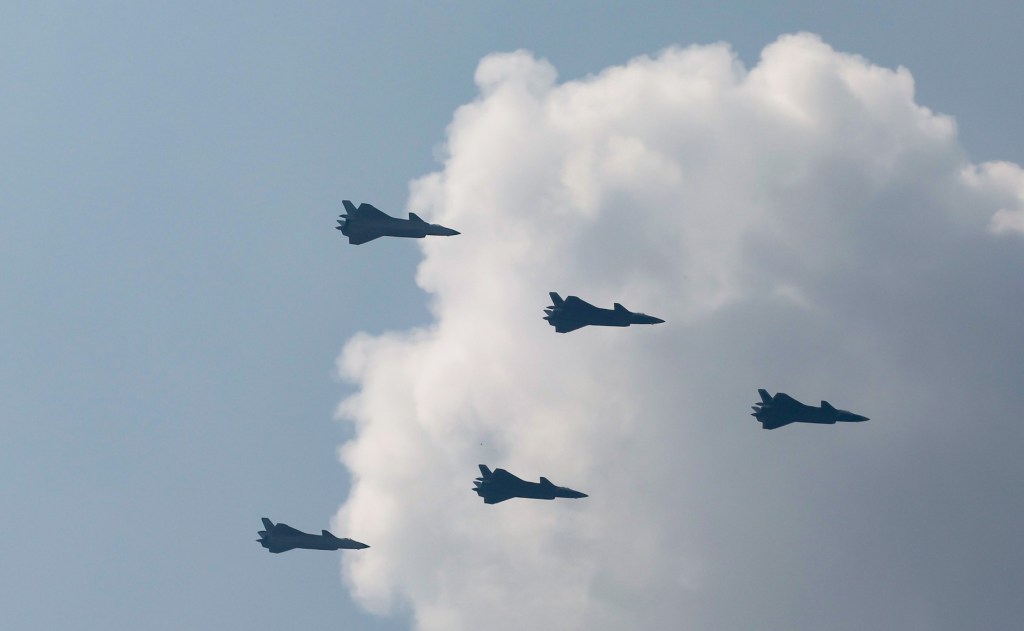
On 26 December 2024, people in Chengdu filmed something nobody had seen before: a huge, tailless, diamond-shaped jet flying low over the city, escorted by a two-seat J-20. Hours later, another tailless design appeared over Shenyang. China had shown the world not one but two candidate sixth-generation fighters, years before the United States had flown its own.
Two years on, the prototypes keep multiplying. This article explains China’s sixth-generation fighters, the J-36 and J-50: what we actually know, what is speculation, how they compare with America’s F-47, and how the J-20 fits into the picture.
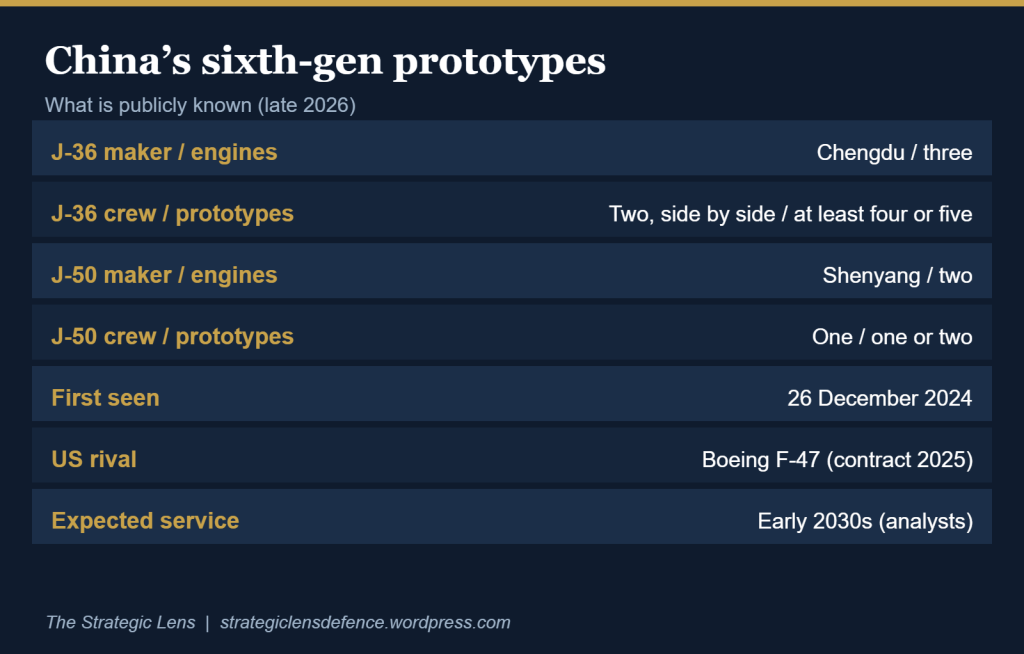
Quick answer: The J-36 is a large, three-engine, two-seat tailless jet from Chengdu, probably designed for long-range strikes and air dominance; at least four, and possibly five, prototypes have been seen. The J-50 is a smaller, single-seat twin-engine tailless jet from Shenyang. Neither has been officially named by Beijing. Analysts expect them to enter service in the early 2030s, around the same time as the US F-47. Meanwhile, China’s J-20 fleet has grown to an estimated several hundred aircraft.
In this article
- What makes a fighter “sixth-generation”?
- J-36: Chengdu’s giant trijet
- J-50: Shenyang’s lighter design
- J-36 vs J-50 vs F-47
- The J-20: China’s workhorse stealth fighter
- Why China is moving so fast
- What it means for India
- Common misconceptions
- Our take
- Frequently asked questions
- Sources and further reading
What makes a fighter “sixth-generation”?
There is no official definition, but most sixth-generation programmes share a few traits: stealth from every angle, which usually means no vertical tail fins; long range and large internal weapons bays; adaptive or very efficient engines; and the ability to control or work alongside drone “loyal wingmen”. They are designed to fight as the hub of a network rather than as a lone dogfighter. Our explainer on the sixth-generation fighter race covers all the programmes worldwide.
J-36: Chengdu’s giant trijet
“J-36” is not an official name. Analysts took it from the serial number 36011 painted on the first prototype. Here is what is publicly known:
- Shape: a tailless flying wing with a diamond-shaped double-delta planform, with no vertical fins, canards or strakes.
- Engines: three, an unusual choice. The extra engine likely provides power for sensors and possibly directed-energy weapons, plus more thrust for a very heavy airframe. The engine type is unknown.
- Crew: two pilots sitting side by side, each with their own head-up display. That suggests long missions and the job of managing drones.
- Weapons: a large main weapons bay estimated at about 7.6 metres long, big enough for long-range air-to-air or anti-ship missiles.
- Range: one analyst estimate puts it at 2,000–3,000 km.
The first prototype flew publicly in December 2024. A second began flight testing in October 2025 with redesigned exhausts using thrust-vectoring petals and new side intakes. A third was reportedly seen in December 2025 and a fourth in February 2026. In July 2026, footage surfaced that may show a fifth flying airframe, though this has not been officially confirmed. In September 2026, a structural model was presented at a Chengdu aviation event, and an AVIC poster even showed a laser weapon on the aircraft, though that is a graphic, not evidence of hardware.
Many analysts think the J-36 is less a dogfighter than a long-range air superiority and strike platform, able to reach US tankers, AWACS radar planes and bases far out over the Pacific. A published research paper on carrier-landing controls from the J-36 design team has also fuelled speculation about a naval version.
J-50: Shenyang’s lighter design
The second design, nicknamed J-50 or J-XDS, is built by Shenyang Aircraft Corporation, the maker of the J-35. It is smaller and more conventional than the J-36, but still radical by most standards:
- A tailless “lambda” wing with movable wingtips that may act as control surfaces in place of tail fins.
- Two engines with serrated, possibly thrust-vectoring nozzles.
- A single pilot, confirmed by photos in 2025.
- A chin-mounted electro-optical sensor.
Fewer J-50 airframes have been seen: one confirmed, and possibly a second in taxi photos from September 2025. Satellite images showed both the J-36 and J-50 at the remote Lop Nur test base in 2025. Fresh images in 2026 suggest testing is continuing, but details are thin.
J-36 vs J-50 vs F-47
| J-36 | J-50 | F-47 (USA) | |
|---|---|---|---|
| Maker | Chengdu (AVIC) | Shenyang (AVIC) | Boeing |
| Engines | Three | Two | Not disclosed |
| Crew | Two, side by side | One | One (expected) |
| Tail fins | None | None (movable wingtips) | Not disclosed |
| Status | Flight testing; at least four prototypes | Flight testing; one or two prototypes | Contract awarded 2025; in development |
| Likely role | Long-range strike and air dominance | Air superiority, possibly carrier-based | Air dominance with drone wingmen |
| Expected service | Early 2030s (analysts) | Early 2030s (analysts) | Around 2030 (US plans) |
The US Air Force awarded the F-47 contract to Boeing in 2025, and the US Navy is developing its own F/A-XX. Europe has two programmes: GCAP (Britain, Italy and Japan, aiming for service around 2035, with a £4.6 billion development contract signed in July 2026) and the French-led FCAS. China is the only country to have flown two very different crewed sixth-generation prototypes in public.
The J-20: China’s workhorse stealth fighter
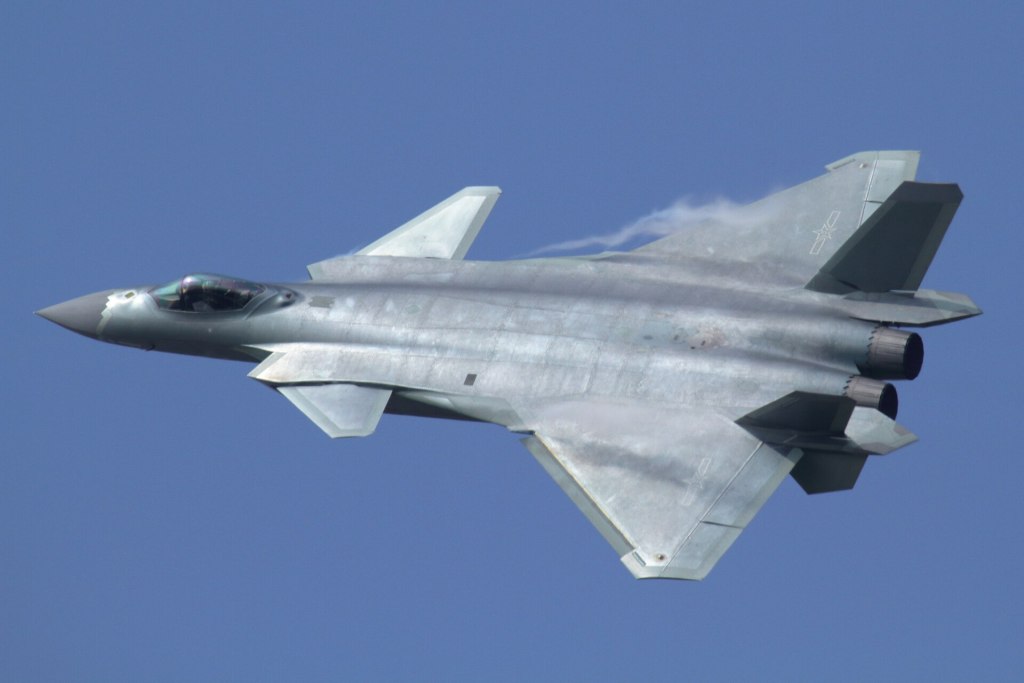
While the sixth-generation jets get the headlines, the J-20 is the aircraft that actually matters today. It first flew in January 2011 and entered service in 2017. Since then China has developed:
- J-20A: a revised airframe with upgraded engines, which made its public debut in September 2025.
- J-20S: the world’s first twin-seat stealth fighter, designed to control drones, officially announced in November 2024.
- WS-15 engine: a long-awaited Chinese engine of about 180 kN that replaces the WS-10C and should give the J-20 supercruise.
Fleet estimates vary widely because China publishes nothing. Estimates have risen from around 200 in 2023 to roughly 300 in mid-2025, and some sources now suggest about 500 built by mid-2026, though that figure is unverified. Even at the lower estimates, China is producing stealth fighters at a pace only the US F-35 line matches. We compare it with other jets in our fighter jet comparison.
Why China is moving so fast
- Industrial muscle. AVIC’s two main design bureaus are competing, and both are being funded.
- The Pacific problem. Fighting the US near Taiwan or beyond the first island chain requires aircraft with much longer range than traditional fighters.
- Learning by flying. China seems to prefer flying prototypes early and iterating, rather than perfecting designs on paper first.
- Signalling. Revealing the jets on the anniversary of Mao Zedong’s birth was a deliberate message of technological confidence.
What it means for India
India’s fifth-generation AMCA is not expected to fly until the end of the 2020s. By then China may be fielding sixth-generation jets on top of hundreds of J-20s, and Pakistan may be flying Chinese-built J-35s. That makes India’s fighter gap one of its most serious strategic problems. Options include speeding up AMCA, buying more Rafales, investing heavily in air defence and long-range missiles, and exploring partnerships in sixth-generation programmes abroad.
Common misconceptions
- “China officially unveiled the J-36.” No. Beijing has not formally confirmed the designations or specifications. Almost everything known comes from photos, videos and satellite imagery.
- “The J-36 is already in service.” No. It is a prototype in flight testing.
- “Three engines means it is just a bomber.” Not necessarily. The size and engines suggest long range and lots of electrical power, which suit a fighter-bomber hybrid built for the Pacific.
Our take
China has done something remarkable: it has two sixth-generation prototypes in the air while America’s F-47 is still being built. That does not mean China is ahead in every respect. Engines, sensors and software are where these aircraft will succeed or fail, and those are invisible in photos. But the pace is a clear signal. The question for the US and India is no longer whether China can build advanced fighters, but how many and how soon.
Frequently asked questions
What is the J-36?
A large, tailless, three-engine prototype fighter built by Chengdu Aircraft Corporation, first seen flying on 26 December 2024. J-36 is an analyst designation, not an official name.
What is the J-50?
A smaller, single-seat, twin-engine tailless prototype built by Shenyang Aircraft Corporation, first seen in December 2024.
Is China ahead of the US in sixth-generation fighters?
China has flown two crewed prototypes publicly, while the US F-47 is still in development after the 2025 contract. Whether China is ahead in capability is unknown.
When will the J-36 enter service?
Analysts expect the early 2030s, but China has not released a timeline.
How many J-20s does China have?
Estimates vary from about 300 in mid-2025 to around 500 built by mid-2026. China does not publish official figures.
Why does the J-36 have three engines?
China has not explained. Analysts think the third engine supplies extra thrust for a very heavy aircraft and more electrical power for sensors and possibly future directed-energy weapons.
Sources and further reading
Researched using official statements and published reporting up to 6 November 2026.


Leave a Reply