
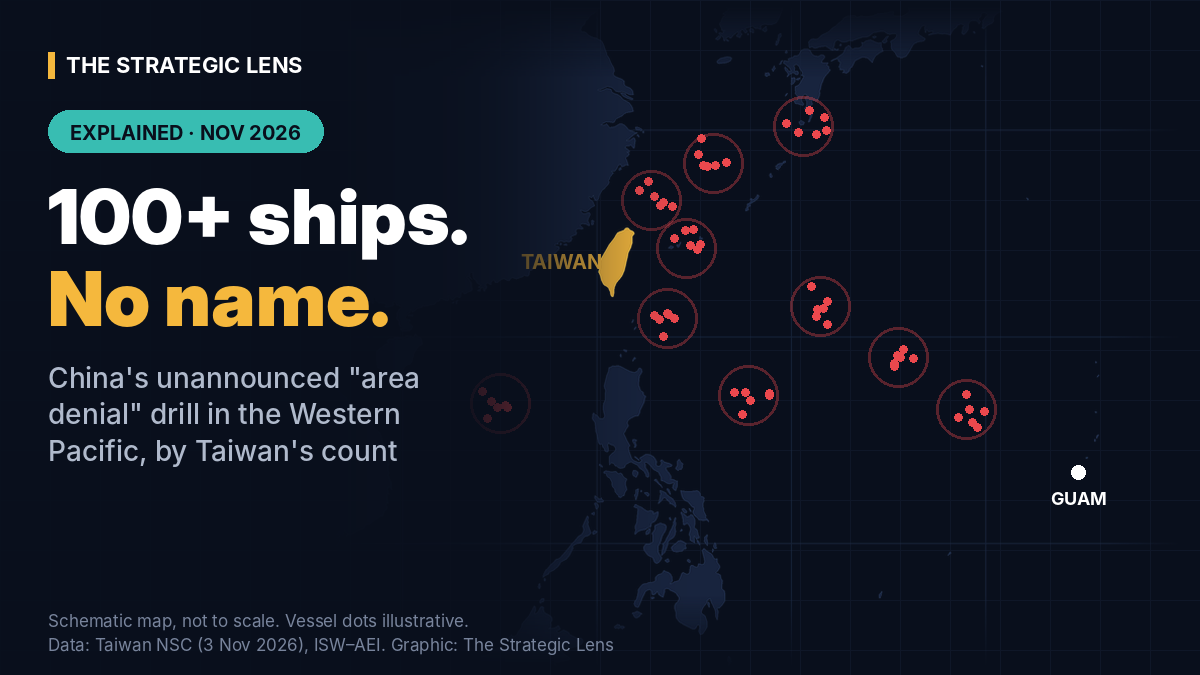
Since late October, China has spread what Taiwan’s top security official counts as more than 100 navy and coast guard ships across the Western Pacific. Two Chinese aircraft carriers have been at sea at the same time. On 10 November, Taiwan’s defence minister gave the activity a name Beijing hasn’t: “area denial” drills.
China hasn’t announced an exercise at all. Its defence ministry calls the carrier training an annual routine. Late on 11 November, the G7 foreign ministers said China’s activities east of Taiwan threaten regional stability. Beijing rejected that statement the next day.
Here’s what we know, what’s claimed, and why the thing that’s missing, a name, may be the most important part.
What Taiwan says happened
On 10 November, Defence Minister Wellington Koo told reporters in Taipei: “China has indeed conducted area denial drills in the Western Pacific,” involving the carrier Liaoning and its group (Reuters). He said the drills undermine peace and stability in the Indo-Pacific and that Taiwan is monitoring them with allies.
The build-up was gradual and public, at least on Taiwan’s side:
- 29 October: Joseph Wu, secretary-general of Taiwan’s National Security Council, published a map showing 53 Chinese ships, 34 of them navy warships, spread from southern Japan to the Philippines. “The simultaneous threat to Taiwan, Japan and the Philippines is obvious,” he wrote (Reuters).
- 2–3 November: Taiwan’s defence ministry counted 49 Chinese military aircraft around the island in one 24-hour period, with 31 crossing the Taiwan Strait median line (ministry data via Taiwan News).
- 3 November: Wu said China had deployed “more than 100 navy and coast guard vessels across the Western Pacific.” His line: “We won’t provoke, but we won’t bow to any pressure” (Taiwan News).
Two carriers were out at once: the Liaoning in the Western Pacific and the newer Fujian in the South China Sea (Taiwan Security Monitor; ISW–AEI satellite analysis shows the Fujian leaving its Hainan base on 2 November).
What China says
Beijing’s public position is short. Defence ministry spokesperson Zhang Xiaogang said on 29 October that the Liaoning’s Western Pacific training “was an annual routine” and “not directed at any particular country” (Reuters). On 12 November, foreign ministry spokesperson Mao Ning said the G7 statement “disregards facts, grossly interferes in China’s internal affairs and maliciously smears China”, adding that China’s activities in waters east of Taiwan are “fully within China’s sovereign rights and jurisdiction” (Chinese foreign ministry transcript).
That’s China’s claim, and it should sit next to Taiwan’s. Carrier deployments into the Pacific do happen most years. What’s different this time is the scale of the surrounding fleet and the fact that it came without the announcements that usually accompany a major drill.
What analysts think it was
The Institute for the Study of War and the American Enterprise Institute, in their 6 November update, assess that China “may be conducting a major, unannounced military exercise simulating surrounding and isolating Taiwan.” They describe four task forces from three PLA theater commands operating between Taiwan and Guam, alongside coast guard and navy ships closer to Taiwan, and judge the activity larger than December 2025’s Justice Mission drill. They also note that China normally announces and names major exercises, and did so for the last four.
That’s an assessment, hedged with “may”, and we present it that way.
What “area denial” means
Area denial means making a stretch of sea or sky too dangerous, or too slow, for an opponent to operate in. In a Taiwan crisis, the opponent China worries about isn’t only Taiwan’s own forces. It’s anyone who might come from the east: US ships and aircraft from Guam and Japan, or Japan’s own forces. Guam is about 2,700 km from Taiwan (our great-circle calculation). That’s the water ISW says the task forces were working in.
The numbers that tell the story
Here’s the comparison we think matters most.
| Justice Mission-2025 (named, Dec 2025) | This drill (unnamed, Oct–Nov 2026) | |
|---|---|---|
| Announced? | Yes, with zones and a name | No |
| Aircraft around Taiwan, peak 24 h | 130 | 49 |
| PLA navy ships near Taiwan (ministry daily count) | 14 | About 6–10 a day in early November |
| Ships across the wider Western Pacific | Not reported this way | “More than 100” navy and coast guard (Wu, 3 Nov) |
Sources: Taiwan Ministry of National Defense via PTI/Tribune India and USNI News (Dec 2025); Taiwan News, Taiwan Security Monitor (Nov 2026).
A caution: these counts don’t measure the same thing. The ministry’s daily report covers the area around Taiwan; Wu’s figure covers the wider Western Pacific. So this isn’t a like-for-like contest. But the shape is clear. The named drill was air-heavy and close to the island. This one is sea-heavy and spread far out.
Our read: The weight has moved from Taiwan itself to the sea approaches. If you wanted to rehearse keeping outside help away rather than pressuring the island directly, that’s roughly what it would look like. It also explains why Japan and the Philippines appear on Wu’s map, not just Taiwan.
Why the missing name matters
Named Chinese drills (Joint Sword in 2024, Strait Thunder in April 2025, Justice Mission in December 2025) arrived with public announcements and names, and in Justice Mission’s case declared live-fire zones. Governments, shipping companies and markets could see them coming and see them end. They became the warning sign everyone watched for.
An unannounced surge removes that signal. It also lowers the political cost: there’s no launch day for other governments to condemn, and Beijing can describe each piece as routine.
Latest (13 November): Joseph Wu said late on 12 November that the number of Chinese vessels had decreased, but that groups from three theater commands and the Liaoning carrier group were still operating east of the Philippines. Reuters, citing two Taiwanese security officials, reported about 70 Chinese vessels operating within the first island chain on 13 November, and quoted an official who said the naval deployment was larger than Justice Mission-2025. China’s defence ministry did not respond to Reuters’ request for comment.
Our take: The most important thing about this exercise is the name it doesn’t have. A big, unnamed, ship-heavy deployment far from Taiwan’s coast shortens everyone’s warning time and is aimed at the people who would come to Taiwan’s aid. The G7 statement suggests Western governments have noticed that shift.
The G7 responds
After meeting in Paris, the G7 foreign ministers published a joint statement late on 11 November saying China’s increasingly assertive activities in the waters east of Taiwan “threaten regional stability, freedom of navigation and the safety of international shipping.” They added: “We reaffirmed our opposition to any unilateral attempts to change the status quo, particularly by force or coercion, or the threat thereof” (Reuters). Reuters described it as the strongest unified expression of concern so far about these activities. Taiwan’s presidential office welcomed it. China’s foreign ministry rejected it on 12 November (see above).
China has also run regular coast guard patrols east of Taiwan since June, which Taiwan’s defence minister condemned as a provocation in June.
Why now? Two dates to watch
- 18–19 November: APEC leaders meet in Shenzhen. President Trump has said he expects to meet Xi Jinping there, possibly together with Vladimir Putin.
- 28 November: Taiwan holds local elections for mayors, county chiefs and councils, about 11,000 posts in all, according to the Central Election Commission.
Reading Beijing’s intent from timing alone is guesswork, so we won’t claim a motive. But a large, deniable show of naval reach, sitting between a Trump–Xi meeting and a Taiwanese vote, gives Beijing leverage in both conversations without a headline-making “launch”.
Who gains, who loses
- Beijing shows it can operate two carriers and a large fleet beyond the first island chain while keeping the political temperature low.
- Taipei gains international attention (the G7 statement) but faces a pressure campaign with no clear start or end.
- Washington and Tokyo have to plan for a PLA that practises far from Taiwan, closer to their own bases and sea lanes.
- Shipping and insurers lose a familiar early-warning signal if unannounced drills become the norm.
What to watch next
- Whether China announces or names anything before APEC, or whether the fleet quietly returns to port.
- Whether Taiwan’s daily counts spike near the 28 November vote.
- Whether Japan or the Philippines publish their own tracking data on the Pacific task forces.
- Whether Taiwan comes up publicly at a Trump–Xi meeting in Shenzhen.
FAQ
Did China announce a military exercise around Taiwan in November 2026? No. As of 13 November, China hadn’t announced or named an exercise. Its defence ministry described the Liaoning carrier’s Western Pacific training as an annual routine not aimed at any country.
How many Chinese ships were involved? Taiwan’s National Security Council chief Joseph Wu said on 3 November that more than 100 Chinese navy and coast guard vessels were deployed across the Western Pacific. On 29 October he had counted 53, including 34 warships.
What is an “area denial” drill? Practice for making an area too dangerous or slow for an opponent to enter. Here, Taiwan’s defence minister used it for Chinese drills in the Western Pacific, east of Taiwan, the direction US and Japanese forces would come from.
What did the G7 say? That China’s increasingly assertive activities east of Taiwan threaten regional stability, freedom of navigation and the safety of international shipping, and that the G7 opposes any attempt to change the status quo by force or coercion (Reuters, 12 Nov).
Is this bigger than previous Chinese drills? ISW and AEI assess it may be larger than Justice Mission-2025 in overall scale. Around Taiwan itself, though, aircraft numbers were lower: a peak of 49 in a day versus 130 during Justice Mission.
Your turn
Is this message aimed mainly at Taiwan’s voters, or at Washington before Trump meets Xi? Tell us in the comments.
References
- Reuters via Taipei Times, “China conducting area denial drills, defense minister says” (10 Nov 2026): https://www.taipeitimes.com/News/front/archives/2026/11/10/2003867493
- Reuters via gCaptain, “Taiwan flags ‘obvious’ threat from 50 Chinese vessels in wide sweep of waters” (29 Oct 2026): https://gcaptain.com/taiwan-flags-obvious-threat-from-50-chinese-vessels-in-wide-sweep-of-waters/
- Reuters via The Jerusalem Post, “G7 foreign ministers say China’s actions east of Taiwan threaten stability” (12 Nov 2026): https://www.jpost.com/international/article-914642
- Taiwan News, “Taiwan says China deploys over 100 navy, coast guard vessels in Western Pacific” (4 Nov 2026): https://www.taiwannews.com.tw/news/6471672
- Taiwan News, “Taiwan tracks 11 Chinese military aircraft and 13 ships” (7 Nov 2026): https://www.taiwannews.com.tw/news/6473240
- ISW–AEI, “China & Taiwan Update, November 6, 2026”: https://www.aei.org/commentary/china-taiwan-update-november-6-2026/
- The Maritime Executive, “Analysis: China’s Naval Drills Suggest Preparation to Isolate Taiwan” (10 Nov 2026): https://maritime-executive.com/article/analysis-china-s-naval-drills-suggest-preparation-to-isolate-taiwan
- Taiwan Security Monitor (George Mason University), weekly report, 19 Oct–8 Nov 2026: https://taiwansecuritymonitor.substack.com/p/taiwan-security-monitor-weekly-october-a58
- PTI via Tribune India, “Taiwan detects 130 Chinese aircraft, 14 vessels around its territory” (30 Dec 2025): https://www.tribuneindia.com/news/world/taiwan-detects-130-chinese-aircraft-nine-14-vessels-around-its-territory/
- USNI News, “China Wraps ‘Justice Mission’ Taiwan Blockade Drills” (31 Dec 2025): https://news.usni.org/2025/12/31/china-wraps-justice-mission-taiwan-blockade-drills
- Reuters via Yahoo News, “China stages unannounced Pacific drills in ‘silent intimidation’ of Taiwan, officials say” (13 Nov 2026): https://www.yahoo.com/news/world/articles/china-stages-unannounced-pacific-drills-040513635.html
- Chinese Ministry of Foreign Affairs, regular press conference transcript (12 Nov 2026): https://www.fmprc.gov.cn/eng/xw/fyrbt/202611/t20261112_12058413.html
- Epoch Times, “Trump Expects Meeting With Xi and Putin at APEC Summit in China” (9 Nov 2026): https://www.theepochtimes.com/china/trump-expects-meeting-with-xi-and-putin-at-apec-summit-in-china-6122412
- 2026 Taiwanese local elections (Central Election Commission figures, via Wikipedia): https://en.wikipedia.org/wiki/2026_Taiwanese_local_elections


Leave a Reply