
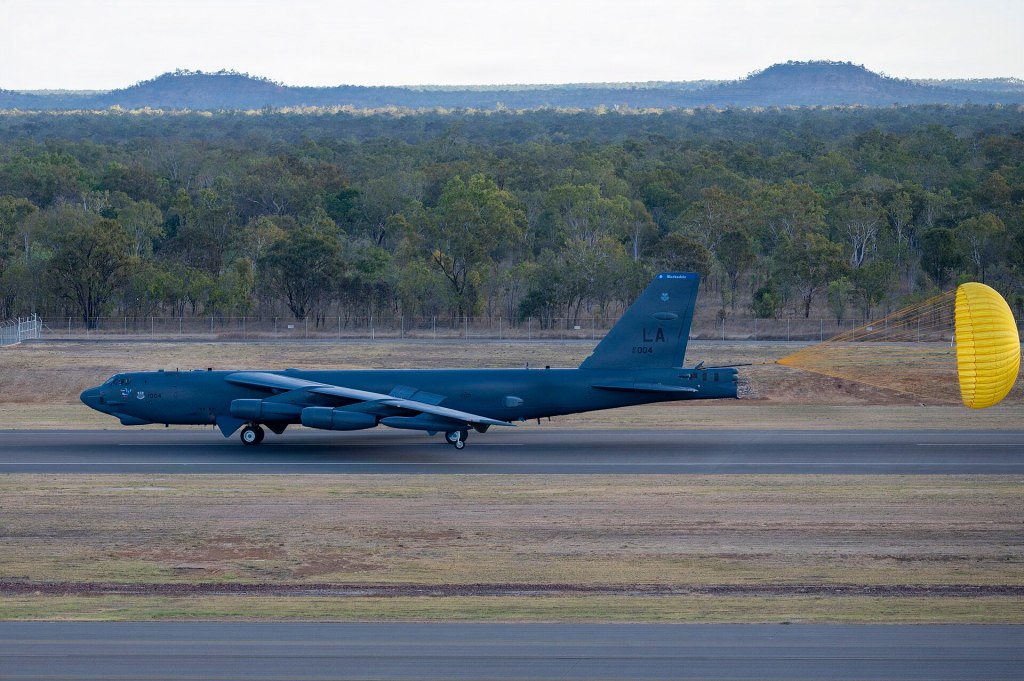
On 1 September 2026, a group of American B-52H bombers touched down at a base in the Australian outback, 15 km from the town of Katherine in the Northern Territory. It was the first bomber deployment to RAAF Base Tindal since years of construction work, partly paid for by the United States, prepared it to host up to six of the giant aircraft at once.
Tindal is the clearest example of a quiet transformation: Australia is turning its sparsely populated north into the front line of its defence, and a platform for American power in the Indo-Pacific. This article explains RAAF Base Tindal and Australia’s northern bases: what has been built, why the B-52s matter, the other bases involved, and the debate over what it all means.
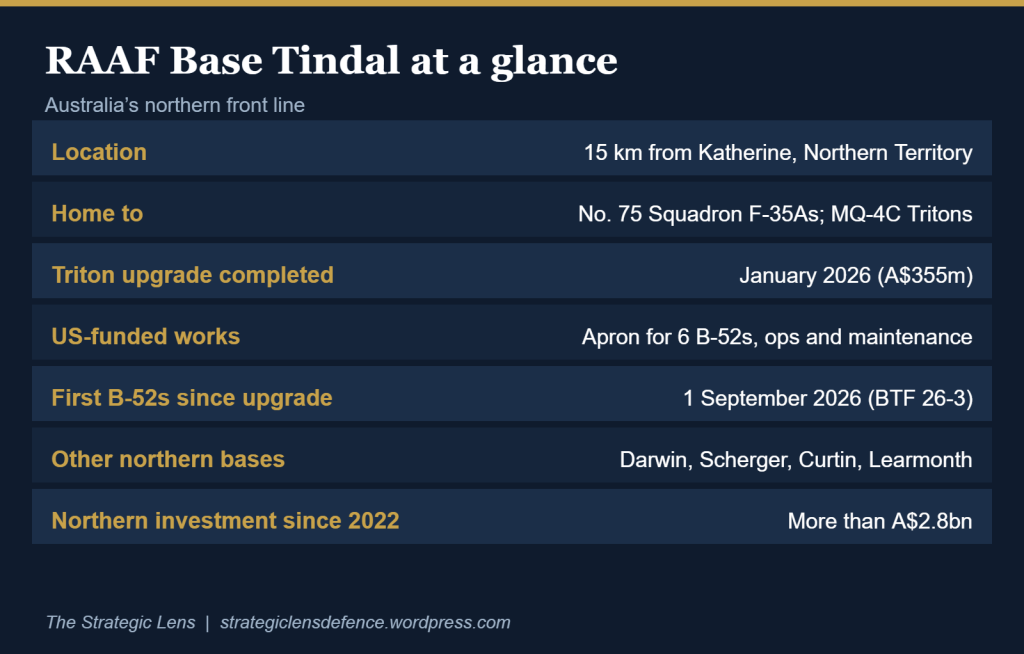
Quick answer: RAAF Base Tindal is home to Australia’s F-35A fighters and its MQ-4C Triton maritime drones, after an A$355 million upgrade completed in January 2026. US-funded works added parking and support facilities for six B-52 bombers, which first used them during Bomber Task Force 26-3 in September 2026. Tindal is part of a wider northern network including RAAF Base Darwin and the “bare bases” at Scherger, Curtin and Learmonth. Supporters see deterrence; critics worry about costs, sovereignty and becoming a target.
In this article
Why the north matters
Most Australians live in the south-east, thousands of kilometres from the country’s northern coastline. But any military threat would almost certainly come from the north, through the islands of Southeast Asia. Darwin is closer to Jakarta than to Sydney, and much closer to the South China Sea than Canberra is.
The 2023 Defence Strategic Review made the north a top priority, calling for bases able to support long-range operations and allied forces. Assistant Defence Minister Peter Khalil said in January 2026 that the government had invested more than A$2.8 billion in northern Australia since 2022.
RAAF Base Tindal: from bare base to front line
Tindal began as a Second World War airfield and became a permanently staffed RAAF base in 1988. It is now home to No. 75 Squadron, flying F-35A Lightning II stealth fighters, and to the RAAF’s MQ-4C Triton high-altitude surveillance drones, which watch the seas to Australia’s north. They are flown remotely by No. 9 Squadron from RAAF Base Edinburgh in South Australia.
In January 2026, the government completed a A$355 million upgrade at Tindal with purpose-built hangars, working accommodation and improved airfield pavements for the Triton fleet, which will grow to four aircraft. Broader works since 2020, including a lengthened runway, new fuel storage and accommodation, have been put at A$1.1–1.6 billion.
The B-52 facilities and BTF 26-3
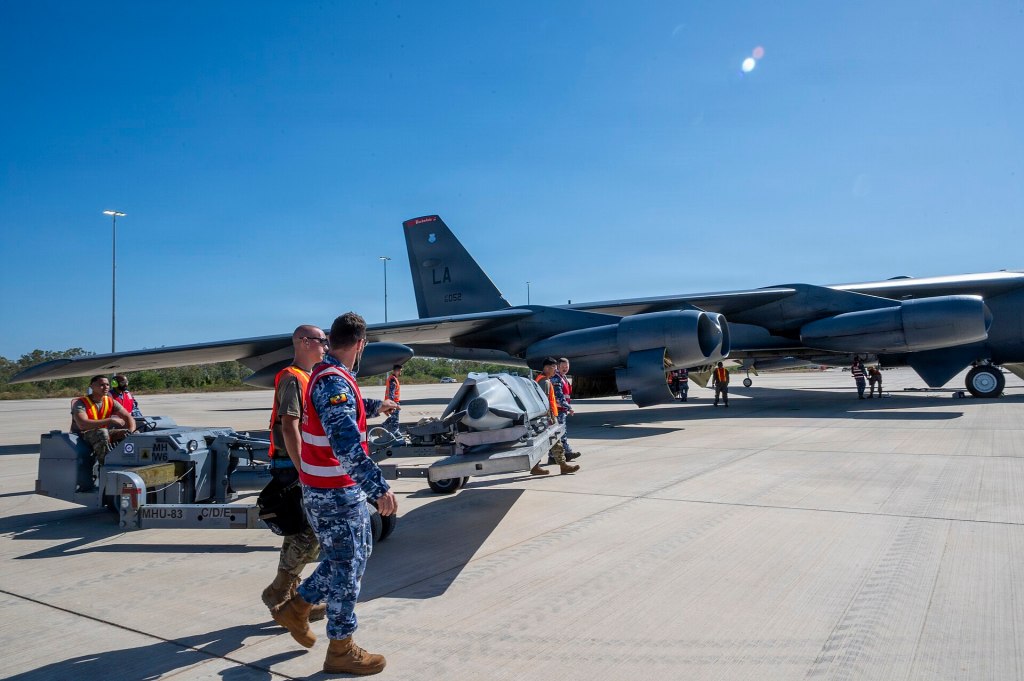
Since 2022, the US government has funded additional works at Tindal so that it can host US bombers for longer periods: an expanded apron with space for six B-52s, a squadron operations facility, maintenance infrastructure, mission planning buildings, and fuel and munitions storage. Planning documents described the aim as running multiple 15-day training exercises during the Northern Territory dry season.
The first test came with Bomber Task Force 26-3. B-52H bombers from the 2nd Bomb Wing at Barksdale Air Force Base in Louisiana landed at Tindal on 1 September 2026. The US Air Force did not say how many aircraft were deployed or for how long. A Pacific Air Forces spokesperson said the missions demonstrated “seamless interoperability with our partners”.
A day later, on 2 September 2026, Defence Minister Richard Marles met US Secretary of Defense Pete Hegseth at the Pentagon to mark 75 years of the ANZUS Treaty. According to the Pentagon readout, “both leaders agreed to accelerate force posture initiatives at Australian bases”.
Why Tindal? It is far enough from China to be out of range of most Chinese missiles, but close enough for B-52s and tankers to reach the South China Sea and beyond. Analysts point out that having multiple airfields in Australia gives the US options if its bases in Guam or Japan are threatened. See our piece on the B-21 Raider for where US bombers are heading next.
The wider northern network
| Base | Location | Role |
|---|---|---|
| RAAF Base Darwin | Darwin, NT | Fast-jet and transport base; hosts US Marines and visiting aircraft |
| RAAF Base Tindal | Near Katherine, NT | F-35A, MQ-4C Triton, US bomber deployments |
| RAAF Base Townsville | Queensland | Major air and army hub for the north-east |
| RAAF Base Scherger | Near Weipa, Queensland | Bare base, activated for exercises and contingencies |
| RAAF Base Curtin | Near Derby, WA | Bare base |
| RAAF Base Learmonth | Near Exmouth, WA | Bare base, close to the Indian Ocean |
The three “bare bases” have runways, fuel and basic facilities but no permanent flying units. A small caretaker staff keeps them ready, and they can be activated quickly in a crisis. Spreading aircraft across many bases makes them harder to target, a key lesson from recent wars.
US force posture in Australia
- Marine Rotational Force–Darwin: since 2012, US Marines have rotated through Darwin each dry season, now numbering up to around 2,500.
- Enhanced air cooperation: regular US bomber, fighter and tanker deployments to northern bases.
- Submarines: from 2027, US and UK nuclear submarines will rotate through HMAS Stirling near Perth under AUKUS, with around 2,300 Americans expected in Western Australia by 2030.
- Logistics: prepositioned fuel and supplies to support US operations in a crisis.
The debate
The Lowy Institute estimated in October 2026 that Australia is spending nearly $30 billion on major bases and shipyards, including Tindal, HMAS Stirling, Osborne and Henderson, and argued that “these projects also require scrutiny”. Other concerns include:
- Becoming a target. Hosting US bombers could make northern Australia a target in a US–China war.
- Nuclear questions. B-52s can carry nuclear weapons. Australia follows the US policy of neither confirming nor denying whether visiting aircraft carry them, which critics find uncomfortable.
- Sovereignty. Critics ask how much control Australia would have over US operations from its soil.
- The Port of Darwin. Darwin’s port has been leased to the Chinese-linked Landbridge Group since 2015 for 99 years. The government has said it wants the port back in Australian hands, but no deal had been finalised by early 2026.
China’s view
When plans for B-52 facilities at Tindal became public in 2022, China’s foreign ministry said defence cooperation should not “target or harm the interests of third parties” and accused the US of raising regional tensions. Chinese state media described Australia as a potential “overseas bomber base”. China has its own long-range bombers and missiles that could, in theory, reach northern Australia, as we cover in our PLA Rocket Force explainer.
What it means for India
Australia’s northern and western bases face the eastern Indian Ocean, a region where the Indian Navy is increasingly active. Learmonth and the Cocos (Keeling) Islands, which Australia is upgrading for P-8A Poseidon maritime patrol aircraft, sit near sea lanes that Chinese ships use to enter the Indian Ocean. Indian P-8Is have already operated from Australian bases, and closer India–Australia maritime surveillance cooperation is a natural next step.
Our take
Tindal shows how geography is becoming Australia’s biggest military asset. A base deep in the outback, out of easy reach of most threats yet within range of the South China Sea, is valuable to both Australia and the US. The upgrades strengthen deterrence, but they also make Australia part of America’s war plans in a way it has not been since the Second World War. That is a trade-off Australians should debate openly, and the B-52s landing at Katherine have made it impossible to ignore.
Frequently asked questions
Where is RAAF Base Tindal?
About 15 km from Katherine in Australia’s Northern Territory, south of Darwin.
What aircraft are based at Tindal?
No. 75 Squadron’s F-35A stealth fighters and the RAAF’s MQ-4C Triton maritime surveillance drones. It also hosts visiting US aircraft, including B-52 bombers.
Are US B-52 bombers based in Australia?
Not permanently. They deploy on rotations. US-funded facilities at Tindal can host up to six B-52s, and bombers arrived for Bomber Task Force 26-3 on 1 September 2026.
How much has Australia spent upgrading Tindal?
A A$355 million Triton-related upgrade was completed in January 2026. Wider works since 2020 have been put at A$1.1–1.6 billion.
What are Australia’s bare bases?
Scherger, Curtin and Learmonth: airfields with runways, fuel and basic facilities but no permanent flying units, kept ready for exercises and crises.
Why is northern Australia important for defence?
Any military threat to Australia would most likely come from the north, and northern bases are closest to Southeast Asia and the South China Sea.
Sources and further reading
Researched using official statements and published reporting up to 6 November 2026.
- ABC News: Government completes $355m upgrade to RAAF Base Tindal, January 2026
- Air & Space Forces Magazine: B-52s deploy to upgraded Australian base, September 2026
- MiGFlug: B-52 bombers land at RAAF Base Tindal, September 2026
- The War Zone: Australian airbase gets upgrades for American bomber deployments, October 2022
- Lowy Institute: Australia’s base boom needs scrutiny too, October 2026
- RAAF Base Tindal (reference overview)


Leave a Reply