
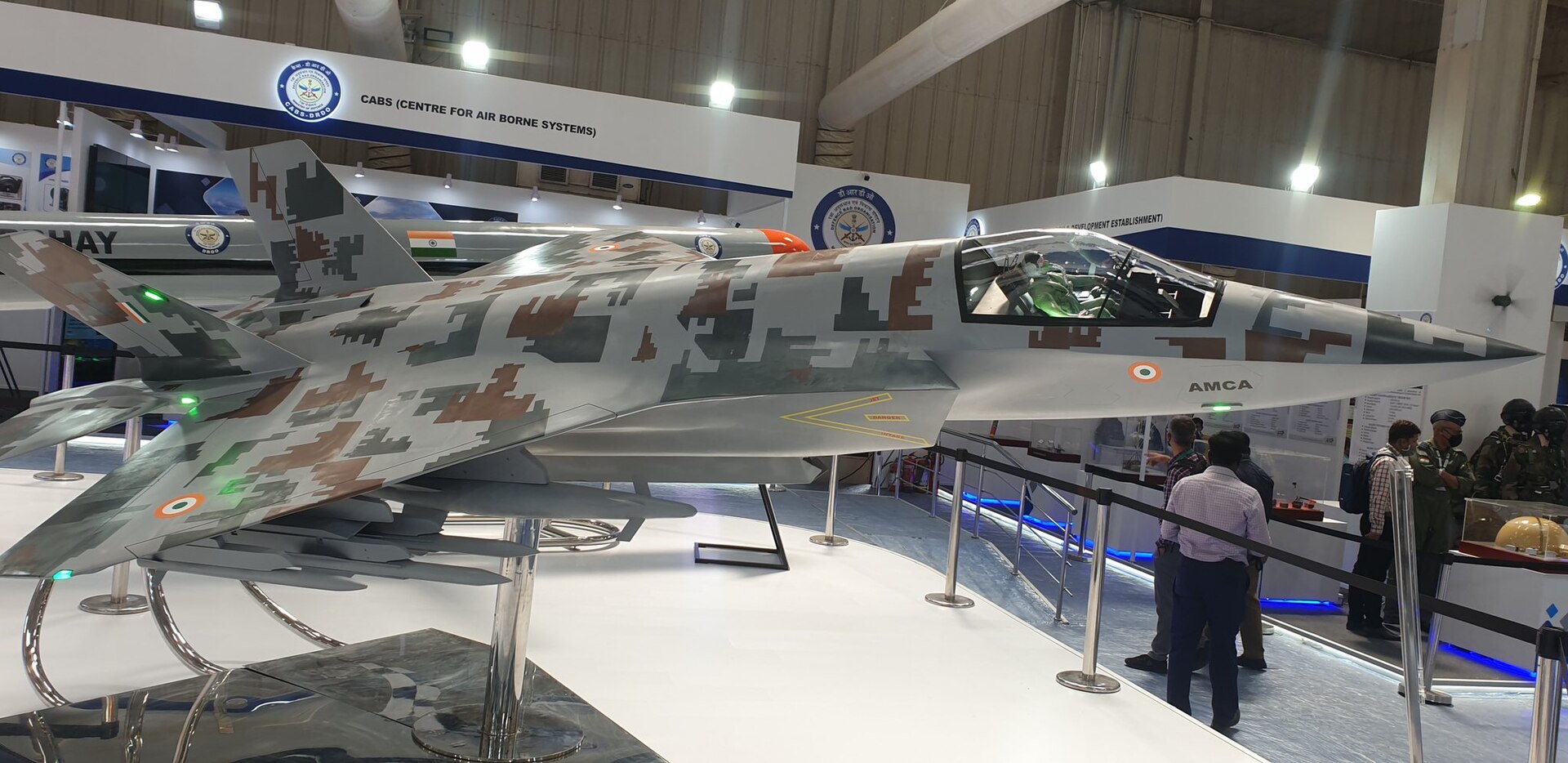
Just after 11 in the morning on 30 October 2026, Tata Advanced Systems handed its sealed bid to the Aeronautical Development Agency in Bengaluru. Within two hours, teams led by Larsen & Toubro and Bharat Forge had done the same. Those three envelopes hold the next chapter of a story India has been trying to write for sixteen years: building its own stealth fighter.
That fighter is the Advanced Medium Combat Aircraft, or AMCA. If it works, India joins a very small club: so far only the United States, China and Russia have put fifth-generation fighters of their own design into service, with Turkey’s KAAN now in flight testing. If it slips, the Indian Air Force faces the 2030s with a shrinking fleet and few good options.
This guide explains what the AMCA is, how it is designed, what powers it, who will build it, when it might fly, and the hard problems that still stand in the way.
Quick answer: The AMCA (Advanced Medium Combat Aircraft) is India’s first fifth-generation stealth fighter, a 25-tonne, twin-engine jet designed by DRDO’s Aeronautical Development Agency. Prototypes will be built by a private-sector partner, the first flight is targeted for September 2028, and induction into the Indian Air Force is planned for around 2034–35.
AMCA at a glance
| Full name | Advanced Medium Combat Aircraft (AMCA) |
| Type | Single-seat, twin-engine fifth-generation stealth multirole fighter |
| Designer | Aeronautical Development Agency (ADA), DRDO |
| Weight class | About 25 tonnes |
| Engines | Mk1: 2 × GE F414 (about 98 kN each). Mk2: 2 × Safran-GTRE engine (120 kN planned) |
| Prototypes | 5 flying prototypes + 1 structural test airframe |
| Prototype funding | Around ₹15,000 crore (cleared March 2024) |
| First flight target | September 2028 |
| Induction target | Around 2034–35 |
| Status (Nov 2026) | Industry partner bids under evaluation |
In this article
- What is the AMCA fighter jet?
- A short history: from MCA to AMCA
- Design and stealth features
- AMCA specifications: what we know so far
- What weapons will the AMCA carry?
- The engine question: Mk1 and Mk2
- Who will build the AMCA? The new industry model
- AMCA timeline: when will it fly?
- How the AMCA compares with other fifth-generation fighters
- Why the AMCA matters for India
- The biggest challenges ahead
- Common myths and misconceptions about the AMCA
- Our take
- Frequently asked questions
- Sources and further reading
What is the AMCA fighter jet?
The AMCA is a single-seat, twin-engine, fifth-generation stealth fighter being designed by the Aeronautical Development Agency (ADA), part of DRDO. It sits in the 25-tonne class, which makes it larger and heavier than the Tejas but lighter than the Su-30MKI.
“Fifth generation” is a loose label, but it usually means four things: a shape and materials that make the jet hard to see on radar, weapons carried inside the body rather than under the wings, powerful sensors whose data is fused into one picture for the pilot, and the ability to fly fast for long periods. The AMCA is being designed around all four.
It is meant to be a multirole aircraft. The same jet should be able to fight for control of the air, strike targets on the ground, hunt enemy air defences and carry out electronic warfare. Over time, the Indian Air Force sees it taking over from the Su-30MKI as the backbone of its fighter fleet.
A short history: from MCA to AMCA
The idea is older than many people realise. The programme formally began in 2010 as the Medium Combat Aircraft (MCA), at first imagined as a 20-tonne jet that would sit alongside the FGFA, the fifth-generation fighter India was then planning with Russia. That joint project fell apart in 2018, which left the homegrown design as India’s main route to a stealth fighter.
Between late 2013 and the end of 2014, ADA studied nine different configurations, labelled 3B-01 to 3B-09, before settling on the last of them. The Air Force accepted the basic design in 2016, and money for detailed design followed in 2018.
The real turning point came in March 2024, when the Cabinet Committee on Security (CCS) cleared roughly ₹15,000 crore for prototype development. In February 2025, ADA showed a full-scale model of the jet at Aero India in Bengaluru. Three months later, the government changed how the aircraft would be built, which we explain below.
Design and stealth features
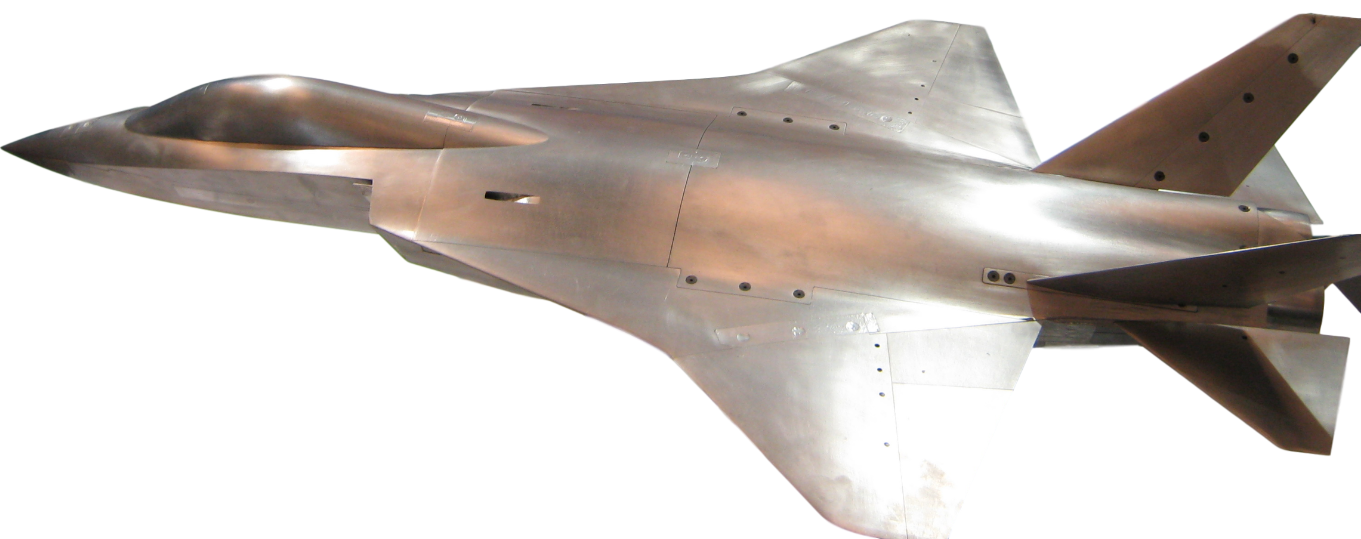
Stealth is less about one clever trick and more about thousands of small decisions. Here is how the AMCA tries to stay hidden:
- Shaping. Edges of the wings, tails and intakes are aligned to a few set angles, so radar energy bounces away in narrow directions instead of straight back to the enemy.
- Internal weapons bay. Missiles and bombs sit inside the fuselage during stealth missions. Bombs hanging under the wings are among the biggest radar reflectors on any jet.
- Hidden engine faces. The air intakes are curved (serpentine), so radar cannot see the spinning fan blades of the engine, which reflect strongly.
- Materials. Composites make up a large share of the airframe, and radar-absorbent coatings are planned for key surfaces.
- “Beast mode”. When stealth matters less, the jet can carry extra weapons on external pylons, trading invisibility for firepower.
Inside, the AMCA is planned to carry an AESA radar developed from DRDO’s work on the Virupaksha radar for the Su-30MKI upgrade, along with passive sensors spread around the airframe and an electronic warfare suite. ADA has also talked about AI-assisted sensor fusion (see our explainer on how AI is changing warfare) and an “electronic pilot” that helps the human pilot sort threats and manage the workload. Much of this will mature on the later Mk2 version.
A single seat and an “electronic pilot”
Most heavy strike fighters, like the Su-30MKI, have two seats: one person flies while the other manages weapons and sensors. The AMCA has one. ADA scientists have described the missing second crew member as an “electronic pilot”, software that handles routine tasks, tracks threats and suggests responses so the pilot can focus on the fight. Earlier reporting on the design also mentioned voice commands, 3D audio and sensors that give the pilot a 360-degree view around the aircraft.
It is an ambitious idea. Whether software can really stand in for a trained weapons officer in a crowded air battle is one of the things flight testing will have to prove.
AMCA specifications: what we know so far
The jet has not flown yet, so every figure below is a design target. Some have already changed over the years, and they will change again during testing.
| Specification | AMCA (design target) |
|---|---|
| Crew | 1 |
| Engines (Mk1) | 2 × GE F414, about 98 kN each with afterburner |
| Engines (Mk2) | 2 × Safran-GTRE engine, 120 kN planned, growth to 140 kN |
| Weight class | About 25 tonnes maximum take-off weight (baseline) |
| Internal fuel | About 6.5 tonnes (reported) |
| Weapons payload | About 1.5 t internal, about 5.5 t external (reported) |
| Top speed | About Mach 1.8 (reported) |
| Combat range | About 1,600 km (reported) |
| Service ceiling | About 20 km / 65,000 ft (reported) |
| Radar | AESA radar derived from DRDO’s Virupaksha work |
| Stealth features | Aligned edges, internal weapons bay, serpentine intakes, composites, radar-absorbent coatings |
Payload, speed and range figures come from ADA displays and published reports. Treat them as indicative.
What weapons will the AMCA carry?
ADA has not published a final weapons list, but officials and design briefings have pointed to a mostly Indian arsenal. That matters: a stealth jet is only as useful as the weapons that fit inside it.
- Astra air-to-air missiles. DRDO’s beyond-visual-range missile, already in service on the Su-30MKI and being integrated on the Tejas. Longer-range versions are in development.
- Rudram anti-radiation missiles. Designed to home in on enemy radar, the key weapon for knocking out air defences on the first day of a conflict.
- BrahMos-NG. A smaller, lighter version of the BrahMos cruise missile, being developed for fighters. Read more about BrahMos in our piece on India’s record defence exports.
- Precision-guided bombs and laser-guided munitions for ground attack.
- An internal gun for close-range combat.
In stealth mode, reports put the internal load at about 1.5 tonnes, typically a mix of air-to-air missiles and guided bombs. With external pylons, the total rises to several tonnes, at the cost of a bigger radar signature.
There is an open debate here. Some analysts have questioned whether longer weapons, such as the Rudram family, will fit inside the internal bay. ADA has not released the bay’s exact dimensions, so for now this is unresolved. Every stealth fighter has faced the same problem: the F-35, for example, needed modified missiles to carry some weapons internally.
The engine question: Mk1 and Mk2
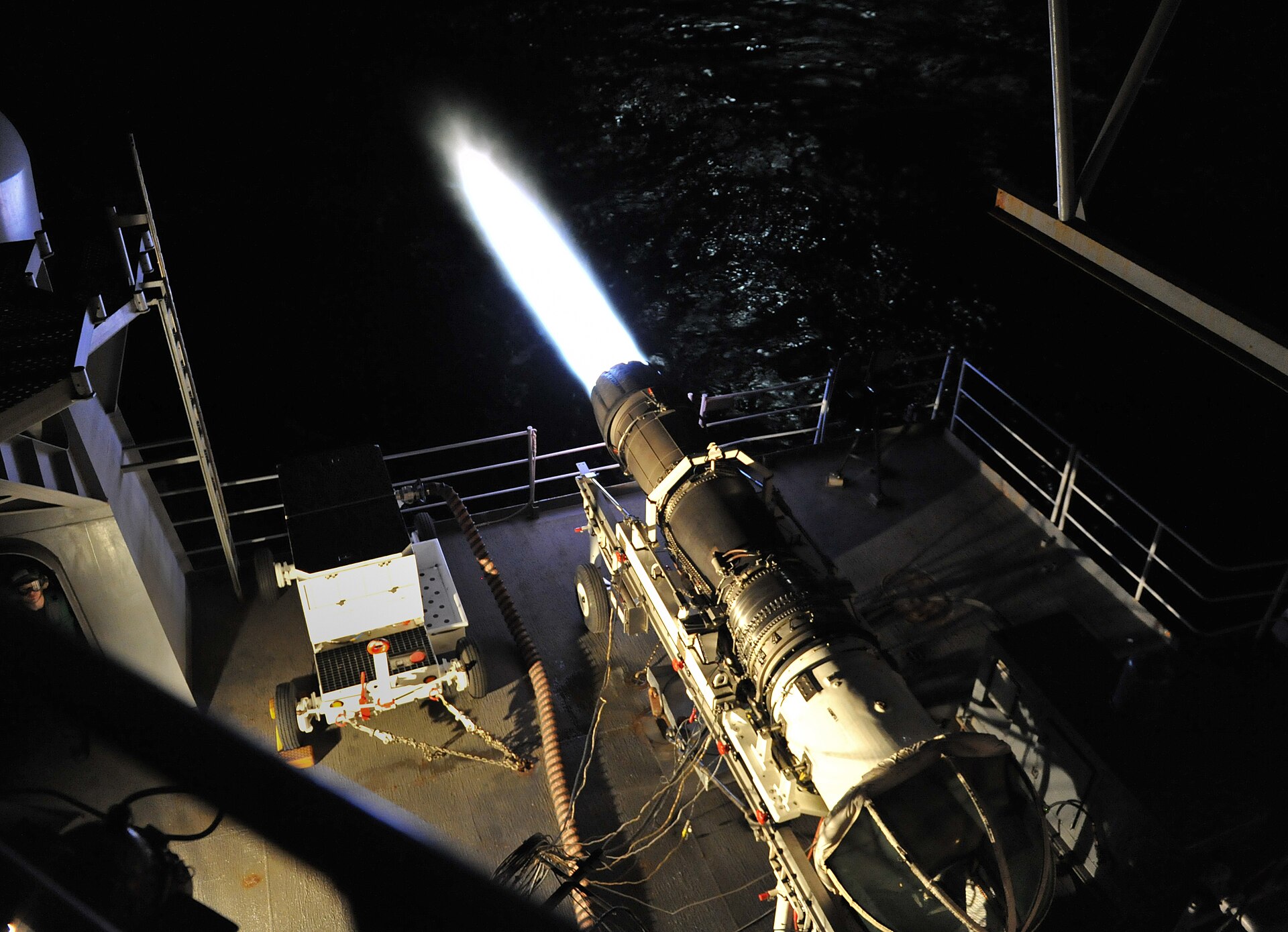
If you want to know whether the AMCA will succeed, look at its engines first. India has never put a combat jet engine of its own into service. The Kaveri, its last attempt, never produced enough thrust for the Tejas. That history shapes everything about how the AMCA is being powered.
AMCA Mk1 will use two General Electric F414 engines, each producing about 98 kN with afterburner. It is the same engine chosen for the Tejas Mk2, and HAL plans to build it in India with GE. Using a proven engine lets the prototypes start flight testing without waiting for a new one. The catch is that the F414 is not quite powerful enough for everything the AMCA should do, such as cruising at supersonic speed without afterburner.
AMCA Mk2 is meant to get a new, more powerful engine designed in India with France’s Safran. In August 2025, Defence Minister Rajnath Singh confirmed the partnership: a 120 kN engine to start with, growing to 140 kN later, with nine prototype engines and full transfer of technology to DRDO’s Gas Turbine Research Establishment (GTRE). Reports in August 2026 said the deal had gone to the Cabinet Committee on Security for final approval. As of early November 2026, we have not seen official confirmation that it has been cleared.
The airframe can be designed in a decade. The engine is what decides whether India truly owns this aircraft.
Even on an optimistic timeline, the Safran-GTRE engine is a long-term project, with first core runs reportedly targeted around 2032. That means the early AMCA squadrons will almost certainly fly on American engines, which leaves supply chains and export controls in Washington’s hands for some years.
Who will build the AMCA? The new industry model
For decades, building fighters in India meant one company: Hindustan Aeronautics Limited (HAL). On 27 May 2025, that changed. The Defence Ministry approved an “execution model” that opened the AMCA to competition. Indian companies, private or public, could bid alone, as joint ventures or as consortia.
In February 2026, three teams made the shortlist:
- Larsen & Toubro, leading a consortium with Bharat Electronics (BEL) and Dynamatic Technologies
- Tata Advanced Systems, bidding on its own, with experience from building the C295 transport aircraft with Airbus
- Bharat Forge, leading a consortium with BEML and Data Patterns
HAL did not make the cut for the prototype phase. The Defence Secretary later said this was on routine technical grounds, while earlier reports pointed to a rule about the size of a bidder’s order book compared with its turnover. HAL could still play a role in series production.
The winner will build five flying prototypes and one structural test airframe to ADA’s design, in a contract worth around ₹15,000 crore. The request for proposals went out in May 2026, the bid deadline moved from 27 August to 30 October, and all three teams submitted on time. A technical evaluation is expected to run until about the end of 2026, followed by price negotiations.
AMCA timeline: when will it fly?
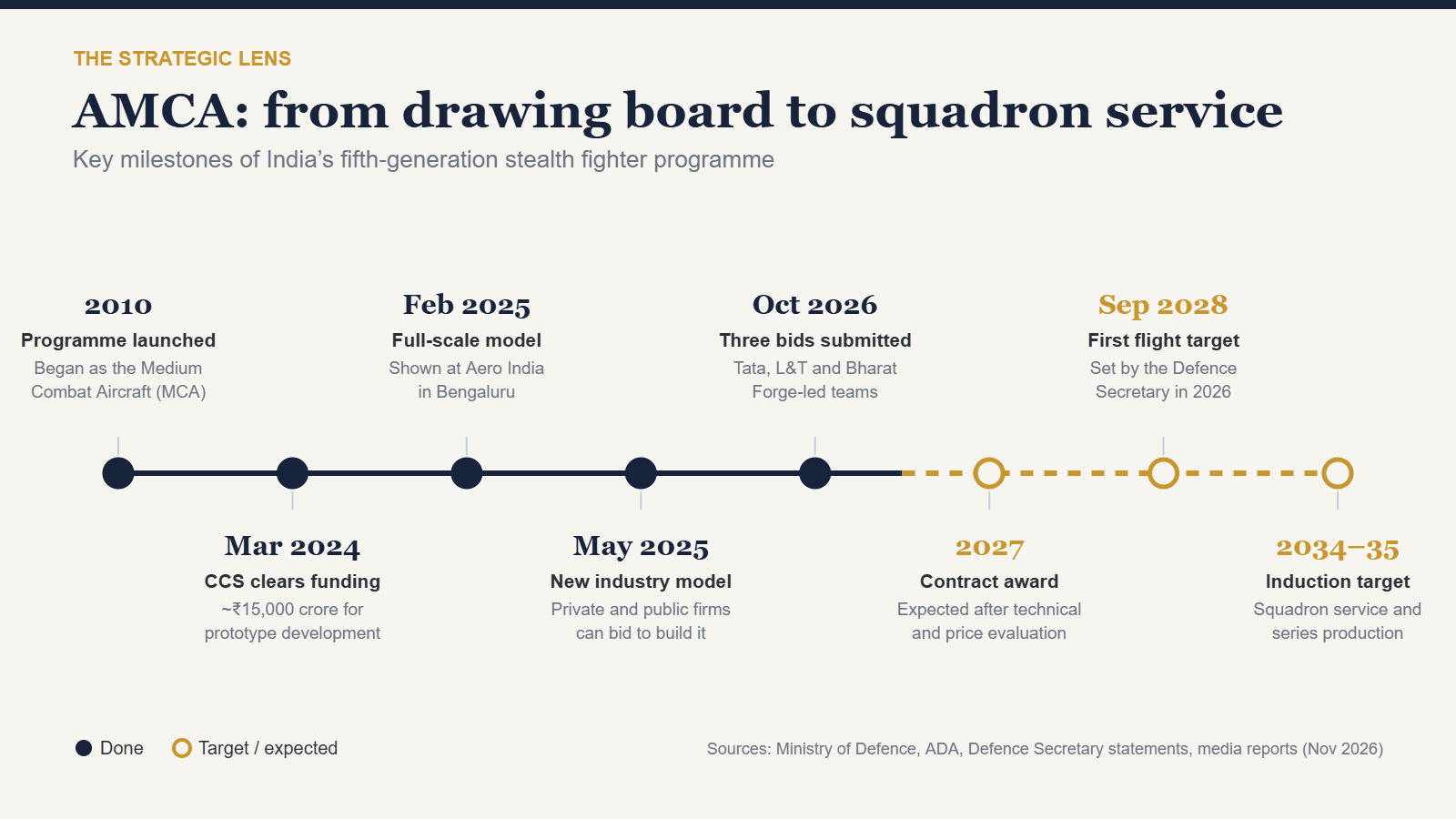
At the NDTV Defence Summit in late September 2026, Defence Secretary Rajesh Kumar Singh set a target of September 2028 for the first flight. Programme documents reported in the media go further: the first flight within 30 months of the contract, all five prototypes within 64 months, and around 1,800 test sorties within 84 months.
Do the maths and you can see the tension. If the contract is signed in 2027, a 30-month clock points to first flight closer to 2029 or 2030 than to September 2028. Earlier official statements also moved around, with first flight dates between 2028 and 2029 and induction pencilled in for 2034, with series production from about 2035.
To support testing, Rajnath Singh laid the foundation stone in 2026 for ADA’s Aircraft Integration and Flight Testing Centre at Puttaparthi in Andhra Pradesh. It is planned with a 10,000-foot runway, its own air traffic control tower and integration hangars.
How the AMCA compares with other fifth-generation fighters
| Fighter | Country | First flight | In service | Status (2026) |
|---|---|---|---|---|
| F-22 Raptor | USA | 1997 | 2005 | In service, production ended |
| F-35 Lightning II | USA | 2006 | 2015 | In service, in large-scale production |
| J-20 | China | 2011 | 2017 | In service in large numbers |
| Su-57 | Russia | 2010 | 2020 | In service in small numbers |
| KAAN | Turkey | 2024 | — | Flight testing |
| AMCA | India | Target: Sept 2028 | Target: ~2034 | Prototype contract being awarded |
The table shows the honest picture. The AMCA starts more than a decade behind the American, Chinese and Russian jets, and behind Turkey’s KAAN, which flew in February 2024. India’s advantage is that it can learn from their mistakes and design for the 2040s from day one. For a deeper head-to-head, read our comparison of the world’s top fighter jets.
Why the AMCA matters for India
- The squadron gap. The Air Force is cleared for 42 fighter squadrons but has been operating around 30, and older types like the MiG-21 have already retired. New jets are needed in large numbers, which is also why the 114-Rafale deal matters so much.
- China. China already flies the J-20 in large numbers and is bringing the J-35 into service. India needs stealth aircraft of its own to keep the balance along the Himalayan frontier. China is also expanding its navy fast, as our piece on China’s carrier leap explains.
- Pakistan. There were reports in 2025 that Pakistan was looking at Chinese stealth fighters such as the J-35. Even the possibility shapes Indian planning, on top of Pakistan’s growing JF-17 fleet.
- Self-reliance. Buying foreign stealth jets brings restrictions on how they can be used, upgraded and maintained. A homegrown jet gives India control.
- Industry. If private firms can build the AMCA, India gains a second fighter production base alongside HAL, something it has never had.
How many AMCAs will India build?
There is no firm order yet. A 2022 report on the design said the Air Force had planned for seven AMCA squadrons, including the later Mk2 version. At roughly 18 jets per squadron, that is about 126 aircraft, though the number could grow if the programme performs well. Reports also suggested the Mk1 would be over 70 percent Indian by content, rising to about 90 percent once an Indian engine is fitted.
The biggest challenges ahead
It would be dishonest to write about the AMCA without spelling out the risks. Here are the ones that matter most.
- Engines. Mk1 depends on GE F414 deliveries, and the Mk2 engine is still awaiting its final go-ahead. Engine delays have already slowed the Tejas Mk1A.
- A new builder. None of the three bidders has built a combat jet before. Building stealth airframes demands extreme precision in composites, coatings and assembly.
- Time. India’s own record is sobering: the Tejas took roughly three decades from launch to squadron service. A 2028 first flight would require everything to go right.
- Testing and certification. Stealth testing needs special ranges and measurement facilities. Some are still being built.
- The stopgap debate. With the AMCA years away, there is pressure to buy a foreign fifth-generation jet such as the Su-57 or F-35 as an interim step. The Defence Secretary said in September 2026 that no decision had been made. A large foreign buy could pull money and attention away from the AMCA.
Common myths and misconceptions about the AMCA
- “HAL is building the AMCA.” Not in the prototype phase. ADA designs it, and a private-sector partner will build the prototypes. HAL may still compete for series production.
- “It will fly with an Indian engine.” The first AMCAs will use American GE F414 engines. The Indian-French engine is meant for the later Mk2.
- “Stealth means invisible.” Stealth shrinks the distance at which radar can detect and track a jet. It does not make an aircraft invisible, especially to low-frequency radars or infrared sensors.
- “The AMCA is a sixth-generation fighter.” The Mk1 is a fifth-generation design. Some sixth-generation ideas may arrive with the Mk2. Our explainer on the sixth-generation fighter race explains the difference.
- “₹15,000 crore is the cost of the whole programme.” That money covers prototype development only. Series production and the new engine will cost far more.
Our take
The AMCA fighter jet programme is in better shape today than at any point in its history. It has money, an approved design, a full-scale model, a competition among serious companies and a firm date from the Defence Ministry. That is real progress.
But a date on paper is not a flying aircraft. The September 2028 target is ambitious, and a first flight in 2029 or 2030 would still be a respectable result for a first-of-its-kind stealth jet. What matters more is that the programme does not lose momentum when the first delays come, as they almost always do.
Keep an eye on two things over the next year: the contract award to one of the three bidders, and final approval of the Safran engine deal. If both happen in 2027, the AMCA will have cleared its two biggest hurdles on the ground. Then the hard part begins in the air.
Frequently asked questions
What does AMCA stand for?
AMCA stands for Advanced Medium Combat Aircraft. It is India’s fifth-generation stealth fighter, designed by the Aeronautical Development Agency (ADA) under DRDO.
When will the AMCA make its first flight?
The Defence Secretary has set a target of September 2028. Contract clauses reported in the media allow 30 months from contract award, so a first flight in 2029 or later is possible if the contract is signed in 2027.
Which engine does the AMCA use?
The AMCA Mk1 will use two General Electric F414 engines of about 98 kN each. The Mk2 is planned to use a new 120 kN engine co-developed by DRDO’s GTRE and France’s Safran.
Who is building the AMCA?
ADA designs the jet. The prototypes will be built by an industry partner chosen from three bidders: a Tata Advanced Systems team, an L&T-led consortium with BEL and Dynamatic, and a Bharat Forge-led consortium with BEML and Data Patterns. HAL is not part of the prototype phase.
How much does the AMCA programme cost?
The Cabinet Committee on Security cleared around ₹15,000 crore for prototype development in March 2024. The full cost of series production and the new engine will be much higher.
When will the AMCA join the Indian Air Force?
Current official targets point to induction around 2034, with series production from about 2035.
What is the difference between AMCA Mk1 and Mk2?
The Mk1 is the first version, powered by two GE F414 engines. The Mk2 is planned to use a more powerful Indian-French engine of about 120 kN, which should allow supercruise and better performance, along with more advanced sensors and AI features.
Is the AMCA a sixth-generation fighter?
No. The AMCA Mk1 is a fifth-generation stealth fighter. Some features associated with sixth-generation jets, such as deeper AI support and teaming with drones, may be added to the Mk2.
Will the AMCA be better than China’s J-20?
It is too early to say. The J-20 has been in service since 2017 and is produced in large numbers. The AMCA is still a design, and its real performance will only be known after flight testing. Its biggest advantage is that it is designed a decade later and can use newer technology.
What weapons will the AMCA carry?
Officials and briefings have pointed to Indian weapons such as Astra air-to-air missiles, Rudram anti-radiation missiles, BrahMos-NG and precision-guided bombs. In stealth mode, reports put the internal load at about 1.5 tonnes.
Sources and further reading
This article was researched using official statements and published reporting up to 5 November 2026.
- ThePrint (PTI): Rajnath approves execution model for 5th-gen fighter jet project, 27 May 2025
- Indian Defence News: Three private-sector contenders submit bids for ₹15,000 crore AMCA contract, 31 Oct 2026
- idrw.org: AMCA bid status, 3 Nov 2026
- Indian Masterminds: India targets September 2028 for AMCA first flight, 1 Oct 2026
- MigFlug: AMCA first flight set for 2028, Sept 2026
- Meta-Defense: Safran and GTRE submit the AMCA Mk2 engine project, 5 Aug 2026
- Defense Mirror: India unveils full-size AMCA engineering model at Aero India 2025
- Wikipedia: HAL AMCA (programme history and design data)
- The Week: How India finalised the design for its indigenous stealth fighter jet, April 2022
- The Defense News: The AMCA internal weapons bay debate, June 2026


Leave a Reply