
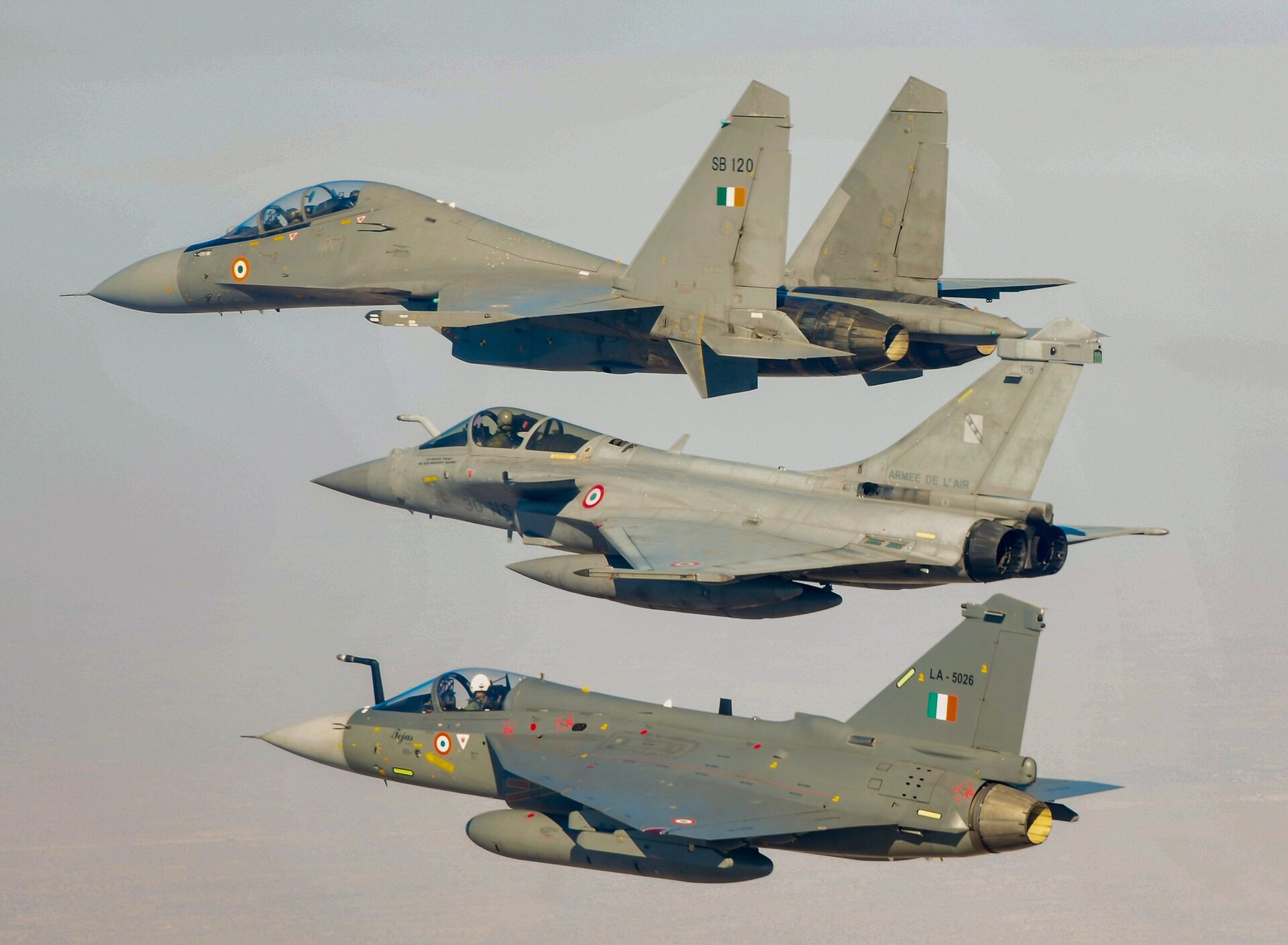
On 1 October 2026, India’s Defence Secretary said something the Indian Air Force has waited years to hear: the deal for 114 more Rafale fighters should be wrapped up before the end of the year. If it happens, it will be the largest fighter purchase in India’s history, worth an estimated $35 to $40 billion. It would also be an admission that the IAF cannot wait for home-grown jets to fill its empty squadrons.
In this article
How we got here
The story starts in 2018, when the IAF asked the world’s fighter makers for proposals for 114 Multi-Role Fighter Aircraft (MRFA). Almost every Western and Russian manufacturer was in the frame, from the Eurofighter Typhoon and Saab Gripen to the F-15EX and Su-35. Over the years, the field effectively narrowed to one: the Dassault Rafale, a jet the IAF already flies and the Navy has now ordered in its carrier version.
In February 2026, the Defence Acquisition Council cleared the need for the aircraft, according to reports, and a formal Letter of Request went to France in May. Bids are now under evaluation. Earlier hopes of signing during President Macron’s visit in February came and went.
What India would get
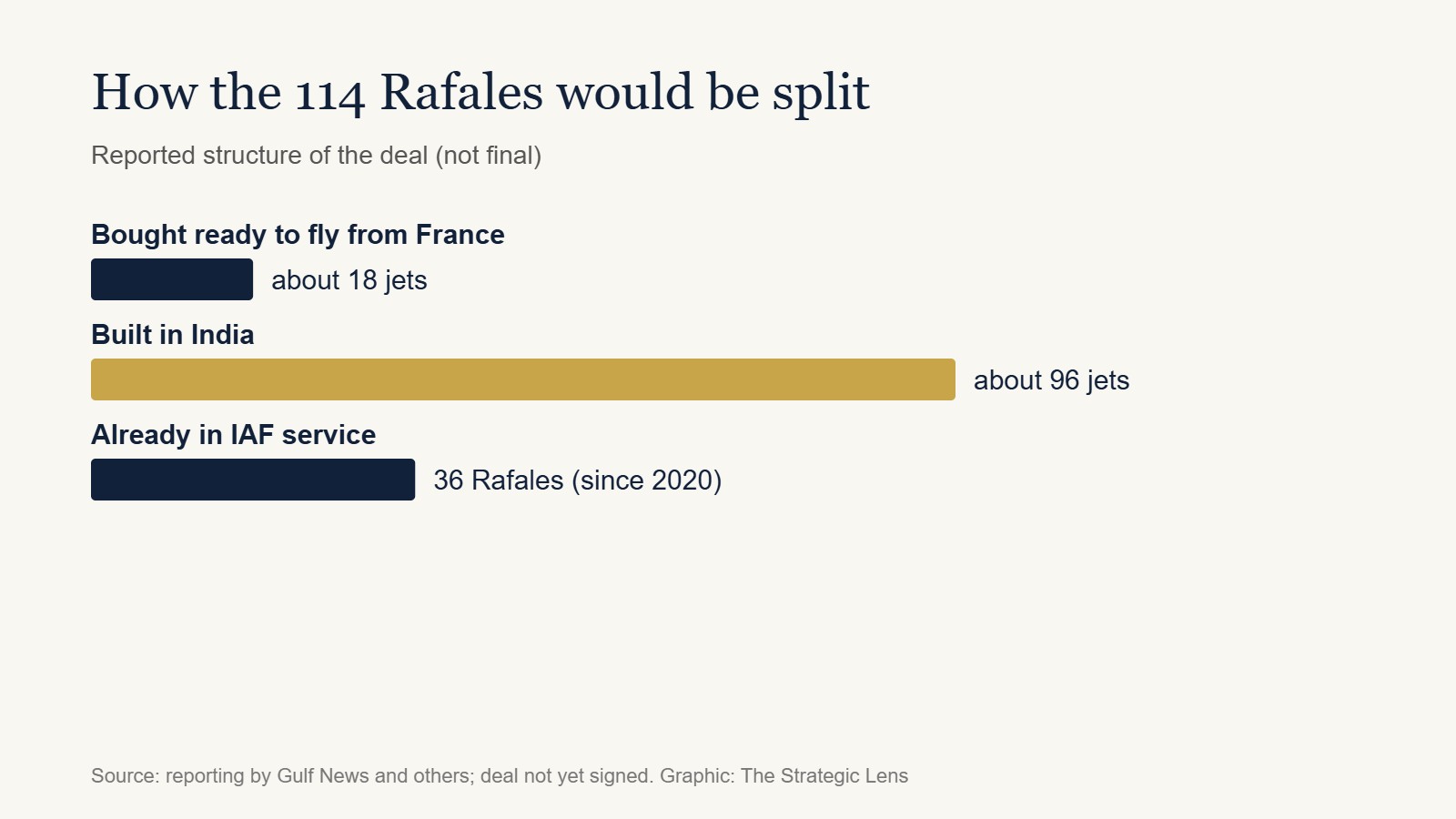
The deal is being structured as “buy and make”. Reports suggest around 18 jets would come ready to fly from France, with the remaining 96 or so assembled in India, creating a second fighter production line alongside HAL. Dassault already has agreements with Tata Advanced Systems to build Rafale fuselage sections in Hyderabad, though it has not been officially confirmed who would assemble the Indian-built jets.
Crucially, the Defence Secretary said Dassault has agreed to integrate Indian weapons on the aircraft, including on the Navy’s Rafale M. That would let the IAF arm its Rafales with home-grown missiles rather than relying only on expensive French ones.
The sticking points
- Timing. The Defence Secretary’s words were “before the end of this year”, which some outlets read as the end of the financial year in March 2027. Either way, the final cost still has to be negotiated.
- Source code. French business media have reported that India wants access to the software of the Rafale’s radar, mission computer and electronic-warfare suite, and that France has offered controlled interfaces instead. Neither government has commented publicly.
- Cost. Estimates of $35–40 billion are pre-negotiation figures. Local manufacturing and weapons integration will push the final number one way or the other.
The Rafale deal is not just about a jet. It is about buying time.
Why the IAF needs it now
The IAF is sanctioned to have 42 fighter squadrons. It has been well below that number for years, and the gap widened when the last MiG-21s were retired in 2025. Reports put the current figure at around 29 squadrons. The home-grown Tejas Mk1A has been delayed by engine supply problems, the larger Tejas Mk2 is not expected to fly until mid-2027, and the fifth-generation AMCA is a 2030s programme, as we explain in our AMCA explainer.
The 36 Rafales India bought in 2016 have been heavily used since their arrival in 2020, including in the May 2025 clashes with Pakistan. Buying more of a jet the IAF already knows reduces training and maintenance costs and gets combat power into squadrons faster than any alternative.
The critics’ case
Not everyone is convinced. Critics argue that spending tens of billions on a foreign 4.5-generation fighter could squeeze funding for AMCA and Tejas, and that India risks repeating its long dependence on imported platforms. The Defence Secretary’s answer is that India is putting all its eggs in the AMCA basket for the long term, and the Rafale is the bridge to get there.
Our take
The 114-Rafale deal is the right answer to a problem India should never have let get this bad. The real test is whether it comes with genuine local manufacturing and weapons integration, and whether the money is protected for AMCA. If both happen, India gets a stronger air force now and a home-grown one later. If not, it will have bought itself another decade of dependence.
Frequently asked questions
What is India’s MRFA deal?
The Multi-Role Fighter Aircraft programme aims to buy 114 fighters for the Indian Air Force. The Dassault Rafale is now the chosen aircraft, with most jets to be built in India.
When will the 114 Rafale deal be signed?
India’s Defence Secretary said in October 2026 that it should be concluded before the end of the year; some reports interpret this as the end of the financial year in March 2027.
How many squadrons does the Indian Air Force have?
The IAF is sanctioned for 42 fighter squadrons but is reported to have around 29 after retiring its MiG-21s in 2025.
More from Strategic Lens Defence: Air Force · Defence Industry & Deals
Sources and further reading
This is original analysis by Strategic Lens Defence. Key facts were cross-checked across multiple independent sources; where reports disagree or rest on a single source, we say so in the text. All wording and graphics are our own.
- ANI — 114 Rafale deal likely to be completed by year-end: Defence Secretary (1 Oct 2026)
- Business Today — India eyes closing 114 Rafale deal by financial year end (2 Oct 2026)
- MiGFlug — Rafale source code dispute (Aug 2026)
- MiGFlug — 114 Rafale deal: India expects decision by year-end
- Gulf News — $39b deal for 114 Rafale jets nears clearance (Feb 2026)
- Wikimedia Commons — photo: Exercise Garuda IAF Su-30 MKI, French Rafale, IAF Tejas (GODL-India)


Leave a Reply