
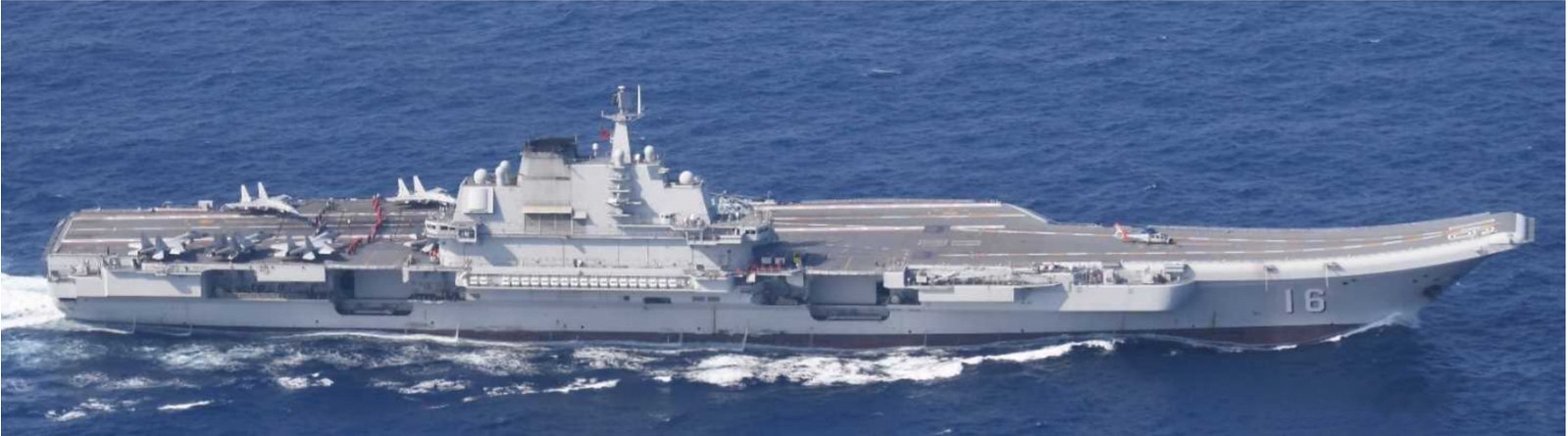
Fifteen years ago, China did not have a single working aircraft carrier. It had a rusting, engineless Soviet hull bought from Ukraine and towed to Dalian. Today it operates three carriers, the newest of which launches jets with electromagnetic catapults, a technology only the US Navy had fielded before. A fourth, almost certainly nuclear-powered, is taking shape in a shipyard.
In this article
Here is how China got here, what its carriers can and cannot do, and why it matters for the Indian Ocean.
From Liaoning to Fujian
China’s first two carriers, Liaoning and Shandong, use a ski-jump ramp at the bow. Jets take off under their own power, which limits how much fuel and weaponry they can carry. Liaoning was built from that old Soviet hull; Shandong, commissioned in December 2019, was China’s first home-built carrier.
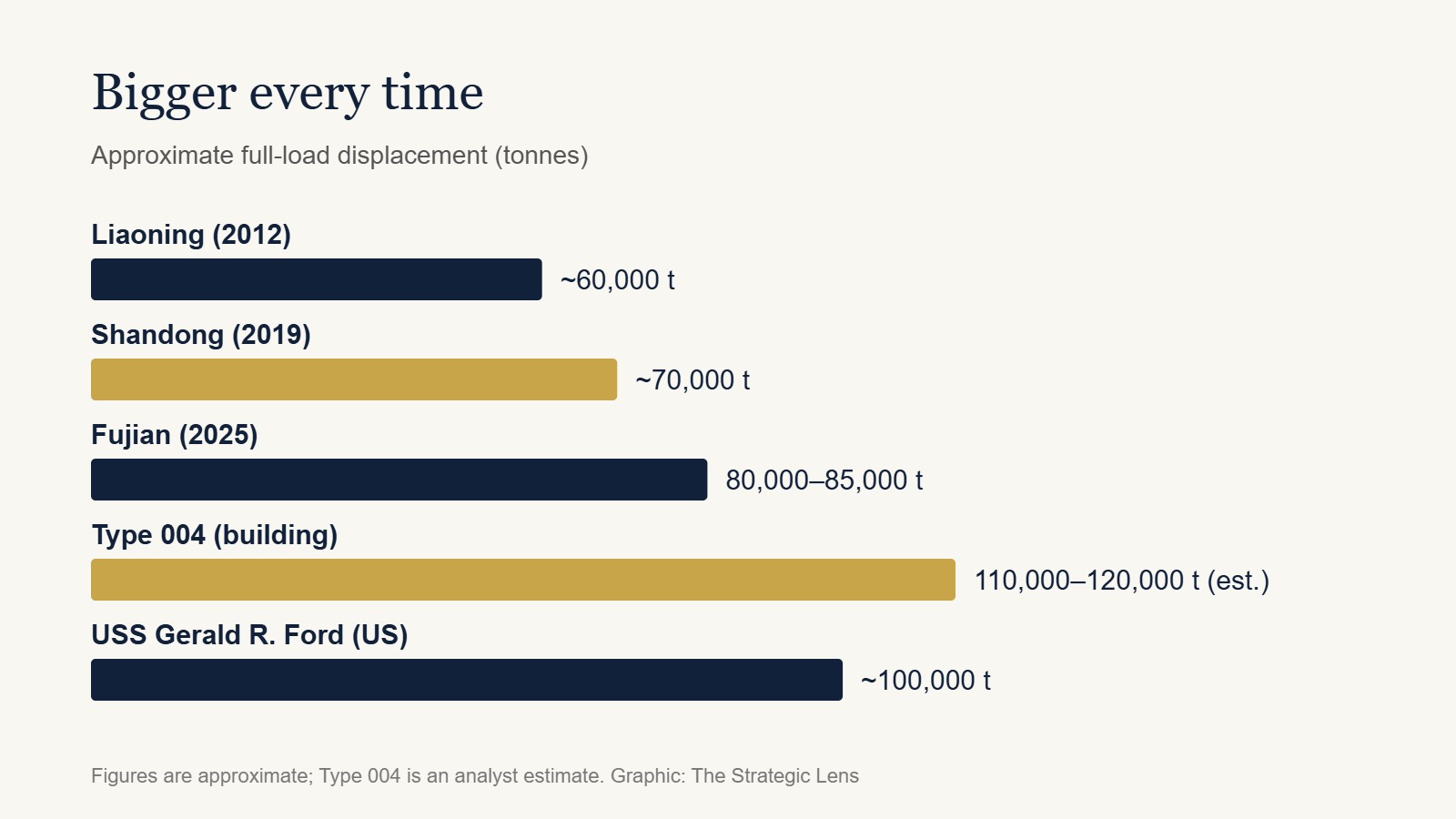
Fujian is a different animal. Launched at Shanghai’s Jiangnan shipyard in June 2022 and commissioned on 5 November 2025 at a naval base on Hainan Island, with Xi Jinping in attendance, it is about 316 metres long and displaces an estimated 80,000 tonnes or more. Its three electromagnetic catapults can fling heavier aircraft into the air with more fuel and weapons. In September 2025, state media showed J-15T fighters, the new J-35 stealth fighter and the KJ-600 airborne early warning aircraft all launching from its deck.
The Type 004: going nuclear
At Dalian shipyard, construction of a fourth carrier, usually called the Type 004, has been under way since at least 2024. Satellite imagery from August 2026 shows a hull already around 320 metres long. Analysts have spotted what appear to be twin reactor containment structures, which would make it China’s first nuclear-powered carrier, though Beijing has not confirmed this. Estimates put its size at 110,000 to 120,000 tonnes, potentially larger than the US Navy’s newest carriers. No launch date has been announced.
Nuclear power matters because it gives a carrier near-unlimited range and frees up space and energy for catapults, radars and future weapons. It is what lets American carriers sail anywhere in the world for months at a time.
The Type 004 would be the clearest sign yet that China wants a navy that can operate far from home.
Not as good as it looks, yet
Fujian’s progress has not been flawless. A Chinese military journal, as reported by the South China Morning Post, pointed to design problems: the island superstructure sits in a way that eats into usable deck space, and one catapult overlaps the landing area, so it cannot be used while jets are recovering. One outside estimate puts Fujian’s sortie rate at around 60% of a US Nimitz-class carrier. These are second-hand claims, but they fit a familiar pattern: first-of-class ships are learning platforms.
Operational experience is the other gap. US carrier crews have a century of deck-handling know-how. Fujian has made transits of the Taiwan Strait but, by public accounts, had not yet carried out a full operational deployment by late 2026. Chinese state media have said it would reach full readiness during 2026.
Why it matters for India
According to a December 2025 Pentagon report, China’s navy aims to have nine carriers by 2035. Even a fraction of that fleet operating in the Indian Ocean would change the balance there. India operates two carriers, INS Vikramaditya and INS Vikrant, both ski-jump designs, and is only now replacing its MiG-29K fighters with the Rafale M. A Chinese carrier group with catapult-launched stealth fighters and airborne early warning aircraft would outclass either of them on paper.
India’s advantages are geography, land-based air power along its long coastline, and partnerships with navies like the US, France, Japan and Australia. But the debate over whether India needs a third, larger carrier will only get louder as the Type 004 grows.
Our take
China’s carrier programme is not about matching the US Navy ship for ship by 2030. It is about steadily building the skills, aircraft and industrial base to project power far beyond its shores. Fujian proves it can build the hardware. The next decade will show whether it can master the much harder craft of using it.
Frequently asked questions
How many aircraft carriers does China have?
China operates three carriers: Liaoning, Shandong and Fujian. A fourth, the Type 004, is under construction and is widely believed to be nuclear-powered.
What makes Fujian different from China’s earlier carriers?
Fujian uses electromagnetic catapults instead of a ski-jump, allowing heavier aircraft such as the J-35 stealth fighter and KJ-600 early warning aircraft to launch with more fuel and weapons.
Is the Type 004 nuclear-powered?
Satellite imagery suggests reactor containment structures, and most analysts believe it is nuclear-powered, but China has not officially confirmed it.
More from Strategic Lens Defence: Navy · Geopolitics
Sources and further reading
This is original analysis by Strategic Lens Defence. Key facts were cross-checked across multiple independent sources; where reports disagree or rest on a single source, we say so in the text. All wording and graphics are our own.
- Breaking Defense — China commissions first catapult-equipped aircraft carrier (Nov 2025)
- The War Zone — China’s next aircraft carrier is taking shape (Aug 2026)
- Interesting Engineering — Fujian’s flaws push China towards nuclear carrier (Jan 2026)
- Wikipedia — Chinese aircraft carrier Fujian
- Wikipedia — Type 004 aircraft carrier
- Wikipedia — Chinese aircraft carrier programme
- Wikimedia Commons — photo: PLANS Liaoning (CV-16) 20210427 (CC BY 4.0)


Leave a Reply