
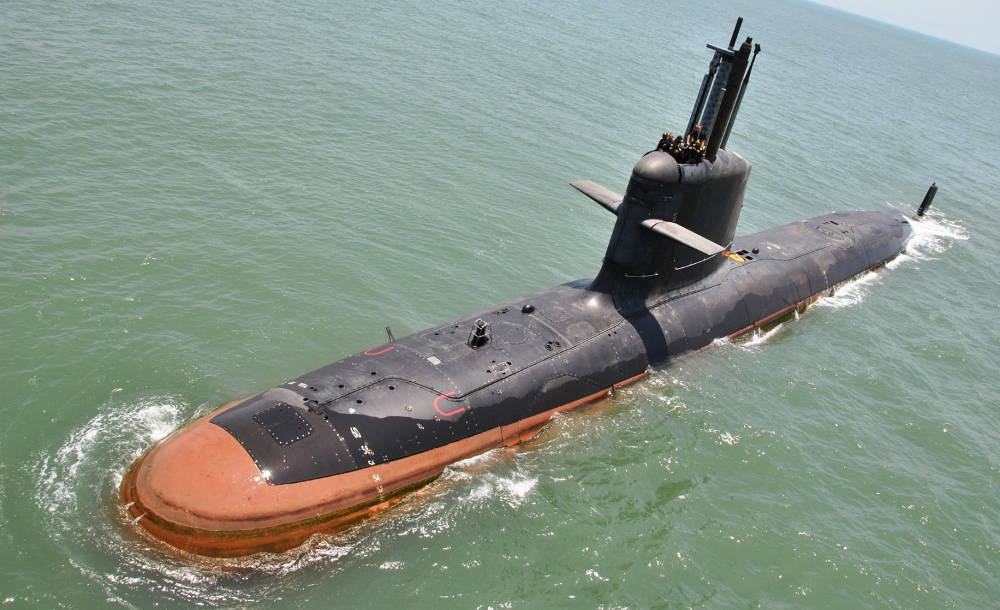
A conventional submarine has one big weakness. Every few days it has to come close to the surface and run its diesel engines to recharge its batteries. That is the moment it is most likely to be spotted. India’s Project 75(I) is meant to fix that problem for the Indian Navy. It has been in the works for well over a decade, and as of late 2026 it is still waiting for a final signature.
In this article
What Project 75(I) is
The project calls for six new diesel-electric attack submarines, built in India at Mazagon Dock Shipbuilders (MDL) in Mumbai with design and technology from Germany’s TKMS. The boats are based on TKMS’s Type 214 family, enlarged for Indian requirements, and the key feature is air-independent propulsion, or AIP.
AIP lets a submarine generate power underwater without surfacing. TKMS uses fuel cells, which are very quiet. Instead of coming up every couple of days, an AIP boat can stay submerged for a couple of weeks. For a navy trying to track Chinese submarines and warships in the Indian Ocean, that endurance and stealth are exactly what is needed.
Why it has taken so long
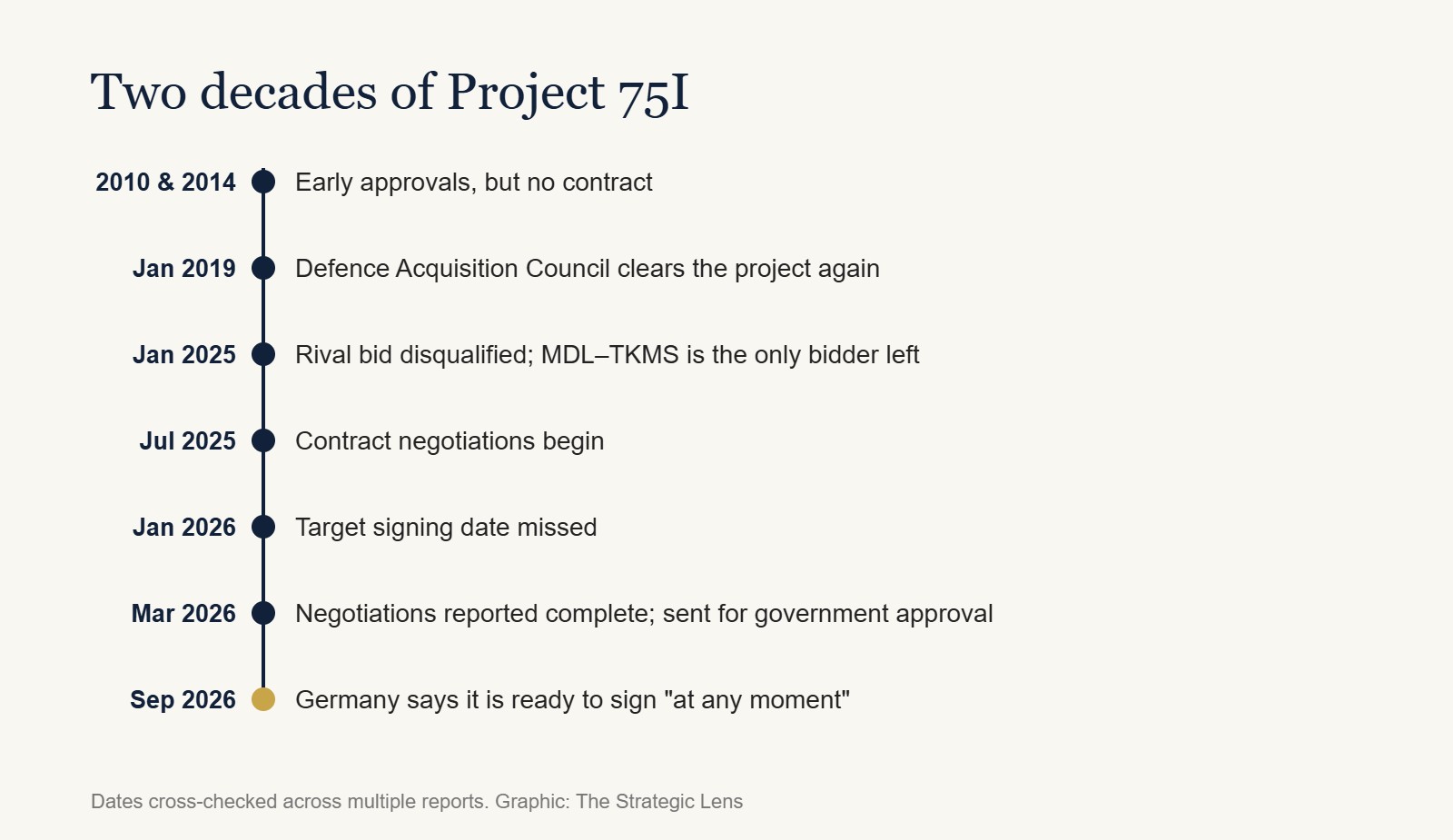
Approvals in 2010 and 2014 did not lead to a contract. The Defence Acquisition Council cleared the project again in 2019, and a long competition followed. In January 2025, the rival bid from L&T and Spain’s Navantia was disqualified, partly over the Navy’s insistence on a proven, operational AIP system. That left MDL and TKMS as the only bidders.
Negotiations began in mid-2025, with signing targeted for January 2026. That date slipped. In March 2026, MDL reported that contract talks were complete and the proposal had gone to the government for approval. In September, Germany said its paperwork was finalised and it could sign at any moment; the hold-up is India’s own internal approval process.
What will it cost?
Nobody has published a final figure. Reported estimates range from around ₹70,000 crore to nearly ₹1 lakh crore for six boats, depending on the source and on what is included. Earlier estimates were much lower, which tells its own story about the cost of delay. Indigenous content is reported to start at about 45% on the first boat and rise towards 60% by the sixth.
Every year of delay is a year when the Navy’s older submarines get older and the Indian Ocean gets more crowded.
The gap it is meant to fill
India’s current front-line conventional submarines are the six Kalvari-class boats, built at MDL with France’s Naval Group and commissioned between 2017 and January 2025. They are capable, but they do not yet have AIP; the first retrofit, on INS Khanderi, is scheduled to start around now. The rest of the fleet includes older Russian- and German-designed boats that are reaching the end of their lives.
India is also working on longer-term projects: Project 76, a fully indigenous conventional submarine designed by DRDO, and Project 77, a plan for nuclear-powered attack submarines, the first two of which were cleared by the Cabinet Committee on Security in October 2024. But both are years away. Project 75(I) is the bridge.
The bigger picture
China’s navy now regularly sends submarines and research vessels into the Indian Ocean, and Pakistan is adding Chinese-designed submarines to its own fleet. Undersea warfare is where India’s maritime advantage could erode fastest, because submarines are hard to find and slow to build. A navy that waits too long to replace its boats cannot catch up quickly.
Our take
The engineering choice has been made, the partner is chosen and the price has been negotiated. What remains is a political signature. Each month of delay pushes the first boat’s delivery further into the 2030s. If India is serious about the Indian Ocean, Project 75(I) should be signed, and then protected from the kind of drift that has cost it the last fifteen years.
Frequently asked questions
What is Project 75I?
Project 75(I) is India’s plan to build six advanced diesel-electric submarines with air-independent propulsion at Mazagon Dock in partnership with Germany’s TKMS.
Why is AIP important for submarines?
Air-independent propulsion lets a conventional submarine stay submerged for weeks instead of days, making it far harder to detect.
Has the Project 75I contract been signed?
As of late 2026, negotiations were reported complete and Germany said it was ready to sign, but the deal was still awaiting final Indian government approval.
More from Strategic Lens Defence: Navy · Defence Industry & Deals
Sources and further reading
This is original analysis by Strategic Lens Defence. Key facts were cross-checked across multiple independent sources; where reports disagree or rest on a single source, we say so in the text. All wording and graphics are our own.
- The Week — Germany ready to sign Project 75(I) submarine deal with India (23 Sep 2026)
- IDRW — Mazagon Dock confirms progress on Project-75I (Mar 2026)
- Wikipedia — TKMS
- Wikipedia — Kalvari-class submarine (2015)
- Wikipedia — Project 76 submarine
- Wikimedia Commons — photo: INS Kalvari Sea Trial (GODL-India)


Leave a Reply