
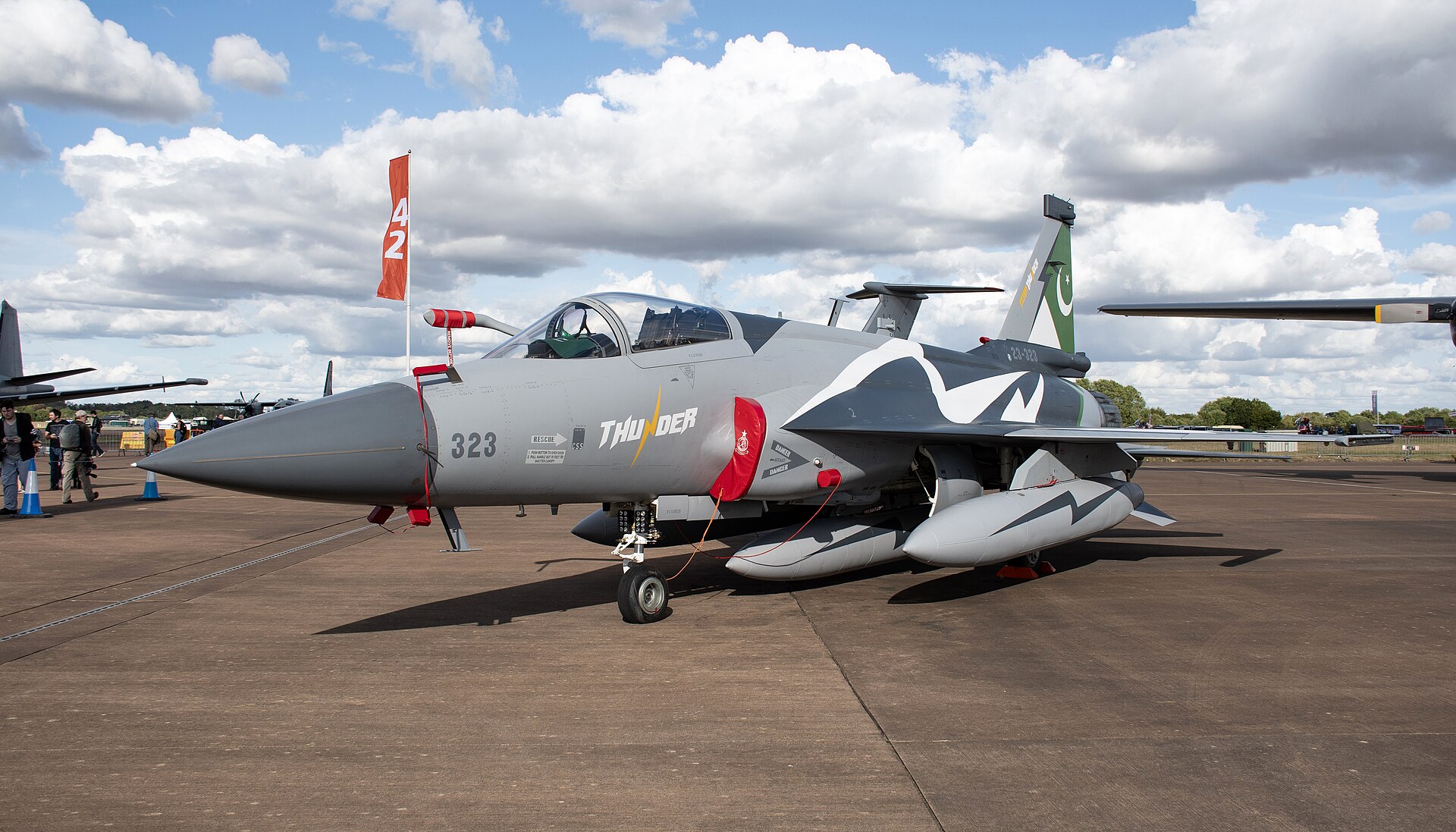
Pakistan cannot afford a large fleet of F-16s or Rafales, so it helped build a fighter of its own. The JF-17 Thunder, developed with China’s Chengdu Aircraft Corporation, now makes up the biggest share of the Pakistan Air Force’s combat fleet, has flown in two rounds of fighting with India, and sits at the centre of an unusually aggressive export campaign. Here is what the jet is, what it can and cannot do, and why India should be paying attention.
In this article
Origins: a fighter Pakistan could afford
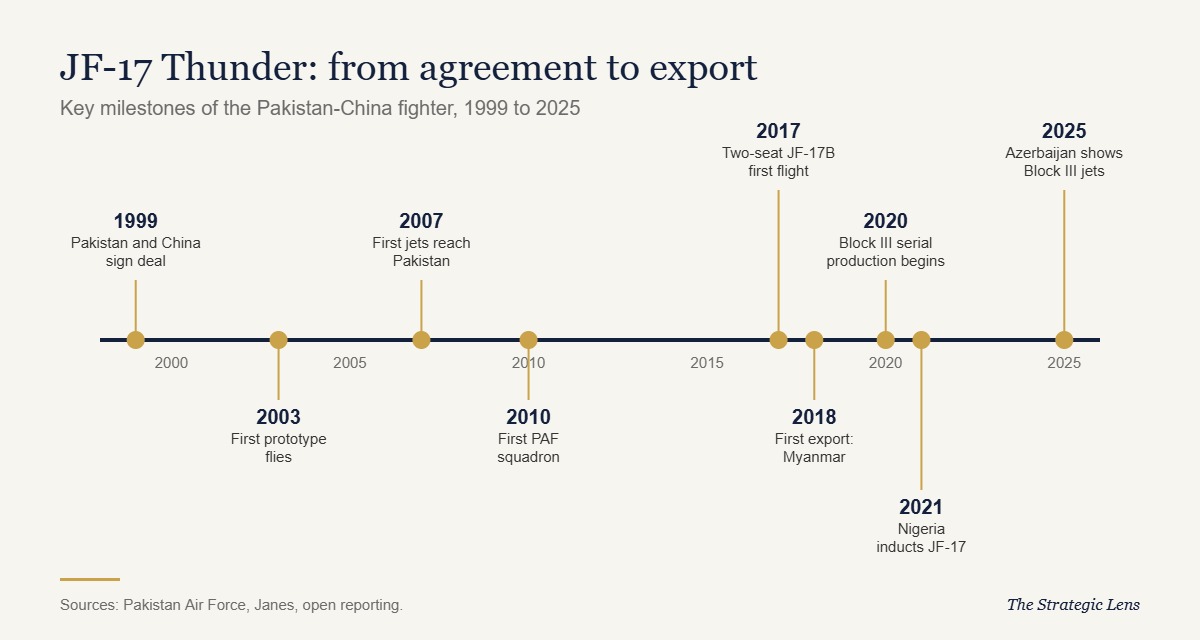
The programme was born out of necessity. In the 1990s, US sanctions cut Pakistan off from new F-16s just as its large fleet of ageing Mirages and Chinese-built F-7s and A-5s was heading for retirement. Pakistan needed a lot of fighters cheaply, and China was willing to help. The two countries signed an agreement in 1999 to develop a light, single-engine multirole jet, known in China as the FC-1 Xiaolong.
A prototype flew in 2003, the first aircraft reached Pakistan in 2007, and the first PAF squadron formed in 2010. By fighter standards the development bill was small, reportedly around $500 million shared between the two countries. Final assembly takes place at the Pakistan Aeronautical Complex in Kamra, which builds the larger part of the airframe; China supplies the rest along with most of the avionics and weapons.
From Block I to Block III
The JF-17 has been upgraded in steps, and the differences between versions matter more than the name suggests.
| Version | What changed | Status |
|---|---|---|
| Block I | Basic multirole fighter with a Chinese KLJ-7 radar and SD-10 beyond-visual-range missiles | In service; the oldest jets in the fleet |
| Block II | Air-to-air refuelling probe, improved avionics and data link | In service |
| JF-17B | Two-seat version for training and combat; first flew in 2017 | In service |
| Block III | AESA radar, helmet-mounted display, new glass cockpit and the long-range PL-15 missile; serial production from December 2020 | In service with Pakistan; exported to Azerbaijan |
Block III is the version that changes the conversation. An AESA radar paired with a missile in the PL-15’s class gives even a small, inexpensive jet the ability to threaten opponents at long range. It still has limits: as a light single-engine fighter, it carries less, flies shorter distances and has less room for future growth than heavier jets such as the Su-30MKI or the Rafale.
The JF-17 is not a great fighter, and it was never meant to be. It was meant to be affordable, upgradeable and Pakistan’s own.
The Russian engine problem
Every JF-17 flies on a Russian engine, the Klimov RD-93, a derivative of the engine used in the MiG-29. Block III is reported to use the improved RD-93MA. That leaves a Pakistani-Chinese fighter dependent on Moscow for its most important component, something India has long objected to. China’s own WS-13 was meant to replace the Russian engine but has not become the standard fit.
The issue resurfaced in late 2025, when reports that Russia would keep supplying RD-93MA engines for Block III jets drew sharp questions in India about Moscow’s balancing act between the two neighbours. As long as the engine comes from Russia, the JF-17’s future depends partly on a third country’s politics.
Combat record and contested claims
The PAF has used the JF-17 against militants inside Pakistan and in cross-border strikes into Afghanistan and Iran in 2024. Myanmar and Nigeria have used theirs against insurgent groups. Against India, Pakistan says JF-17s took part in its response after the Balakot strike in February 2019 and in the May 2025 clashes that followed India’s Operation Sindoor.
The most famous claim is also the most disputed. Pakistan said a JF-17 destroyed an Indian S-400 air-defence system at Adampur in May 2025. India rejected this, and days later Prime Minister Narendra Modi visited Adampur with an S-400 launcher visible behind him. No independent evidence has supported Pakistan’s version. Even so, Pakistan now markets the jet abroad as “combat proven”, and for many buyers the label matters more than the details.
The export push
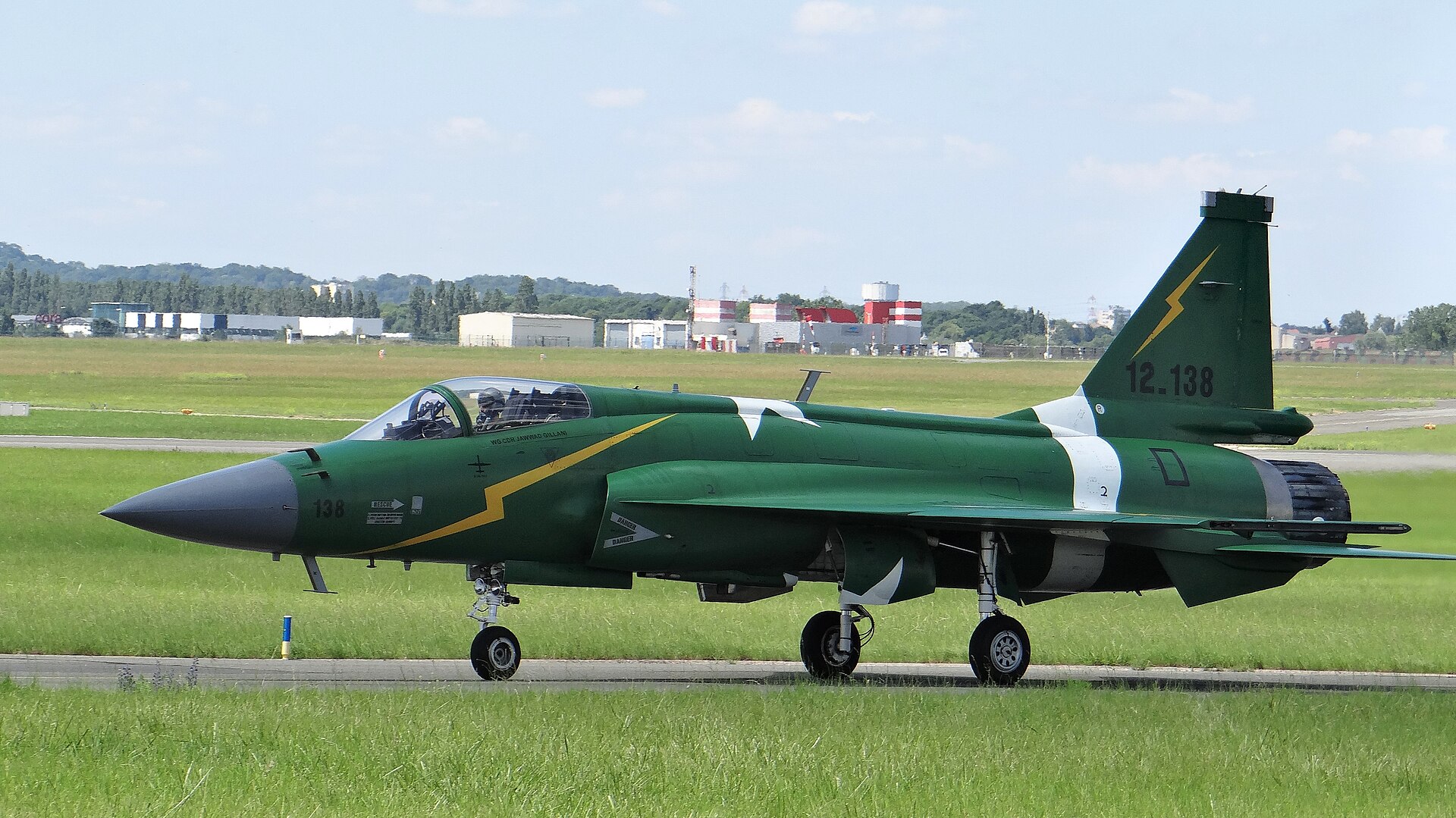
Pakistan’s sales pitch is simple: a capable-enough fighter with Chinese weapons, at a fraction of Western prices and without American political conditions. One estimate put a Block II at around $25 million, far below a new F-16 or Rafale.
- Myanmar: the first export customer, receiving jets from 2018. Its fleet has reportedly suffered from technical problems.
- Nigeria: inducted its first JF-17s in 2021 and has used them against insurgents.
- Azerbaijan: the biggest deal so far. Pakistan announced in 2025 that Azerbaijan would buy up to 40 Block III jets, in a deal widely reported at about $4.6 billion, and the first jets were shown publicly later that year.
Beyond those, the list of reported talks is long. In January 2026, Reuters reported discussions with Saudi Arabia, reportedly linked to converting Saudi loans to Pakistan, and with Indonesia for around 40 jets, although Indonesia’s defence ministry said no decisions had been made. Iraq, Bangladesh and Libya have also been linked to the jet. None of these has been confirmed as a signed contract, and past rounds of JF-17 export talk have often come to nothing.
What it means for India
On its own, the JF-17 is not the most dangerous aircraft India faces. Pakistan’s F-16s and the Chinese J-10Cs it began receiving in 2022 are more capable. But the JF-17 matters to India in four ways.
- Numbers. It is the jet Pakistan can afford to keep buying, which lets the PAF hold its squadron strength as older Mirages and F-7s retire. India, by contrast, has struggled to keep its own squadron numbers up.
- Weapons. With the PL-15, even a cheap fighter can threaten Indian aircraft from long range, one of the clearest lessons of May 2025.
- Influence. Each export, especially to Azerbaijan, a rival of Armenia, which has become a major buyer of Indian weapons, extends the Pakistan-China defence partnership into regions where India competes.
- Competition. The JF-17 is the most direct rival to India’s own light fighter, the Tejas, in the export market, and so far it has found more foreign buyers.
Our take
The JF-17’s real achievement is industrial rather than technical. A country with a modest economy has built a fighter it can upgrade, maintain and sell. Block III and the PL-15 have closed much of the gap with mid-range Western jets, and if even part of the reported export pipeline turns into signed contracts, Kamra becomes a genuine player in the budget-fighter market. The weak points are the Russian engine and the gap between export talk and export orders. The test for 2026 is simple: watch which of the rumoured deals actually get signed.
Frequently asked questions
Is the JF-17 a Chinese or a Pakistani jet?
Both. It was developed jointly by the Pakistan Aeronautical Complex and China’s Chengdu Aircraft Corporation. Final assembly and the larger part of the airframe are done in Pakistan, while China supplies much of the avionics and weaponry.
Which countries fly the JF-17?
Pakistan, Myanmar, Nigeria and Azerbaijan. Several others, including Saudi Arabia, Indonesia and Iraq, have been reported to be in talks, but no further contracts have been publicly confirmed.
How does the JF-17 compare with India’s Tejas?
They are similar in size and role: light, single-engine multirole fighters. The JF-17 Block III and the Tejas Mk1A both carry AESA radars. The JF-17 has found more export customers, while the Tejas uses a more modern delta-wing design with extensive composites.
More from Strategic Lens Defence: The World’s Top Fighter Jets Compared · India’s Defence Exports · Air Force · Defence Industry & Deals
Sources and further reading
This is original analysis by Strategic Lens Defence. Key facts were cross-checked across multiple independent sources; where reports disagree or rest on a single source, we say so in the text. All wording and graphics are our own. Photographs are used under their Creative Commons licences and credited in each caption.
- The War Zone — JF-17 Thunder fighter to be offered to Saudi Arabia: report (8 Jan 2026)
- Reuters via Malay Mail — Pakistan and Indonesia closing in on jets and drones deal (13 Jan 2026)
- Janes — Azerbaijan confirms JF-17 delivery
- The Defense Post — Azerbaijan orders more JF-17 fighters from Pakistan (9 Jun 2025)
- The Week — Russian RD-93MA engines for JF-17 Block III (6 Oct 2025)
- Business Today — PM Modi’s Adampur visit and the S-400 claim (13 May 2025)
- Wikimedia Commons — JF-17 Block III photo by TunaFish Spotting (CC BY-SA 4.0)
- Wikimedia Commons — JF-17 at the 2019 Paris Air Show, photo by Ibex73 (CC BY-SA 4.0)


Leave a Reply