
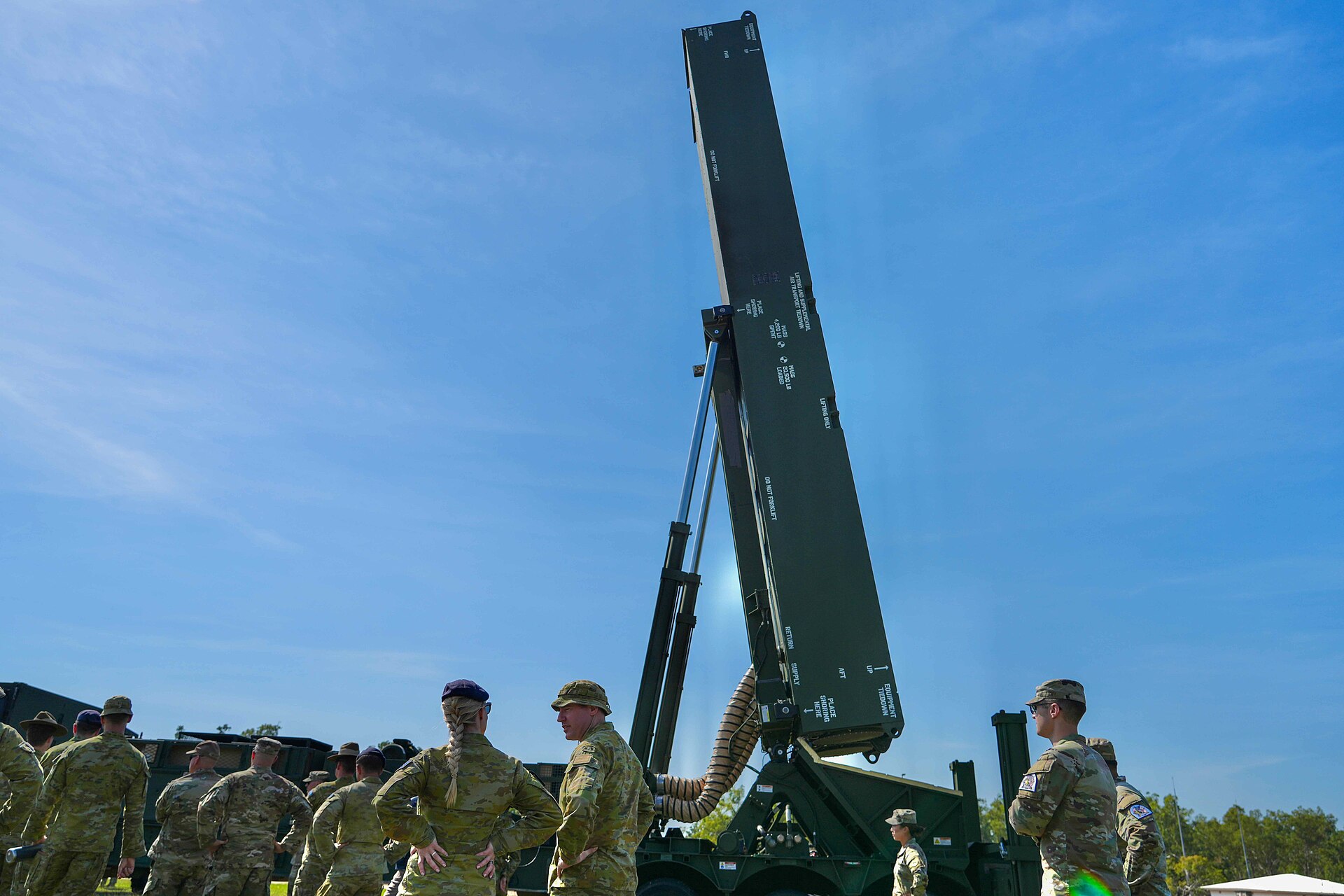
“Hypersonic” has become one of the most overused words in defence journalism. Russia calls several of its missiles hypersonic. China paraded them in 2019. The US has spent billions trying to catch up. And in 2026, India showed off its own. But what actually makes a missile hypersonic, who really has working ones, and are they as unstoppable as the headlines claim?
In this article
What “hypersonic” really means
Technically, hypersonic means faster than five times the speed of sound, or Mach 5. But that alone is not special: ordinary ballistic missiles have flown faster than Mach 5 since the 1950s. What sets modern hypersonic weapons apart is that they travel at those speeds inside the atmosphere while manoeuvring, which makes their path hard to predict.
There are two main types:
- Hypersonic glide vehicles (HGVs) ride a rocket to high altitude, then separate and glide towards the target, steering as they go.
- Hypersonic cruise missiles use air-breathing scramjet engines to keep powered flight at hypersonic speeds.
Who has them
China
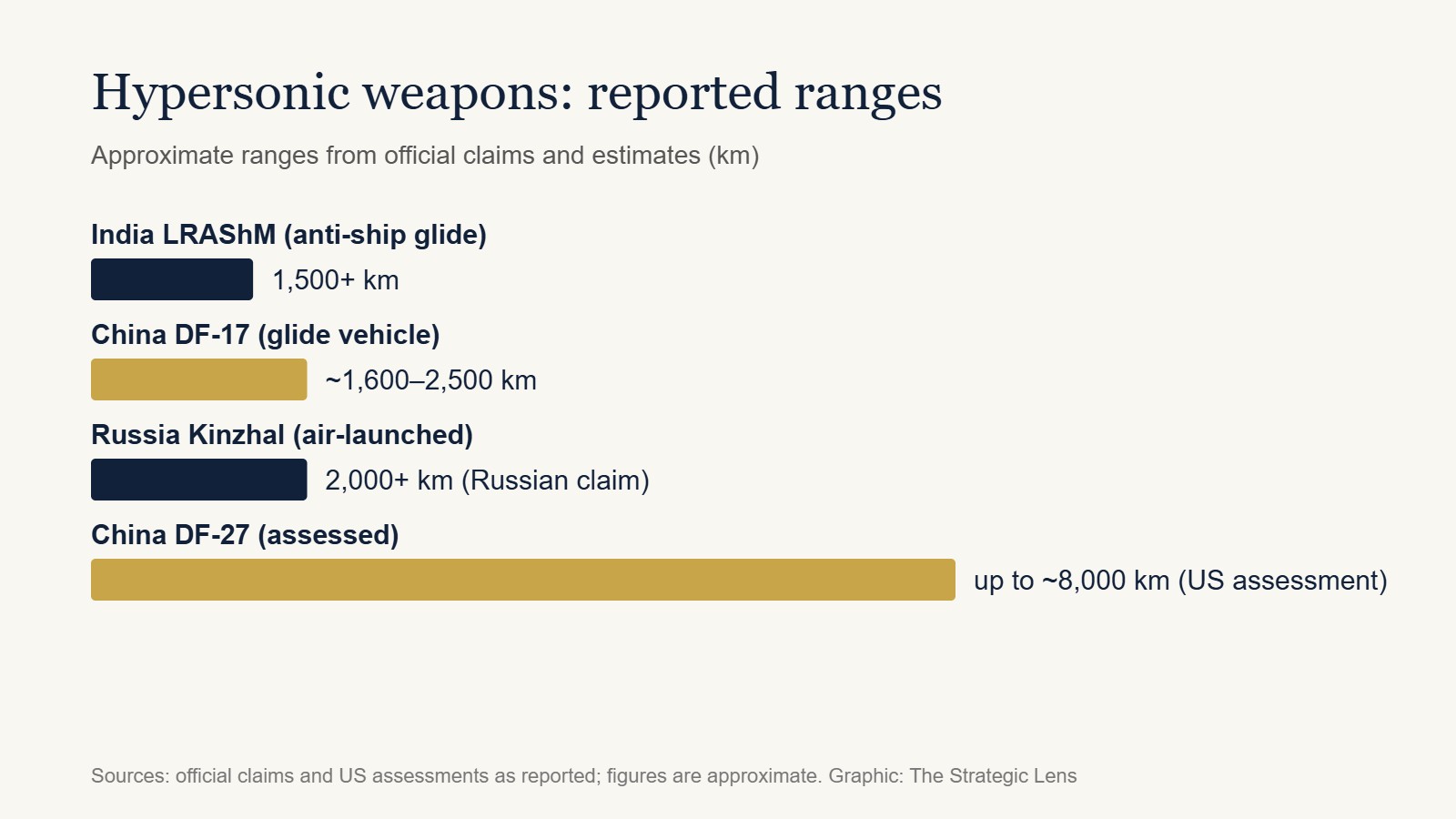
China is widely seen as the leader. Its DF-17, a road-mobile missile carrying the DF-ZF glide vehicle, was first shown publicly at the October 2019 National Day parade and is in service with the PLA Rocket Force. Its range is estimated at roughly 1,600 to 2,500 km, putting US bases in Japan and the Philippines within reach. The Pentagon assesses that the longer-range DF-27 may also carry a glide vehicle.
Russia
Russia has the most combat experience, though some of its “hypersonic” claims are disputed. The Avangard glide vehicle rides on an intercontinental missile. The air-launched Kinzhal has been used in Ukraine, as has the ship-launched Zircon, which some analysts believe flies a quasi-ballistic path rather than a true glide. The newer Oreshnik intermediate-range missile, used against Ukraine in November 2024 and again in 2026, is extremely fast, but experts disagree on whether it carries a glide vehicle at all.
United States
The US has tested its Long-Range Hypersonic Weapon, known as Dark Eagle, successfully in 2024, but as of late 2026 it still does not have an operational hypersonic weapon, according to Newsweek. Fielding has slipped repeatedly. The Air Force and Navy are pursuing other designs, and cost is a big issue: US auditors estimate around $70 million per hypersonic missile, compared with a few million for a Tomahawk cruise missile.
India
India’s DRDO has developed the Long-Range Anti-Ship Missile (LRAShM), a boost-glide weapon designed to hit warships more than 1,500 km away. It was tested in November 2024, displayed at the Republic Day parade in January 2026, and struck a simulated sea target at 1,500 km in a trial in May 2026. It is in limited production, with naval use intended. India has also tested scramjet technology through its Hypersonic Technology Demonstrator Vehicle.
Are they really unstoppable?
Not quite. Hypersonic weapons are hard to intercept because they fly low enough to hide from some radars, fast enough to compress reaction time, and manoeuvre enough to defeat systems that predict a fixed path. But Ukraine has reported shooting down Russian missiles described as hypersonic, and new interceptors are being designed specifically for the threat.
Their real limits are cost, accuracy and numbers. They are expensive, so they are fielded in small quantities. Some, like Oreshnik, are judged accurate enough for a nuclear warhead but not for precise conventional strikes. And intense heat during flight makes control and communication difficult.
Hypersonic weapons do not make defence impossible. They make it more expensive, and give defenders less time to think.
Why it matters for India
For India, the most important hypersonic threat is to its ships. Chinese anti-ship weapons could hold Indian carriers and destroyers at risk far from shore. India’s own LRAShM is the mirror image: a way to keep enemy fleets at a distance in the Indian Ocean. In a region where navies are growing fast, that kind of deterrent matters.
Our take
Hypersonic missiles are real, important and overhyped all at once. China leads, Russia has used them, the US is behind, and India has quietly built a credible anti-ship weapon. The race is less about who has the fastest missile and more about who can afford enough of them, and who can build the sensors and interceptors to stop the other side’s.
Frequently asked questions
What is a hypersonic missile?
A missile that flies faster than Mach 5 within the atmosphere while manoeuvring, either as a boost-glide vehicle or a scramjet-powered cruise missile.
Does India have hypersonic missiles?
Yes. DRDO’s Long-Range Anti-Ship Missile (LRAShM) is a hypersonic glide weapon with a range of over 1,500 km, tested in 2024 and 2026 and in limited production.
Can hypersonic missiles be shot down?
They are difficult but not impossible to intercept. Ukraine has reported shooting some down, and new interceptors are being developed for the threat.
More from Strategic Lens Defence: Missiles & Nuclear · Emerging Tech · Navy
Sources and further reading
This is original analysis by Strategic Lens Defence. Key facts were cross-checked across multiple independent sources; where reports disagree or rest on a single source, we say so in the text. All wording and graphics are our own.
- Newsweek — How US hypersonic programme compares to Russia and China (Oct 2026)
- Wikipedia — Hypersonic weapon
- Wikipedia — LRAShM (missile)
- Wikipedia — DF-17
- Wikipedia — Oreshnik (missile)
- Wikipedia — Dark Eagle (Long-Range Hypersonic Weapon)
- The National Interest — The industrial race behind hypersonic weapons
- Wikimedia Commons — photo: U S Army Showcases Long-Range Hypersonic Weapon During TS25 in Australia (9234499) (public domain)


Leave a Reply