
Few numbers in defence circles carry as much weight as 2027. It shows up in congressional hearings, Pentagon budget requests and think-tank war games as the year China might try to take Taiwan by force. In late October 2026, the commander of US Army Pacific said the “2027 window” still holds. Seven months earlier, America’s own intelligence agencies said Beijing has no current plan to invade that year.
In this article
Both statements are true at the same time. Understanding why tells you a lot about how militaries plan, and about what is really happening across the Taiwan Strait.
Where the 2027 date came from
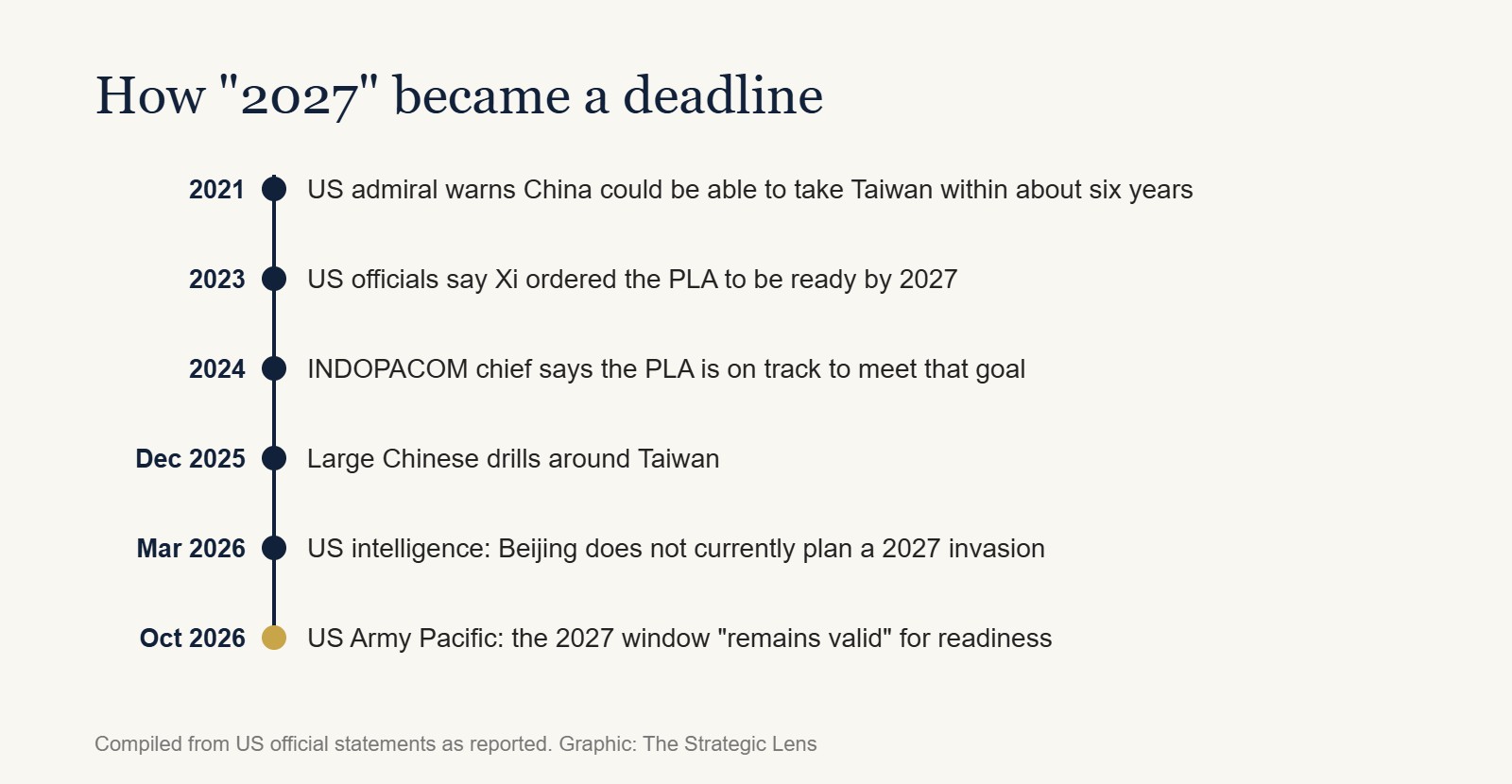
The date entered the public conversation in 2021, when Admiral Philip Davidson, then head of US Indo-Pacific Command, told a Senate committee that China could have the ability to invade Taiwan within about six years. Critics noted at the time that he was also making the case for more Pacific funding. Still, the idea stuck, and it was reinforced in 2023 when senior US officials said Chinese leader Xi Jinping had told his military to be ready by 2027. In 2024, the then INDOPACOM commander said all indications pointed to the People’s Liberation Army meeting that goal.
The key word is ready. The 2027 goal, as understood in Washington, is about capability: having the forces to attempt an invasion. It is not a decision to launch one.
What the US said in 2026
In March 2026, the US intelligence community’s annual threat assessment said Chinese leaders do not currently plan to invade Taiwan in 2027 and have no fixed timeline for unification. It said Beijing weighs the readiness of its own forces and the likelihood of American intervention, and still prefers to achieve its goals without a war.
Then, on 27 October in Honolulu, General Ronald Clark of US Army Pacific was asked whether the 2027 window was still valid. His answer was yes, but he was careful to explain what he meant. For his command, 2027 is a line in the sand for readiness, not a forecast of war. US Army Pacific is positioning equipment, supplies and soldiers along the first and second island chains under a plan it calls “Army Ready Forward”, and Clark stressed the need for cheap, mass-produced systems such as drones alongside high-end weapons.
2027 is less a prediction than a deadline the US has set for itself.
What China is actually doing
Beijing’s pressure on Taiwan has become constant rather than episodic. Large-scale drills now surround the island every few months, most recently in December 2025. Chinese aircraft and ships operate near Taiwan almost daily, and coast guard vessels increasingly patrol waters Taipei considers its own. This is coercion designed to wear Taiwan down and normalise Chinese presence, without crossing the line into war.
At the same time, Xi has carried out sweeping purges of senior military commanders in recent years, including leaders of the forces that would be central to any invasion. Some analysts read this as a sign the PLA is not yet trusted to fight a major war. Others see it as preparation: clearing out corruption before a test.
The case that 2027 is overhyped
- Capability is not intent. Having the ability to try does not mean choosing to try. An amphibious invasion across 160 km of rough water would be the riskiest military operation in decades.
- Beijing’s long-term goal is 2049, the centenary of the People’s Republic, which is the date US analysts associate with national “rejuvenation”.
- The current INDOPACOM chief has himself said the year carries less meaning than headlines suggest, while still urging readiness.
- Fixation on one year can make every month after 2027 feel like a reprieve, when the real risk is steady and long-term.
Why it matters for India and Asia
A war over Taiwan would be an economic earthquake. Taiwan makes most of the world’s most advanced chips, and the sea lanes around it carry a huge share of Asian trade. For India, it would mean disrupted supply chains, a shock to electronics and auto manufacturing, and a China that is either distracted or emboldened on the Himalayan frontier. That is why New Delhi watches every PLA drill around Taiwan as closely as it watches the Line of Actual Control.
Our take
2027 is best understood as a planning tool, not a prophecy. The US military uses it to force urgency on budgets and deployments. The real danger is not a single year, but a gradual tightening of pressure that could one day give Beijing an opening it judges too good to miss. Readiness, not dates, is what keeps that day away.
Frequently asked questions
Why is 2027 important for Taiwan?
US officials have said Xi Jinping ordered the PLA to be capable of invading Taiwan by 2027. It is a readiness goal, not a confirmed plan to attack.
Will China invade Taiwan in 2027?
US intelligence said in March 2026 that Chinese leaders do not currently plan to invade in 2027 and have no fixed timeline, though pressure on Taiwan continues to grow.
What is the US doing to prepare?
US Army Pacific is positioning equipment and forces along the first and second island chains and investing in drones and low-cost systems, aiming to be ready by 2027.
More from Strategic Lens Defence: Geopolitics · Conflicts & Flashpoints · Navy
Sources and further reading
This is original analysis by Strategic Lens Defence. Key facts were cross-checked across multiple independent sources; where reports disagree or rest on a single source, we say so in the text. All wording and graphics are our own.
- Breaking Defense — Taiwan 2027 conflict window remains valid, Army Pacific commander says (Oct 2026)
- Stars and Stripes — US Army Pacific plans for possibility of war over Taiwan (28 Oct 2026)
- Taipei Times — US Army outlines Pacific deployments (30 Oct 2026)
- USNI News — China not committed to 2027 Taiwan invasion, US intel report says (Mar 2026)
- SCMP — Is Beijing’s 2027 milestone now a US readiness deadline?
- Defense News — US Army long-range fires on the frontline with China (Oct 2026)
- Wikimedia Commons — photo: Han Kuang No.38 exercise 2022-07-26 02 (CC BY 2.0)


Leave a Reply