
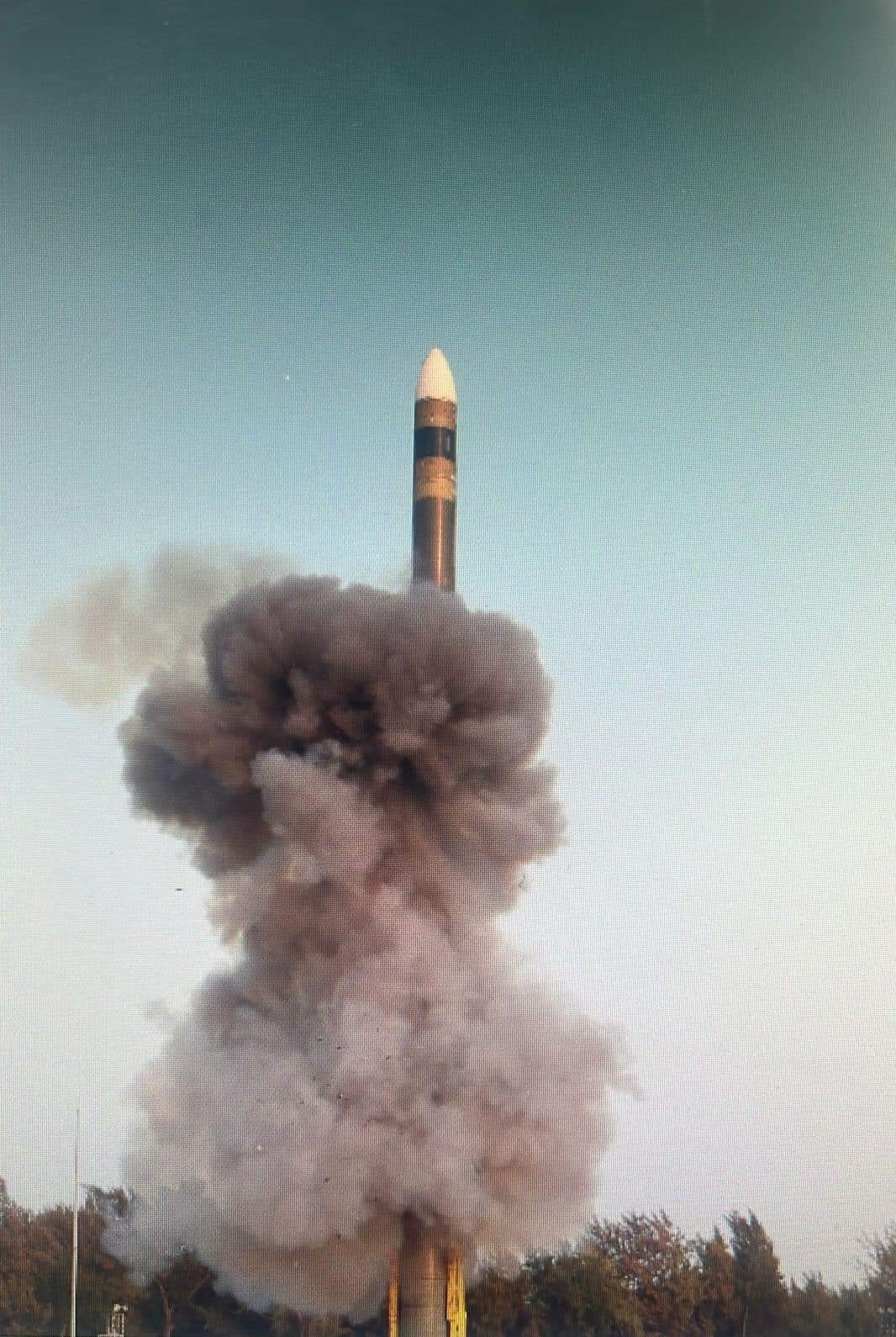
India’s nuclear deterrent rests on a simple promise: India will never use nuclear weapons first, but if it is attacked with them, the response will be devastating. Making that promise believable is the job of the Agni missiles and the land, air and sea forces that together form India’s nuclear triad.
2026 has been an unusually busy year for that deterrent. India tested a missile carrying multiple warheads for the second time, commissioned a third nuclear-armed submarine, and, according to SIPRI, appears to have placed some warheads on missiles in peacetime for the first time. This guide explains how it all fits together.
Quick answer: India’s nuclear triad is its ability to launch nuclear weapons from land (Agni ballistic missiles), air (fighter aircraft) and sea (Arihant-class submarines). The Agni family ranges from the 700 km Agni-I to the 5,000+ km Agni-V, which has been tested with multiple warheads. SIPRI estimated India held about 190 warheads in January 2026, under a No First Use doctrine.
India’s nuclear forces at a glance
| Warheads (SIPRI, Jan 2026) | About 190 (up from about 180 in 2025) |
| Doctrine | Credible minimum deterrence, No First Use, massive retaliation |
| Land leg | Agni-I, II, III, IV, V and Agni-Prime ballistic missiles |
| Longest range in service | Agni-V, 5,000+ km officially |
| MIRV tests | March 2024 (Mission Divyastra) and May 2026 |
| Sea leg | INS Arihant, INS Arighaat, INS Aridhaman (SSBNs) |
| Air leg | Fighter aircraft such as Mirage 2000 and Jaguar (open-source estimates) |
| Controlled by | Nuclear Command Authority; Strategic Forces Command operates the weapons |
In this article
- What is a nuclear triad, and why does India want one?
- India’s nuclear doctrine in plain language
- The Agni family, missile by missile
- Agni-V: India’s longest-range missile
- MIRV: one missile, many warheads
- Agni-Prime and the rail launcher
- Agni-VI: the missile that hasn’t been approved
- The sea leg: India’s nuclear submarines
- The air leg: fighters with nuclear roles
- What SIPRI’s 2026 report says
- How India compares with China and Pakistan
- Common misconceptions
- Our take
- Frequently asked questions
- Sources and further reading
What is a nuclear triad, and why does India want one?
A triad spreads nuclear weapons across three types of launcher so that no enemy can destroy them all in a surprise attack. Missiles on land can be hidden and moved. Aircraft can be dispersed and recalled. Submarines hiding deep in the ocean are the hardest of all to find.
For a country with a No First Use policy, this matters even more. India has promised not to strike first, so it must be sure its weapons will survive an enemy’s first strike and still be able to retaliate. That “assured second strike” is the core of Indian nuclear thinking.
India’s nuclear doctrine in plain language
India’s doctrine was drafted in 1999 and formally adopted on 4 January 2003. Its main points are:
- Credible minimum deterrence: enough weapons to deter, not an open-ended arms race.
- No First Use: nuclear weapons are used only in retaliation against a nuclear attack on Indian territory or Indian forces anywhere.
- Massive retaliation: the 2003 statement says retaliation to a first strike will be massive and designed to inflict unacceptable damage.
- Exception: India keeps the option of a nuclear response to a major attack with biological or chemical weapons.
- Non-nuclear states: no use against countries that do not have nuclear weapons.
- Civilian control: only the political leadership can authorise nuclear use.
The decision sits with the Nuclear Command Authority. Its Political Council, chaired by the Prime Minister, is the only body that can approve nuclear use. The weapons themselves are managed by the tri-service Strategic Forces Command, set up in 2003.
The Agni family, missile by missile
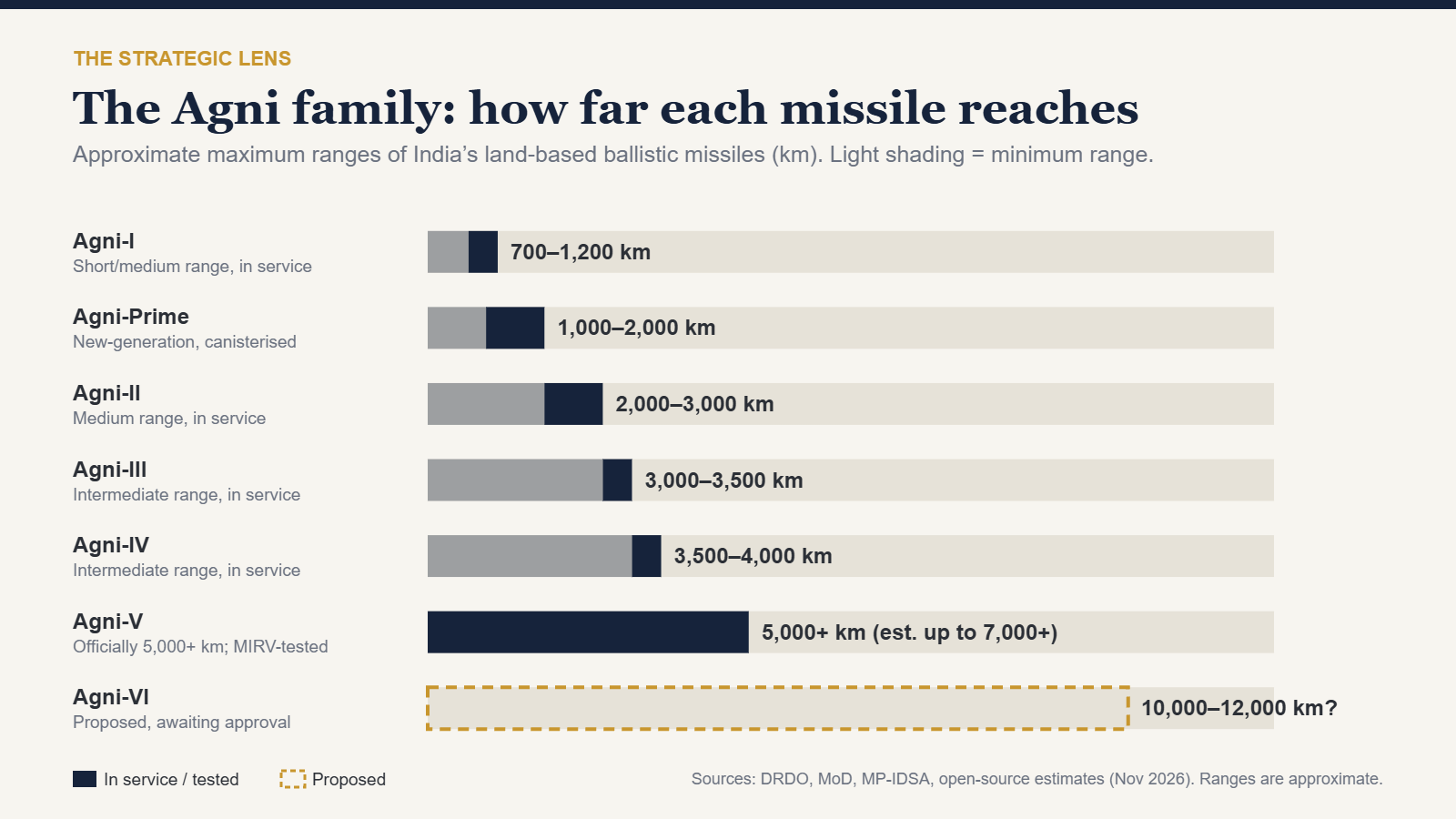
| Missile | Range (approx.) | Stages / fuel | Status |
|---|---|---|---|
| Agni-I | 700–1,200 km | 1, solid | In service; user test May 2026 |
| Agni-II | 2,000–3,000 km | 2, solid | In service |
| Agni-III | 3,000–3,500 km | 2, solid | In service |
| Agni-IV | 3,500–4,000 km | 2, solid | In service; tested August 2026 |
| Agni-V | 5,000+ km | 3, solid, canisterised | In service; MIRV-tested 2024 and 2026 |
| Agni-Prime | 1,000–2,000 km | 2, solid, canisterised | Road-mobile version inducted; rail launch 2025 |
| Agni-VI | 10,000–12,000 km (projected) | Reported 3–4, solid | Design ready; awaiting approval |
The early Agnis were built mainly with Pakistan in mind. The longer-range Agni-III, IV and V push coverage deep into China, which SIPRI says is now the main focus of India’s long-range development.
Agni-V: India’s longest-range missile
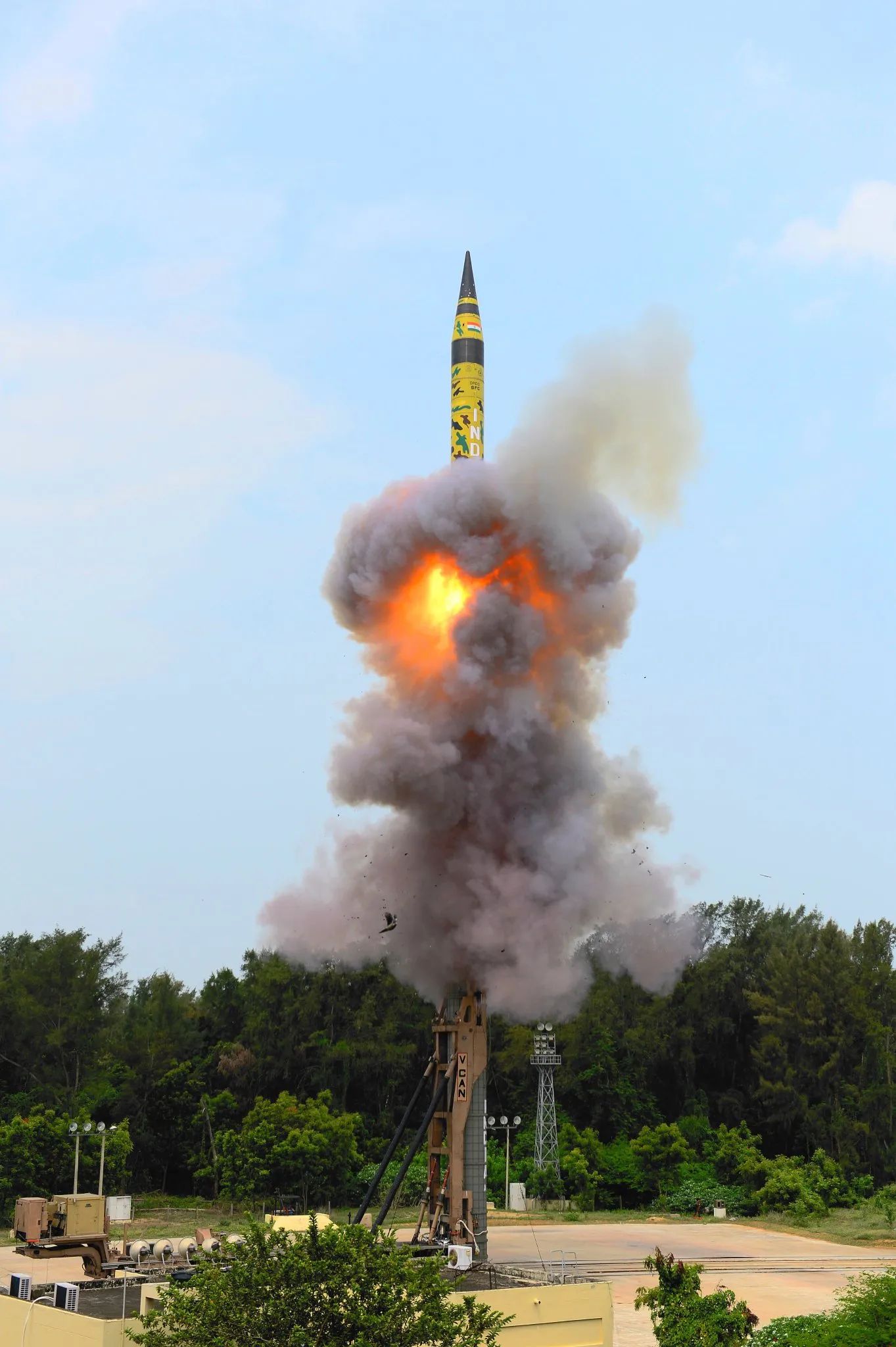
The Agni-V first flew on 19 April 2012. It is a three-stage, solid-fuel missile weighing about 50 tonnes and stored in a sealed canister on a road-mobile launcher. Officially it has a range of more than 5,000 km. Many analysts, and some Chinese researchers, believe it can go further, up to 7,000–8,000 km, though India has never confirmed this.
Because it sits in a canister, the Agni-V can be launched quickly from almost anywhere on its launcher’s route. The Strategic Forces Command carried out its first user trial in October 2021, a first night trial in December 2022 and a training launch in August 2025.
MIRV: one missile, many warheads
A MIRV, or multiple independently targetable re-entry vehicle, lets one missile carry several warheads that can each hit a different target. It makes a small arsenal far more potent and much harder for missile defences to stop.
- 11 March 2024, Mission Divyastra: India’s first MIRV test, on an Agni-V. Prime Minister Modi announced it personally.
- 8 May 2026: a second test of an “advanced Agni missile” with MIRV, according to the Defence Ministry. Media reports identified it as an Agni-V variant. The ministry said multiple payloads hit different points spread over a wide area of the Indian Ocean and that all mission objectives were met.
The exact number of warheads has not been disclosed. Analysts at MP-IDSA noted it is not yet clear whether more tests will be needed before the system is handed over to the Strategic Forces Command.
Agni-Prime and the rail launcher
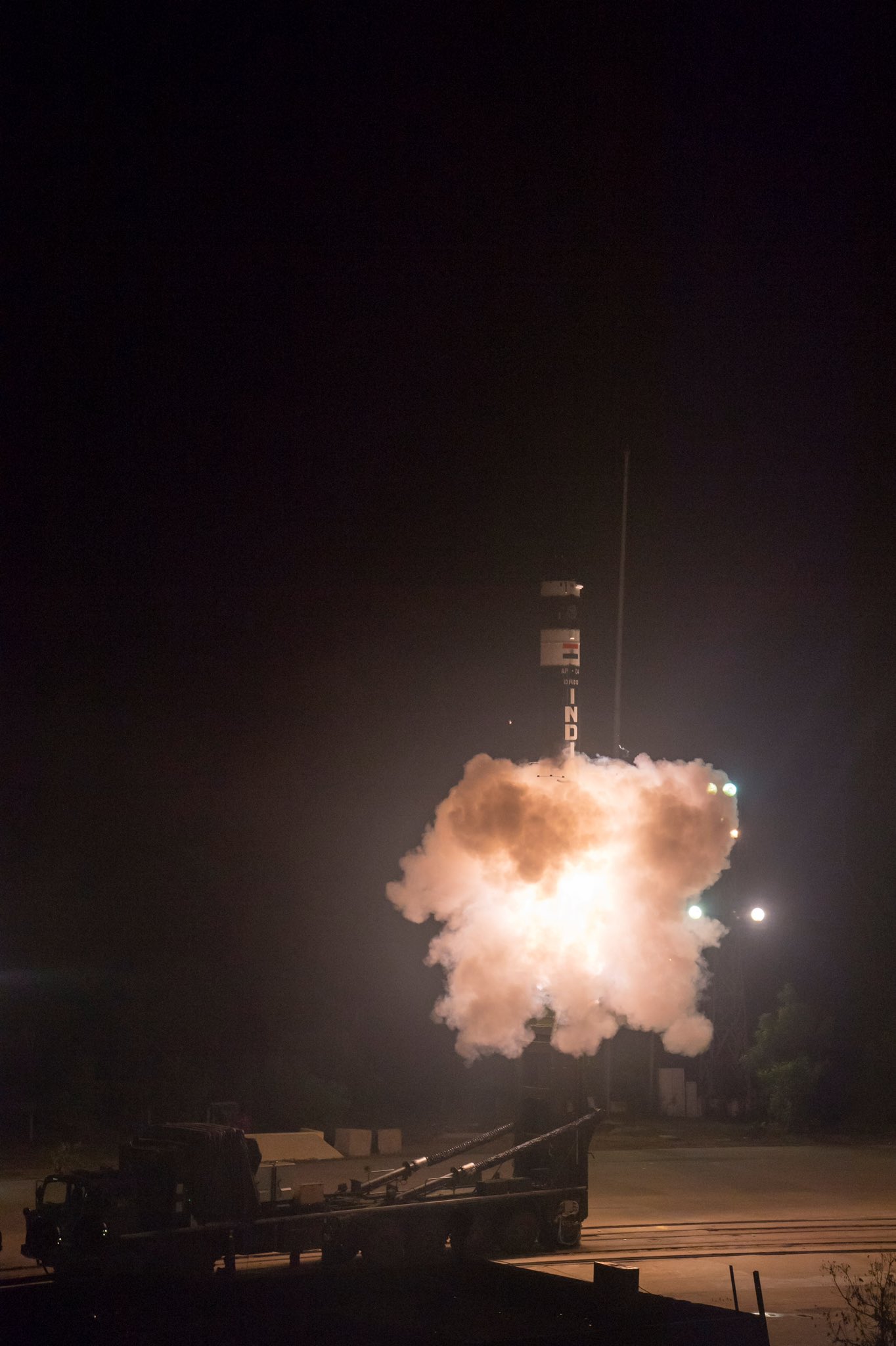
Agni-Prime is a new-generation, lighter missile with a range of 1,000–2,000 km. It uses composite materials and a canister, making it more accurate and easier to deploy than the older Agni-I and II it is meant to replace. The government has said the road-mobile version has been inducted.
On 24 September 2025, India launched an Agni-Prime from a rail-based mobile launcher for the first time, in what the Defence Ministry called a full operational scenario. Missiles hidden on India’s vast rail network are very hard for an enemy to track.
Agni-VI: the missile that hasn’t been approved
Agni-VI is a proposed intercontinental missile with a projected range of 10,000–12,000 km and multiple warheads. In April 2026, DRDO chairman Samir V Kamat said DRDO was ready to begin full-scale development once the government gives approval. As of November 2026, no approval has been announced and no test has taken place.
There were also media reports in 2025 that DRDO was studying conventional, non-nuclear versions of the Agni-V with very heavy bunker-busting warheads. These have not been officially confirmed.
The sea leg: India’s nuclear submarines
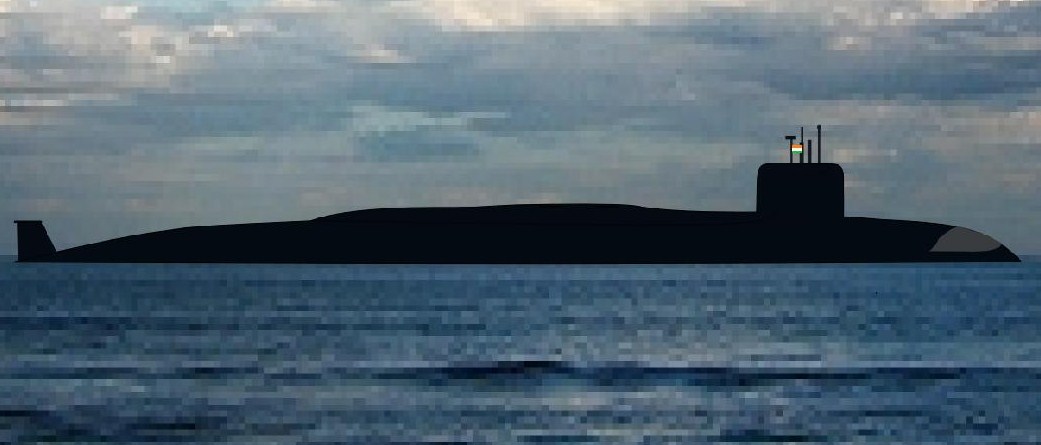
Submarines are the most survivable part of any triad, and this is where India has moved fastest recently.
| Submarine | Commissioned | Missile tubes | Status |
|---|---|---|---|
| INS Arihant | 2016 | 4 | Active; first deterrence patrol November 2018 |
| INS Arighaat | 29 August 2024 | 4 | Active |
| INS Aridhaman | 2026 (reported April) | 8 | Active (reported) |
| Fourth boat (S4*) | Expected 2027 | 8 | Sea trials |
The submarines carry two main missiles: the K-15 with a range of about 750 km and the K-4 with about 3,500 km. Longer-range K-5 and K-6 missiles are in development. With only short-range K-15s, a submarine would have to sail close to an enemy coast; the K-4 and its successors let it patrol in safer waters far from home.
The air leg: fighters with nuclear roles
India does not officially say which aircraft carry nuclear bombs. Open-source estimates, such as those by the Federation of American Scientists, have long pointed to the Mirage 2000H and Jaguar, with some analysts suggesting the Rafale may take on the role. Aircraft are the most flexible leg, since they can be recalled after take-off, but also the most vulnerable to modern air defences.
What SIPRI’s 2026 report says
The Stockholm International Peace Research Institute’s Yearbook 2026, released in June, estimated:
| Country | Estimated warheads (Jan 2026) |
|---|---|
| China | About 620 |
| India | About 190 |
| Pakistan | About 170 |
The most striking detail was that SIPRI assessed, for the first time, that about 12 Indian warheads were operationally deployed. India has long been thought to keep warheads separate from missiles in peacetime. Canisterised missiles and submarine patrols suggest India may be moving toward keeping some ready to launch. SIPRI also noted that India struck Pakistani air and missile bases believed to have nuclear-related roles during the May 2025 conflict, a reminder of how close conventional fighting can come to the nuclear threshold.
How India compares with China and Pakistan
- China has the fastest-growing arsenal in the world, with intercontinental missiles such as the DF-41, a growing submarine force and new missile silos. India’s Agni-V and MIRV work are largely about keeping a credible deterrent against China.
- Pakistan rejects No First Use and follows “full-spectrum deterrence”, including short-range tactical nuclear weapons such as the Nasr. Its longest-range missile, the Shaheen-III, reaches about 2,750 km, and it has claimed tests of the MIRV-capable Ababeel. For a wider comparison, see our analysis of the India–Pakistan military balance.
Arms control is weakening globally, too. Our explainer on the end of New START explains why the wider nuclear order is under strain, and hypersonic missiles are adding new ways to deliver warheads.
Common misconceptions
- “Agni-V is officially an ICBM.” India officially describes it as having a range above 5,000 km. Intercontinental range usually means 5,500 km or more, so most media call it an ICBM, but India avoids the label.
- “No First Use means India would not retaliate strongly.” The doctrine promises massive retaliation to a nuclear first strike.
- “India keeps all warheads separate from missiles.” That was the traditional view, but SIPRI now assesses some are deployed.
- “Agni-VI is ready.” Its design is reportedly complete, but the government has not approved development or testing.
Our take
India’s deterrent is quietly becoming more mature: more survivable submarines, canisterised and rail-mobile missiles, and MIRV technology. These steps strengthen No First Use rather than weaken it, because they make India’s ability to retaliate more certain.
The open questions are about pace and signalling. Watch for the induction of a MIRV Agni with the Strategic Forces Command, the commissioning of the fourth submarine and longer-range K-5 missiles, and whether the government approves Agni-VI. Each would mark a step from a regional deterrent toward one that can reach anywhere China might threaten.
Frequently asked questions
What is the range of Agni-V?
Officially more than 5,000 km. Some analysts estimate it could reach 7,000–8,000 km, but India has not confirmed this.
Has India tested MIRV technology?
Yes. India tested an Agni-V with MIRV on 11 March 2024 (Mission Divyastra) and tested an advanced Agni missile with MIRV again on 8 May 2026.
How many nuclear weapons does India have?
SIPRI estimated about 190 warheads in January 2026, up from about 180 a year earlier. India does not publish official figures.
Does India have a nuclear triad?
Yes. India can deliver nuclear weapons from land-based Agni missiles, fighter aircraft and Arihant-class submarines armed with K-series missiles.
What is India’s No First Use policy?
India has pledged to use nuclear weapons only in retaliation against a nuclear attack on its territory or forces, with an exception for major biological or chemical attacks, and promises massive retaliation if attacked.
What is Agni-VI?
A proposed intercontinental missile with a projected range of 10,000–12,000 km and multiple warheads. DRDO says it is ready to develop it, but the government has not yet approved the project.
Sources and further reading
Researched using official statements and published reporting up to 6 November 2026.
- MP-IDSA: India tests Agni-5 with MIRV capability, 11 May 2026
- The Week: India expands nuclear arsenal to 190 warheads (SIPRI), 9 Jun 2026
- The Wire: India deploys 12 nuclear warheads (SIPRI), 8 Jun 2026
- Wikipedia: Agni-V
- Wikipedia: Agni-VI
- Wikipedia: Arihant-class submarine
- Wikipedia: Strategic Forces Command


Leave a Reply