
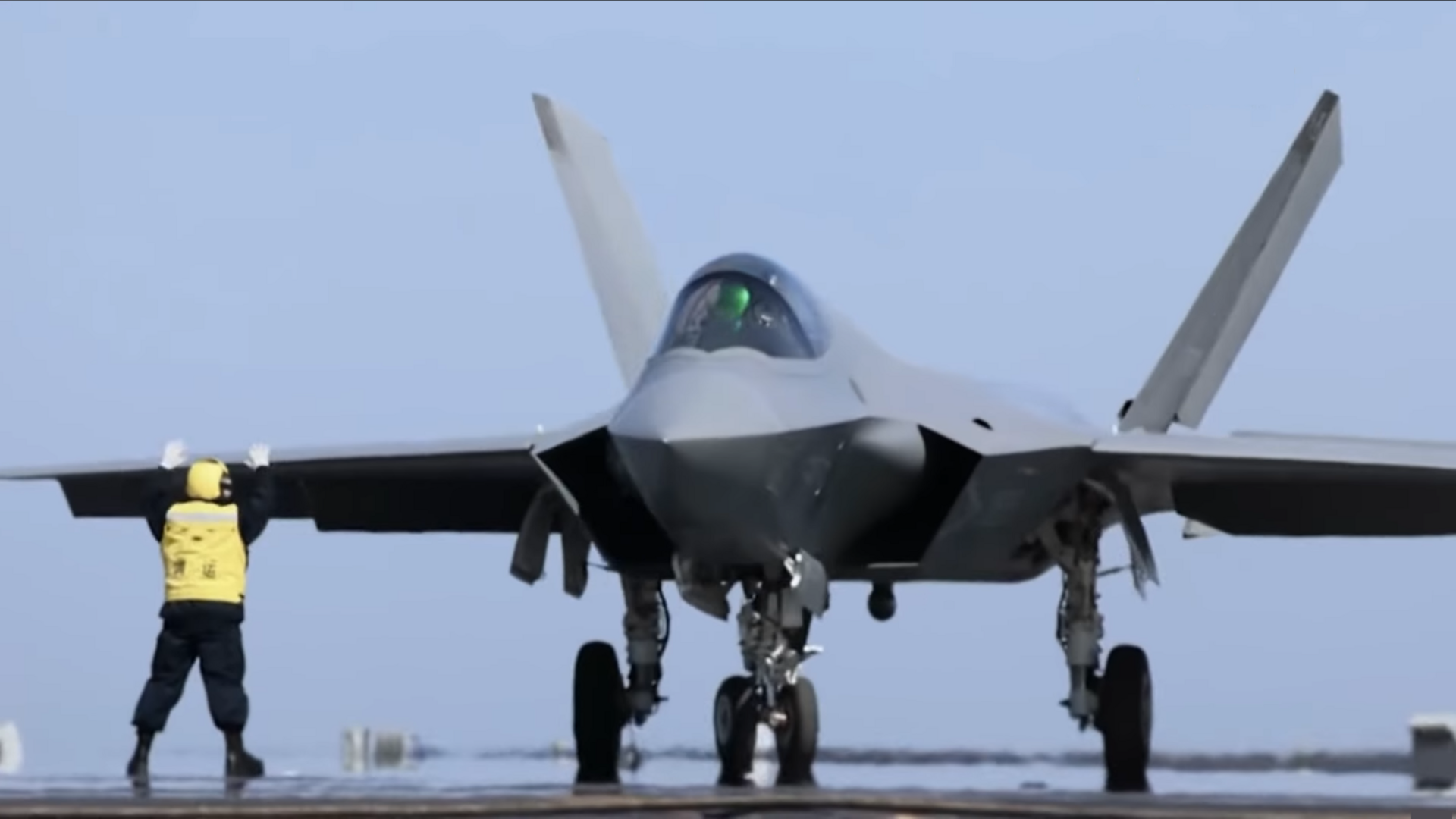
For years, China’s second stealth fighter lived in the shadow of the J-20. It began as a company-funded demonstrator that nobody had ordered. Today the J-35 flies from China’s newest aircraft carrier, has a land-based version for the air force, and is reportedly heading to Pakistan as China’s first stealth fighter export.
That last point is why India is paying close attention. This guide explains what the J-35 is, where it came from, what it can do, how it compares with the F-35 and J-20, and what a Pakistani J-35 fleet would mean for South Asia.
Quick answer: The Shenyang J-35 is China’s medium-weight, twin-engine fifth-generation stealth fighter. The naval J-35 flies from the carrier Fujian using electromagnetic catapults, while the land-based J-35A serves the air force. China announced both in service in September 2025, and Pakistan reportedly signed an initial agreement for the jet in May 2026.
J-35 at a glance
| Maker | Shenyang Aircraft Corporation (AVIC) |
| Type | Twin-engine, single-seat fifth-generation stealth fighter |
| Origins | FC-31 Gyrfalcon demonstrator, first flight October 2012 |
| Versions | J-35 (navy, carrier-based), J-35A (air force), J-35AE (export, reported) |
| Engines | Early: WS-21 class (~93 kN each); planned: WS-19 (~110–116 kN each) |
| Internal weapons | Up to six air-to-air missiles, e.g. PL-15 and PL-10 |
| Service | Announced September 2025 |
| Carrier | Fujian (commissioned November 2025) |
| Export | Pakistan: initial agreement reported, May 2026 |
In this article
- What is the J-35?
- From FC-31 to J-35: an unlikely success story
- The three versions: J-35, J-35A and J-35AE
- The J-35 and China’s carrier Fujian
- Design, stealth and sensors
- J-35 specifications (reported)
- Weapons: why the PL-15 worries India
- The engine question
- J-35 vs F-35 vs J-20
- The Pakistan deal: what we actually know
- What the J-35 means for India
- Common myths about the J-35
- Our take
- Frequently asked questions
- Sources and further reading
What is the J-35?
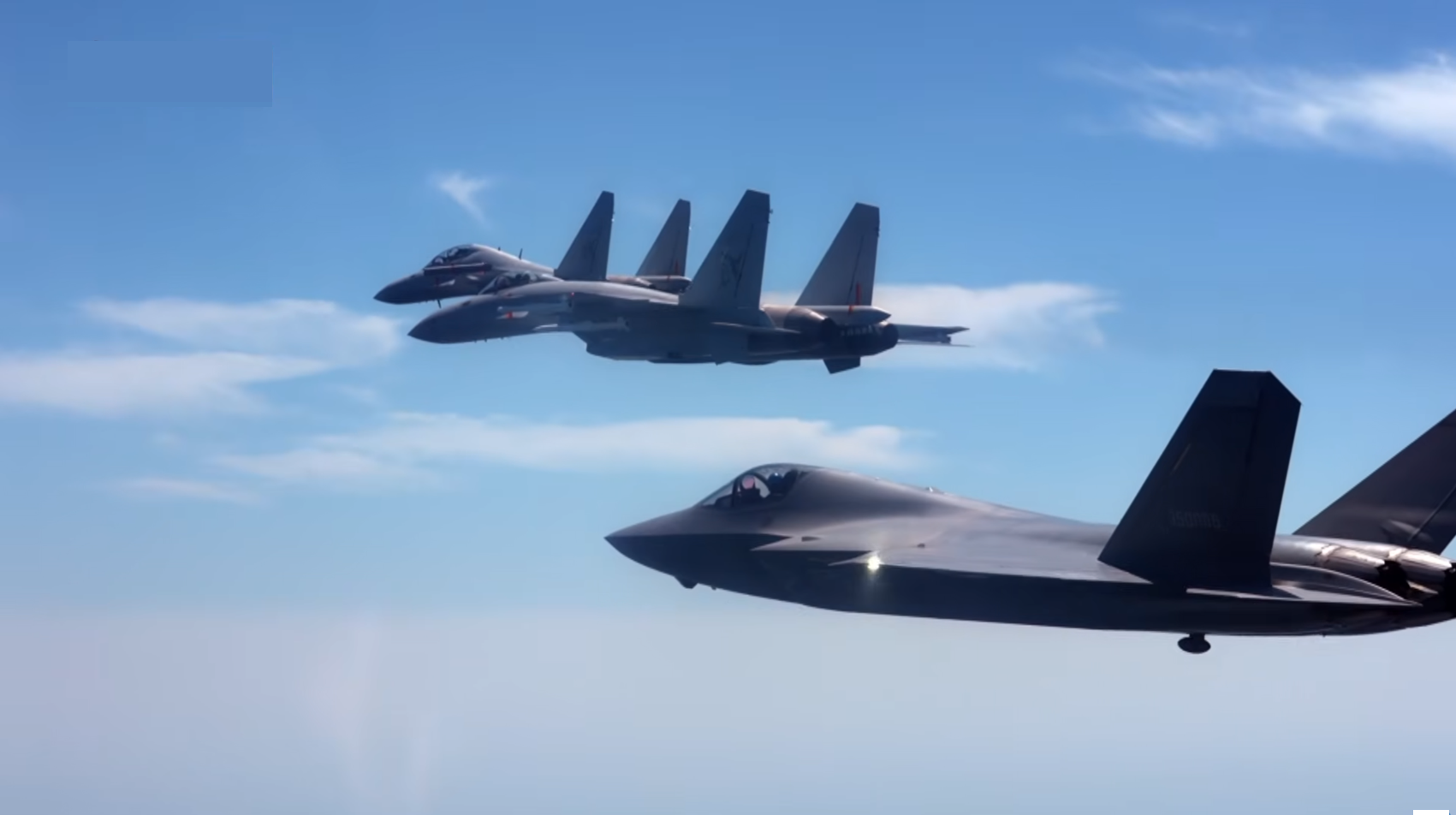
The J-35 is a single-seat, twin-engine stealth fighter built by Shenyang Aircraft Corporation, part of the state-owned AVIC group. It is smaller and lighter than Chengdu’s J-20, China’s first stealth fighter, and is designed to complement it at a lower cost.
If the J-20 is China’s long-range heavyweight, the J-35 is the more versatile middleweight. Its job list is long: fly from carriers, defend airspace, escort strike aircraft, and eventually sell abroad. That is the same balance the United States strikes between the F-22 and the F-35.
From FC-31 to J-35: an unlikely success story
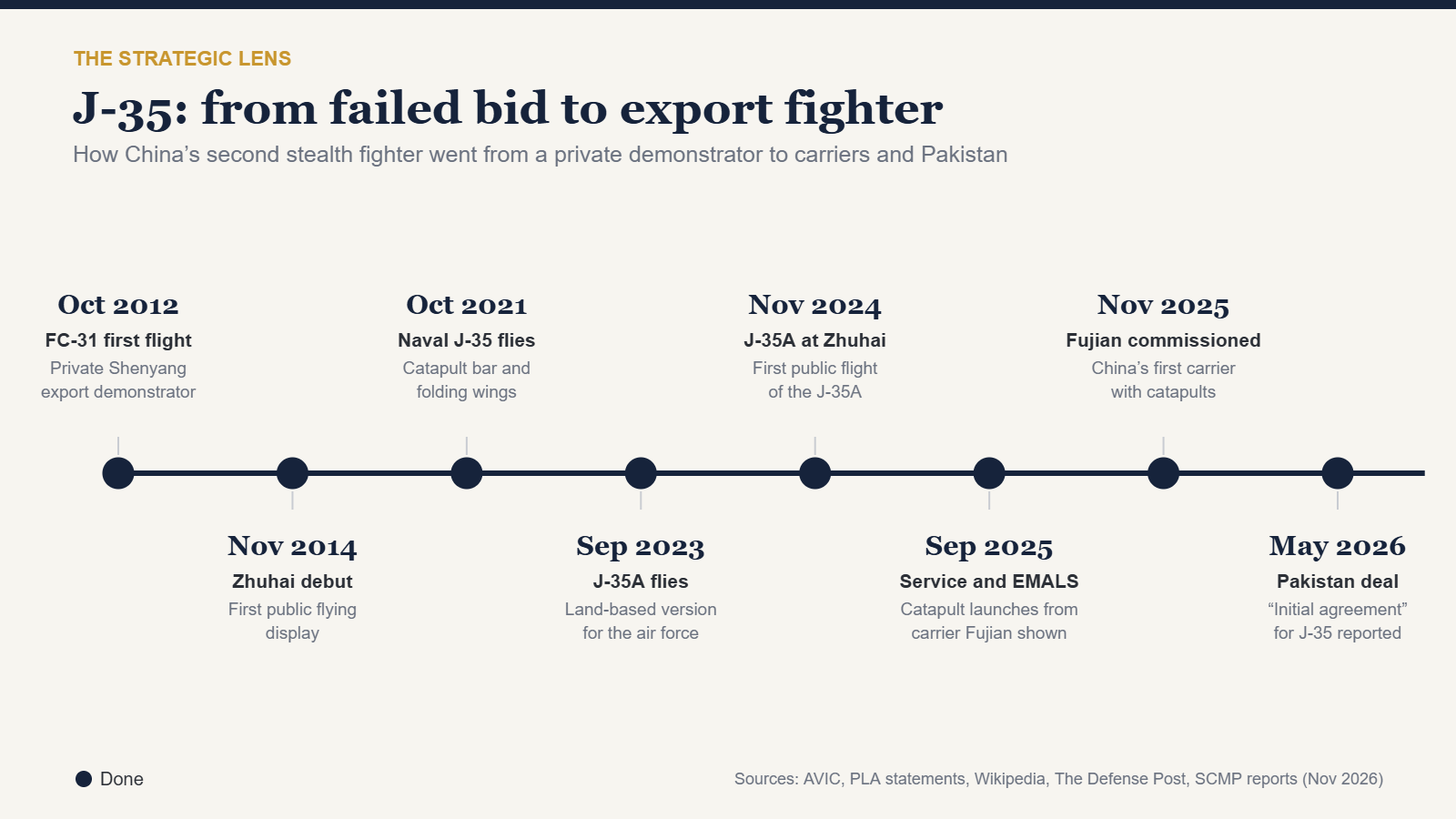
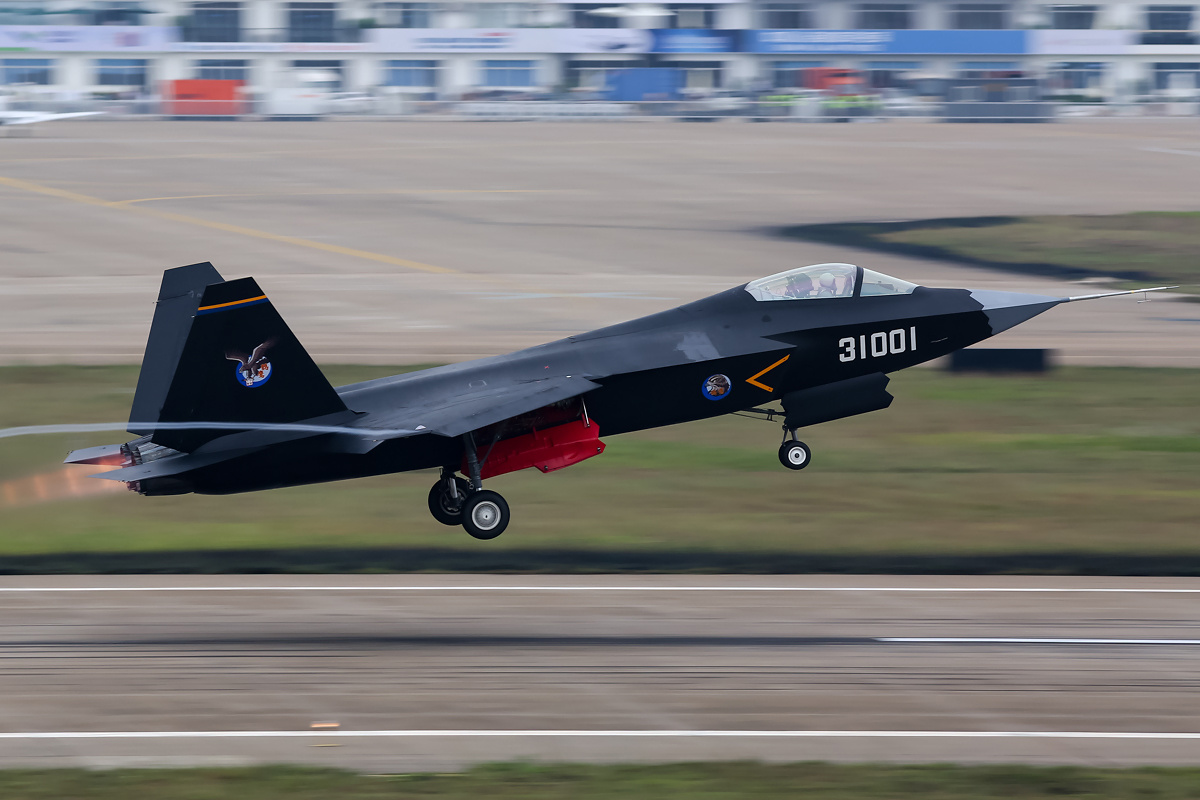
Shenyang lost the competition to build China’s first stealth fighter to Chengdu. Rather than give up, the company built its own demonstrator, the FC-31 Gyrfalcon, aiming at export customers. It first flew on 31 October 2012 and gave a flying display at the 2014 Zhuhai Airshow, powered by Russian RD-93 engines that left a smoky trail.
A redesigned second prototype flew in December 2016 with Chinese WS-13 engines. The breakthrough came when the Chinese navy chose the design for its future carriers. A naval J-35 with a catapult bar and folding wings flew in October 2021, and a land-based J-35A followed in September 2023. The J-35A made its public debut at Zhuhai in November 2024.
The three versions: J-35, J-35A and J-35AE
- J-35 (navy): built for catapult launches from carriers, with folding wings, a strengthened undercarriage and a catapult bar.
- J-35A (air force): a lighter land-based version with a single nose wheel and a slightly different wing and tail.
- J-35AE (export): an export model based on the J-35A, reportedly shown by AVIC in May 2026. Some reports call it the J-35E.
The J-35 and China’s carrier Fujian
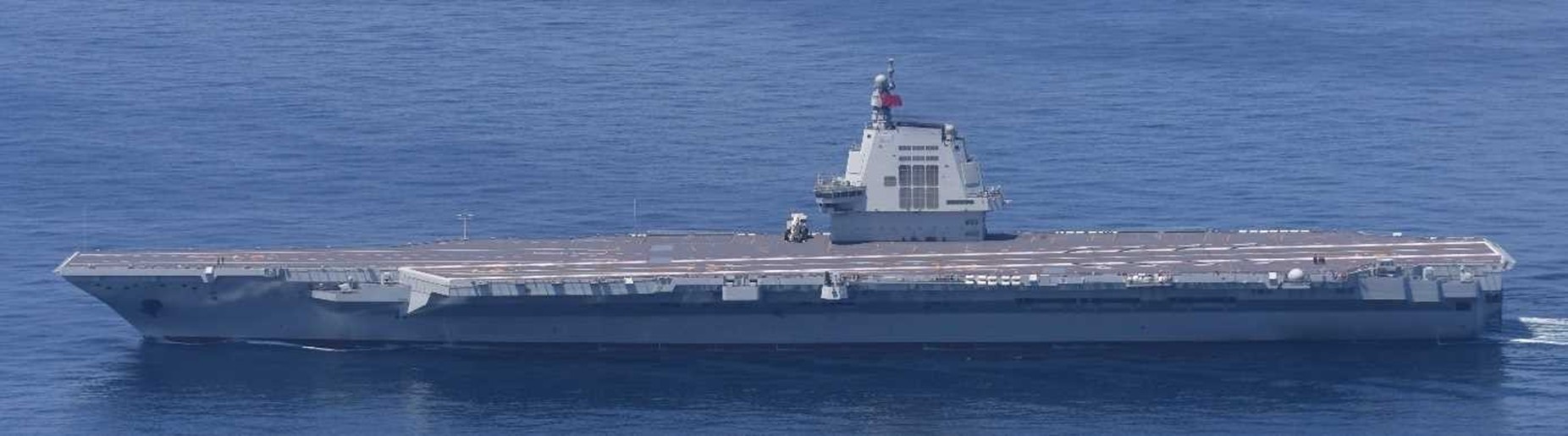
The naval J-35 matters because of the ship it flies from. The Fujian, commissioned on 5 November 2025 at Sanya on Hainan Island, is China’s first carrier with electromagnetic catapults (EMALS) rather than a ski-jump. Catapults let jets take off heavier, with more fuel and weapons.
In September 2025, Chinese state television showed J-35s, J-15T fighters and KJ-600 early-warning aircraft being launched and recovered on the Fujian. China claimed this made the J-35 the first stealth fighter launched by an electromagnetic catapult at sea. Read our explainer on China’s carrier leap for more on the Fujian and the nuclear Type 004.
Design, stealth and sensors
The J-35 follows the now-familiar stealth formula: angled surfaces, internal weapons bays, curved intakes that hide the engine faces, serrated engine nozzles and radar-absorbent coatings. AVIC claims it is stealthy against both long-wave L-band and short-wave Ku-band radars, a claim that cannot be checked from outside.
Its sensor suite is modern on paper:
- An AESA radar, linked to a distributed aperture system of cameras that watch for missiles and aircraft in all directions
- A chin-mounted electro-optical targeting system, similar in concept to the F-35’s
- A helmet-mounted display that lets the pilot aim weapons by looking at a target
- A wide touchscreen cockpit and triple-redundant fly-by-wire controls
J-35 specifications (reported)
China publishes little official data. These figures come from AVIC displays and open-source reporting and should be treated as estimates.
| Specification | J-35 / J-35A (reported) |
|---|---|
| Crew | 1 |
| Length | About 17.3 m (second prototype) |
| Max take-off weight | About 25–28 t (varies by version and source) |
| Engines | 2 × WS-21 class (~93 kN) early; 2 × WS-19 (~110–116 kN) planned |
| Top speed | About Mach 1.8 |
| Combat radius | About 1,200–1,250 km on internal fuel |
| Internal weapons | Up to 6 air-to-air missiles (PL-15, PL-10) |
| External hardpoints | 6 under the wings |
| Payload | About 8 t total (2 t internal) for the FC-31 design |
Weapons: why the PL-15 worries India
In stealth configuration, the J-35 can carry up to six air-to-air missiles inside its fuselage. The most important is the PL-15, a long-range radar-guided missile. Pakistan’s J-10C fighters fired PL-15s in combat during the May 2025 conflict with India, and Reuters reported, citing US officials, that at least one Indian Rafale was shot down. India has not confirmed the number or type of aircraft it lost.
For ground attack, the J-35 can carry small-diameter bombs, larger guided bombs or anti-ship and anti-radiation missiles internally, with more on the wings when stealth matters less.
The engine question
Like India, China has struggled with fighter engines. Early J-35s use WS-21 or WS-13 derivatives producing around 93 kN each. The planned definitive engine is the WS-19, at roughly 110–116 kN, which should give the jet more speed, better acceleration and possibly supercruise. Whether production J-35s already fly with the WS-19 is not publicly confirmed.
J-35 vs F-35 vs J-20
| Fighter | Country | Engines | First flight | In service | Role |
|---|---|---|---|---|---|
| J-35 / J-35A | China | 2 | 2021 / 2023 | 2025 | Medium, carrier and land |
| J-20 | China | 2 | 2011 | 2017 | Heavy, long-range |
| F-35 | USA | 1 | 2006 | 2015 | Multirole, three versions |
| AMCA | India | 2 | Target 2028 | Target ~2034 | Medium, land-based |
The J-35 is often compared to the F-35 because of its shape, but the two are different machines. The F-35 has one very powerful engine and a decade of combat experience, global production and a vast data network behind it. The J-35 has two smaller engines and a shorter track record. Against the J-20, it is smaller and shorter-ranged but better suited to carriers and export. For a wider comparison, see our guide to the world’s top fighter jets.
The Pakistan deal: what we actually know
This is where reporting gets murky, so it is worth separating what is known from what is claimed:
- June 2025: Pakistan disclosed that China had offered a package of 40 J-35s, KJ-500 early-warning aircraft and HQ-19 ballistic missile defence systems. Pakistan’s defence minister later called some reports speculative.
- May 2026: The South China Morning Post reported that a senior Pakistan Air Force officer said Pakistan had signed an “initial collaborative agreement” for the J-35. No quantity, value or signing date was published.
- Deliveries: Reports have suggested the first jets could arrive as early as late 2026, but neither government has released a contract or schedule.
If it goes ahead, Pakistan would become the first foreign operator of a Chinese stealth fighter, adding it to a fleet built around the JF-17 and J-10C. Our India–Pakistan military balance analysis looks at what that means.
What the J-35 means for India
- India has no stealth fighter in service. The AMCA is not expected before the mid-2030s, so a Pakistani J-35 fleet could open a gap of several years.
- Detection gets harder. Analysts quoted in the media have suggested the Air Force would need to devote more of its Su-30MKI fleet and ground radars to finding stealth jets.
- Air defence matters more. Long-range systems like the S-400 and India’s own Project Kusha (see India’s air defence system explained), plus better sensors and networking, become central.
- The stopgap debate returns. Some analysts argue for buying a foreign fifth-generation jet such as the Su-57 as an interim step. India has made no decision.
- At sea, China’s carrier-based stealth jets raise the stakes for the Indian Navy, which is pairing its carriers with Rafale M fighters.
Common myths about the J-35
- “It is a copy of the F-35.” The shapes look alike, and Western officials have long suspected stolen F-35 data informed Chinese designs. But the J-35 has two engines, different systems and different performance. Looking similar is not the same as being identical.
- “It is the same as the J-20.” No. They are made by different companies; the J-20 is larger and longer-ranged.
- “Pakistan already flies J-35s.” As of November 2026, only an initial agreement has been reported. No deliveries have been confirmed.
Our take
The J-35 is a real achievement for China: a fighter that started as a rejected idea now flies from the most advanced carrier outside the United States. Its export potential is just as important, because it lets China offer stealth to countries the US will not sell the F-35 to.
For India, the J-35 is less a reason to panic than a reason to hurry. The key questions are how fast Pakistan actually receives the jet, how well it performs in Pakistani hands, and whether India can speed up the AMCA, strengthen air defences and sensors, and decide on any interim fighter without derailing its own programme.
Frequently asked questions
What is the J-35 fighter jet?
The J-35 is a Chinese twin-engine fifth-generation stealth fighter made by Shenyang Aircraft Corporation. It has a naval version for aircraft carriers and a land-based J-35A for the air force.
Is the J-35 in service?
China announced in September 2025 that the J-35 and J-35A were part of its navy and air force fleets. Some reports in 2026 still described full operational service as pending.
Is the J-35 better than the F-35?
There is no reliable public evidence that it is. The F-35 has far more operational experience and a mature support network. The J-35’s real performance, especially its stealth and engines, is hard to judge from outside.
Is Pakistan buying the J-35?
Reports in May 2026 said Pakistan signed an initial agreement for the J-35. Earlier reports mentioned up to 40 jets. No final contract, quantity or delivery date has been officially published.
What is the difference between the J-35 and J-35A?
The J-35 is the carrier version, with folding wings and a catapult bar. The J-35A is the land-based air force version, slightly lighter with a different nose gear and tail.
Does India have an answer to the J-35?
India’s planned answer is the AMCA stealth fighter, targeted for induction around 2034. In the meantime, it relies on Rafales, Su-30MKIs, long-range air defence and sensors.
Sources and further reading
Researched using official statements and published reporting up to 6 November 2026.


Leave a Reply