
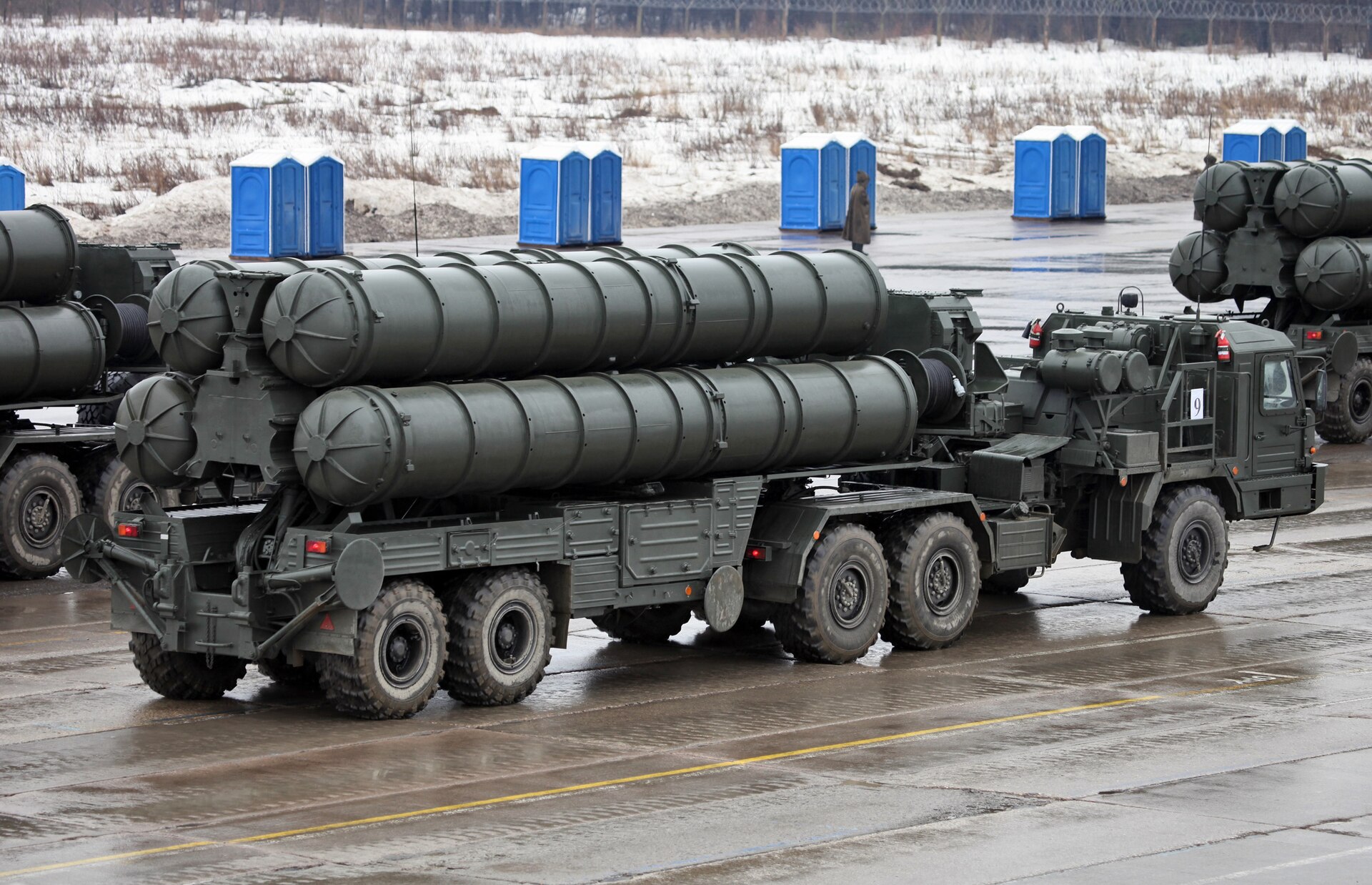
On the nights of 8 to 10 May 2025, Indian cities and air bases faced waves of drones, rockets and missiles from Pakistan. Most were stopped. That moment turned India’s air defence system from a technical subject into a national one, and three months later Prime Minister Modi announced Mission Sudarshan Chakra, a plan to shield the whole country by 2035.
India’s shield is not one system but many, stacked in layers from long-range missiles that can hit aircraft 400 km away to guns that shoot down drones a few kilometres out. This guide explains each layer, how they work together, what happened in Operation Sindoor, and where the gaps still are.
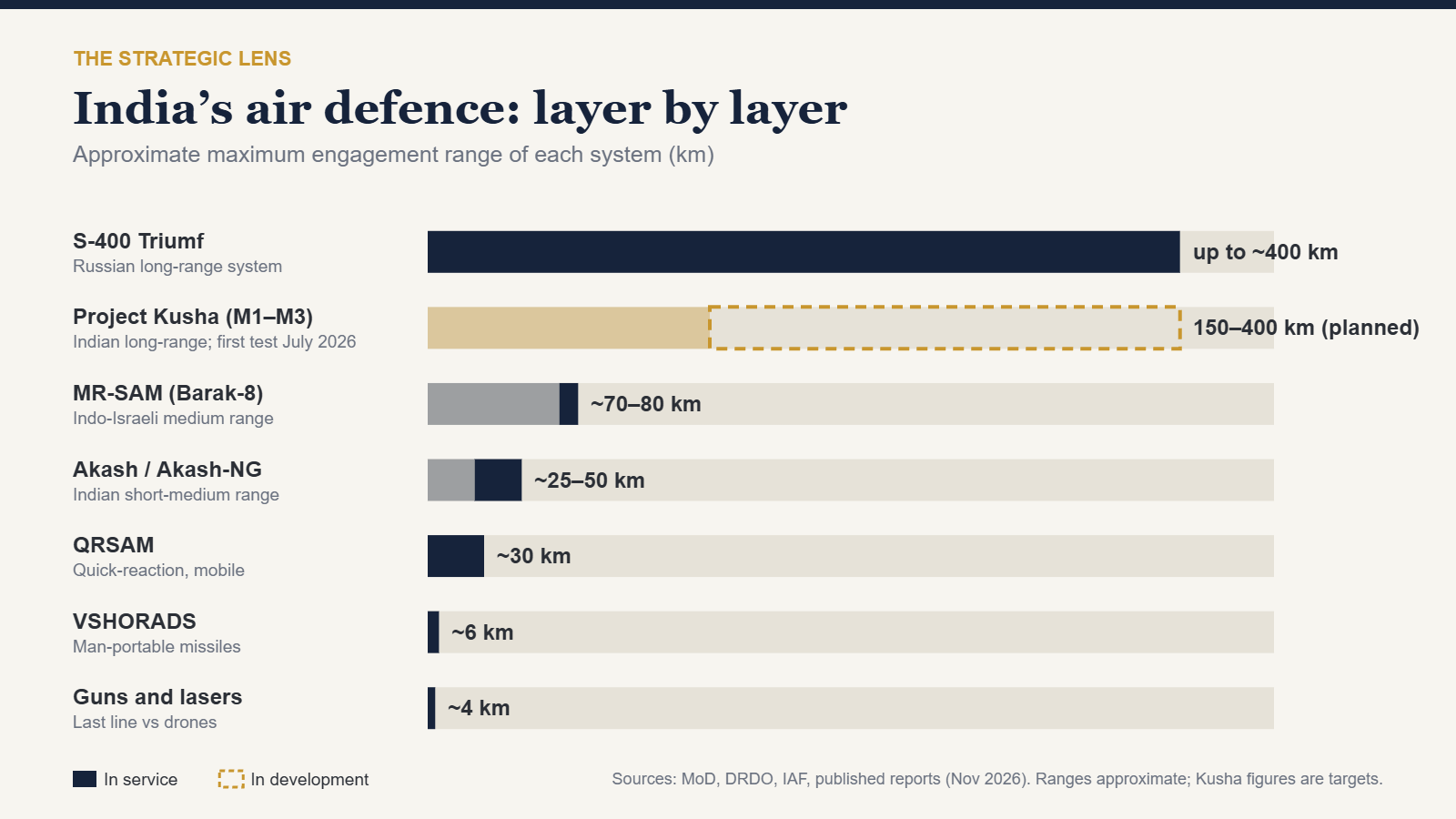
Quick answer: India’s air defence is a layered network. Long-range S-400s (and soon India’s own Project Kusha) engage targets up to about 400 km away; MR-SAM and Akash cover medium and short range; QRSAM, man-portable missiles, guns and lasers handle low-flying threats and drones. A ballistic missile defence shield protects key cities, and the IACCS network ties it all together under Mission Sudarshan Chakra.
India’s air defence at a glance
| Long range | S-400 (Russian, up to ~400 km); Project Kusha (Indian, 150–400 km planned) |
| Medium range | MR-SAM / Barak-8 (~70–80 km) |
| Short range | Akash, Akash Prime, Akash-NG (~25–50 km); QRSAM (~30 km) |
| Very short range | VSHORADS missiles, guns, lasers |
| Missile defence | Two-tier BMD (PAD/AAD, Phase-II AD-1/AD-2) |
| Command network | IACCS (Air Force), Akashteer (Army) |
| National plan | Mission Sudarshan Chakra, announced 15 August 2025, target 2035 |
In this article
- Why air defence comes in layers
- Layer 1: the S-400 “Sudarshan”
- What happened in Operation Sindoor
- Layer 1b: Project Kusha, India’s own S-400
- Layer 2: MR-SAM (Barak-8)
- Layer 3: Akash and Akash-NG
- Layer 4: QRSAM, VSHORADS, guns and lasers
- Ballistic missile defence
- The glue: IACCS and Akashteer
- Mission Sudarshan Chakra: the 2035 plan
- How India compares with Pakistan and China
- The gaps and challenges
- Common misconceptions
- Our take
- Frequently asked questions
- Sources and further reading
Why air defence comes in layers
No single missile can do everything. A long-range interceptor is expensive and wasted on a cheap drone; a gun is useless against a ballistic missile. So modern militaries build overlapping layers. Each layer thins out the attack, and whatever leaks through meets the next one.
The threats India faces have also multiplied: fighter jets and surveillance aircraft, cruise missiles, ballistic missiles, rocket artillery and, increasingly, swarms of cheap drones. Future threats include stealth fighters like China’s J-35 and hypersonic missiles.
Layer 1: the S-400 “Sudarshan”
India signed a $5.43 billion deal with Russia in October 2018 for five S-400 units, which Indian forces call “Sudarshan”. The first three arrived between 2021 and 2023. The war in Ukraine slowed the rest: the fourth arrived around June 2026, and the fifth is expected in November 2026, though delivery, acceptance and full induction are separate steps.
The S-400 can engage aircraft and missiles at ranges of up to about 400 km with different missiles. That reach pushes enemy aircraft far back from the border. In March 2026, India reportedly approved buying five more units, and Russia has submitted a proposal reported to be worth more than ₹50,000 crore.
What happened in Operation Sindoor
The S-400 saw its first combat use in May 2025. Indian officials say it helped stop Pakistani drone and missile attacks, including over Adampur air base. Western Air Command’s chief later said an S-400 shot down a Pakistani surveillance aircraft at a range of 314 km, which India describes as the longest surface-to-air kill on record. The IAF chief also claimed in August 2025 that Pakistani fighters were shot down.
These are Indian claims. Pakistan disputes them, and they have not been independently verified. What is less disputed is that India’s integrated network, linking radars and weapons across the services, handled a very large volume of incoming threats over several nights. The Defence Ministry credited the IACCS network with foiling multiple drone and missile attacks.
Layer 1b: Project Kusha, India’s own S-400
Project Kusha, also called ERADS (Extended Range Air Defence System), is DRDO’s homegrown long-range system. The Cabinet Committee on Security cleared it in May 2022, and in September 2023 the government approved five Air Force squadrons at about ₹21,700 crore.
Its first flight test took place on 23 July 2026 from APJ Abdul Kalam Island in Odisha, when an interceptor destroyed a target simulating a high-speed, high-altitude threat at a range of roughly 140 km. Kusha is planned in three missile types:
| Missile | Planned range | Main targets |
|---|---|---|
| M1 | ~150 km | Aircraft, cruise missiles, drones |
| M2 | ~250 km | Fighters, cruise and some hypersonic threats |
| M3 | ~350–400 km | Large aircraft such as AWACS and tankers |
Induction is planned from about 2028 to 2030. A naval version is also planned. If Kusha works as intended, it would reduce India’s dependence on Russian long-range systems.
Layer 2: MR-SAM (Barak-8)
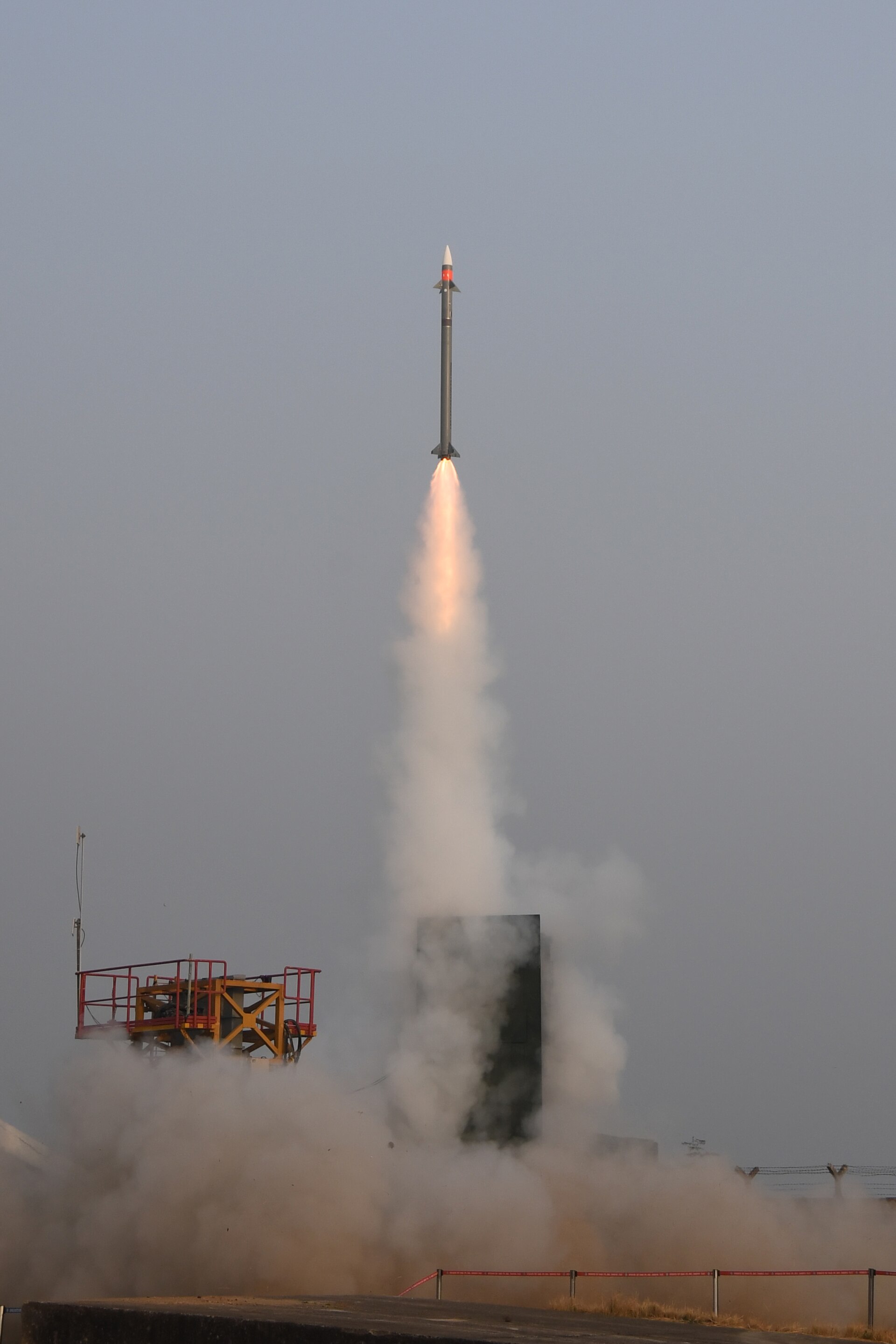
MR-SAM is an Indo-Israeli medium-range system built with Israel Aerospace Industries and produced in India by BDL. It covers roughly 70–80 km and is used by the Air Force, Army and Navy (as Barak-8 on warships). The Air Force received its first unit in 2021 and the Army raised its first regiment in 2023. Further large orders were cleared in 2025 and 2026.
Layer 3: Akash and Akash-NG
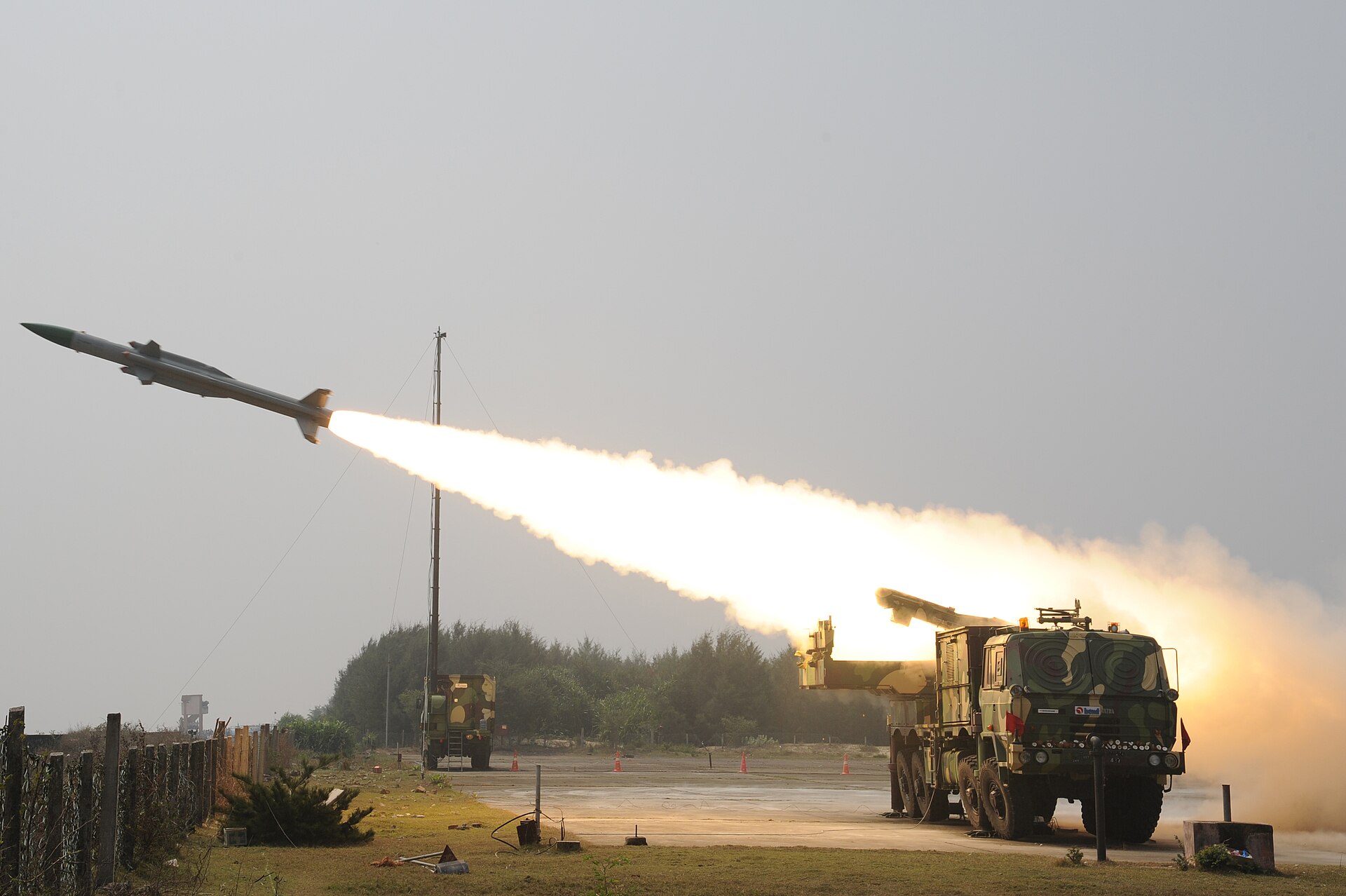
Akash is India’s homegrown short-to-medium range system, now in service with both the Army and Air Force and exported to Armenia. The newer Akash-NG is lighter, faster to deploy and longer-ranged, at about 30–50 km depending on the version. It completed user evaluation trials in December 2025 and was declared ready for induction.
Layer 4: QRSAM, VSHORADS, guns and lasers
- QRSAM (Quick Reaction Surface to Air Missile): a mobile system that can fire on the move, with a range of about 30 km, to protect Army columns.
- VSHORADS: shoulder-fired and light vehicle-mounted missiles for very short range.
- Guns: old L-70 and ZU-23 guns proved surprisingly useful against drones in 2025. The Army is also seeking modern 30 mm close-in weapon systems.
- Lasers: In August 2025, DRDO tested an Integrated Air Defence Weapon System combining QRSAM, VSHORADS and a laser weapon, destroying drones in flight. See our explainer on laser weapons.
The drone threat is the fastest-growing problem. Cheap drones can be launched in hundreds, as India says happened in May 2025, and firing expensive missiles at them is unsustainable. That is why guns, lasers and electronic jammers matter so much. Read more in our piece on how armies are rebuilding around drones.
Ballistic missile defence
Separately, DRDO has built a two-tier ballistic missile defence system, started in 1999. The PAD interceptor works high above the atmosphere, and the AAD works lower down, inside it. Phase I, designed against missiles with ranges up to about 2,000 km, was declared complete in 2012.
Phase II uses new interceptors, AD-1 and AD-2, aimed at longer-range missiles. AD-1 was first tested in 2022, and reports in June 2026 said DRDO tests had engaged targets simulating very long-range threats. A Phase III with even more capable interceptors is planned for the 2030s. India also tested a sea-based interceptor in 2023.
The glue: IACCS and Akashteer
Missiles are only as good as the network that tells them where to shoot. The Air Force’s Integrated Air Command and Control System (IACCS) links military and civilian radars across the country into one air picture. The Army’s Akashteer does the same for its air defence units and is being connected to IACCS. In 2025, this integration let the services share data in real time and avoid shooting at friendly aircraft.
Mission Sudarshan Chakra: the 2035 plan
In his Independence Day speech on 15 August 2025, Prime Minister Modi announced Mission Sudarshan Chakra, named after the god Krishna’s weapon. The goal is a complete national security shield by 2035, protecting cities, military sites and infrastructure while also giving India the ability to strike back.
In practice, the mission ties together everything described above: S-400 and Kusha for long range, MR-SAM and Akash in the middle, short-range systems and lasers at the bottom, ballistic missile defence on top, and IACCS and Akashteer as the network. Defence Minister Rajnath Singh said a committee would plan a medium-term roadmap to 2030 and a long-term one to 2035. Our explainer on America’s Golden Dome shows how other countries are tackling the same challenge.
How India compares with Pakistan and China
- Pakistan relies largely on Chinese systems, especially the HQ-9 family for long range, and reports suggest it has been offered the HQ-19 for missile defence. In 2025, India says it found gaps in Pakistan’s defences around several air bases.
- China operates one of the world’s largest air defence networks, including its own HQ-9 and Russian S-400s, and is investing heavily in missile defence and anti-stealth radars.
For the wider picture, see our analysis of the India–Pakistan military balance.
The gaps and challenges
- Saturation: a large enough salvo of drones and missiles can overwhelm any system. Interceptor stocks matter as much as launchers.
- Cost: long-range interceptors cost far more than the drones they may be used against.
- New threats: stealth aircraft and hypersonic missiles are harder to detect and track.
- Dependence: the S-400 depends on Russia for missiles and spares, which is why Kusha matters.
- Scale: India is huge. Covering every city and base by 2035 will take enormous investment and integration.
Common misconceptions
- “India has an Iron Dome.” India’s network is very different from Israel’s Iron Dome, which is a short-range rocket interceptor. India’s shield covers many more threat types and ranges.
- “The S-400 makes India untouchable.” No single system can stop everything. It is one powerful layer among many.
- “Sudarshan Chakra is the S-400.” Indian forces call their S-400 units “Sudarshan”, but Mission Sudarshan Chakra is the broader national programme.
- “Kusha is ready.” It flew its first test in July 2026; induction is planned from about 2028.
Our take
India’s air defence performed better in 2025 than many expected, largely because of the unglamorous work of linking radars and weapons into one network. That network, not any single missile, is the real strength.
The next decade is about scale and self-reliance. Watch for the fifth S-400 unit’s induction, the decision on five more, Kusha’s M2 and M3 tests, Akash-NG entering service, and cheaper anti-drone layers such as lasers. If those arrive roughly on schedule, Mission Sudarshan Chakra’s 2035 goal looks ambitious but credible.
Frequently asked questions
What is India’s air defence system called?
India does not have a single system. It runs a layered network including the S-400, MR-SAM, Akash, QRSAM and others, linked by IACCS. Mission Sudarshan Chakra is the national plan to expand it into a full shield by 2035.
How many S-400 does India have?
India ordered five S-400 units in 2018. Three were delivered by 2023, the fourth arrived around June 2026, and the fifth is expected in November 2026. India is also reportedly negotiating five more.
What is Project Kusha?
Project Kusha is DRDO’s homegrown long-range air defence system, with planned ranges of about 150, 250 and 350–400 km. It flew its first successful intercept test on 23 July 2026.
What is Mission Sudarshan Chakra?
A national air and missile defence mission announced by Prime Minister Modi on 15 August 2025. It aims to build a complete security shield for India by 2035 by integrating all layers of defence.
Did the S-400 work in Operation Sindoor?
Indian officials say it did, including a claimed 314 km shoot-down of a Pakistani surveillance aircraft. Pakistan disputes these claims and they have not been independently verified.
Does India have ballistic missile defence?
Yes. DRDO has developed a two-tier ballistic missile defence system. Phase I was declared complete in 2012, and Phase II interceptors have been tested against longer-range threats.
Sources and further reading
Researched using official statements and published reporting up to 6 November 2026.
- ThePrint: Project Kusha maiden test flight successful, 23 Jul 2026
- Defence Security Asia: India eyes final S-400 delivery in November, 22 Oct 2026
- Indian Defence News (ANI): Russia responds to India’s tender for five more S-400s, 31 Aug 2026
- Indian Defence News: Fourth S-400 squadron arrives, 4 Jun 2026
- Wikipedia: Project Kusha
- Wikipedia: Indian Ballistic Missile Defence Programme


Leave a Reply