

For years, India’s Tejas has been treated as a light fighter that would plug gaps. The Tejas Mk2 is meant to be something else entirely: a bigger, heavier, longer-range jet that can take over from the Mirage 2000, Jaguar and MiG-29 as they retire. If it delivers, it could become one of the most numerous fighters in the Indian Air Force by the late 2030s.
But the Mk2 has also become a story about timelines. Its first flight has slipped again and again, mostly because of one thing India still cannot make for itself: a fighter engine. Here is what the jet is, what it can do, where the programme stands in November 2026 and what could still go wrong.
Quick answer: The Tejas Mk2 (Medium Weight Fighter) is a 17.5-tonne, single-engine, 4.5-generation multirole fighter designed by ADA and built by HAL. It uses a GE F414 engine, carries 6.5 tonnes of weapons and is meant to replace the Mirage 2000, Jaguar and MiG-29. Its first flight is now targeted for the third quarter of 2027.
Tejas Mk2 at a glance
| Official name | Medium Weight Fighter (MWF), popularly Tejas Mk2 |
| Designer / builder | Aeronautical Development Agency (ADA) / Hindustan Aeronautics Limited (HAL) |
| Class | Single-engine, 4.5-generation multirole fighter |
| Max take-off weight | 17.5 tonnes (design target) |
| Engine | 1 × GE F414-INS6, about 98 kN with afterburner |
| Payload | 6.5 tonnes on 13 hardpoints (reported) |
| Sanctioned | September 2022, about ₹9,000–10,000 crore for development |
| First flight target | Q3 2027 (latest reported) |
| Replaces | Mirage 2000, Jaguar, MiG-29 |
In this article
- What is the Tejas Mk2?
- Why India needs a medium weight fighter
- Design: what changes from the Tejas Mk1A
- Tejas Mk2 specifications
- Radar, electronics and cockpit
- What weapons will it carry?
- The engine: the biggest hurdle
- Timeline: when will the Tejas Mk2 fly?
- How the Tejas Mk2 compares
- How many will India build?
- The challenges ahead
- Common misconceptions
- Our take
- Frequently asked questions
- Sources and further reading
What is the Tejas Mk2?
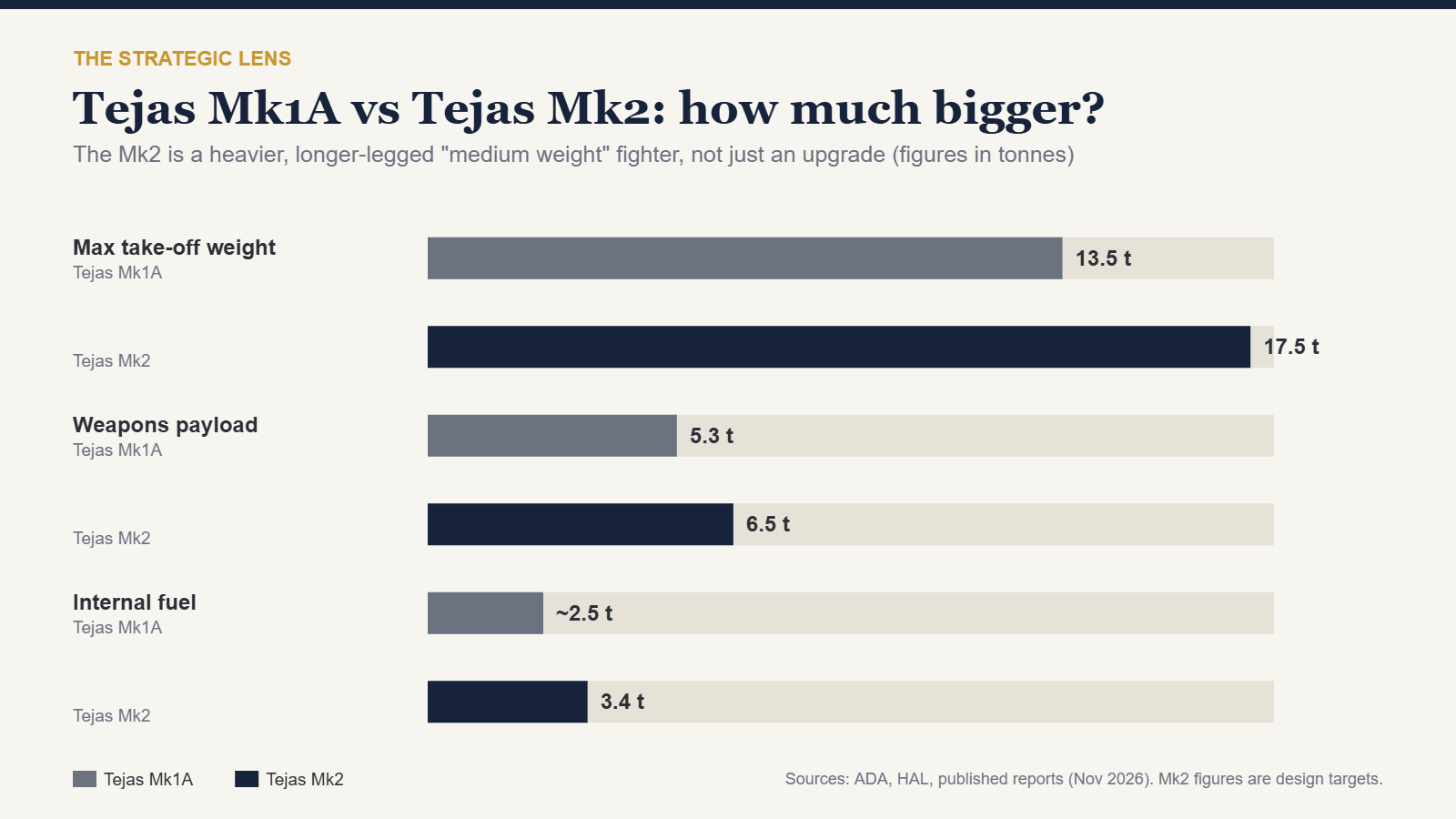
The Tejas Mk2 began life as a modest upgrade of the original Tejas: stretch the fuselage, fit a more powerful engine, add a little fuel. Over time it grew into a new aircraft. The Air Force now calls it the Medium Weight Fighter, and the name is a fair description. At 17.5 tonnes maximum take-off weight, it is about 4 tonnes heavier than the Tejas Mk1A.
It is still a single-engine jet, and it is not a stealth fighter. Think of it as India’s answer to aircraft like Sweden’s Gripen E: affordable, modern, packed with Indian-made electronics and built in large numbers. The truly stealthy role belongs to the AMCA, which is about a decade further away.
Why India needs a medium weight fighter
The Air Force is cleared for 42 fighter squadrons but has been operating around 30. Several workhorse fleets are getting old at the same time:
- Mirage 2000: the French jets that bombed Balakot in 2019 entered service in the 1980s.
- Jaguar: the Air Force’s main deep-strike jet for decades, also from the late 1970s and 1980s.
- MiG-29: upgraded, but still a 1980s design with high running costs.
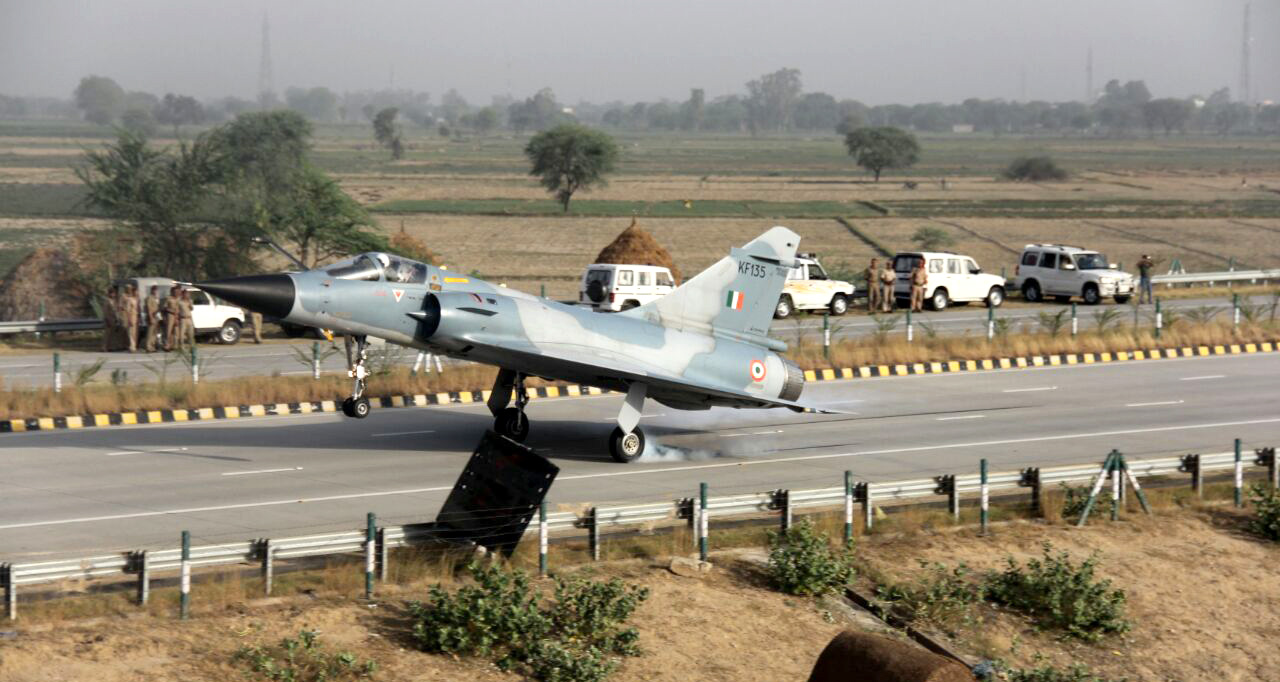
Reports since 2022 have said the Air Force wants to phase out these three types by the mid-2030s, and the Tejas Mk2 is the main planned replacement. Buying a foreign jet for that role, as with the 114-Rafale deal, is expensive. A homegrown jet built in large numbers is the cheaper long-term answer, if it arrives on time.
Design: what changes from the Tejas Mk1A
From a distance the Mk2 still looks like a Tejas, with the same delta wing. Look closer and the differences pile up:
- Canards. Small foreplanes just behind the cockpit improve agility and control at high angles of attack, and help the jet take off and land with heavy loads.
- A longer, wider fuselage. At 14.65 metres, it is longer than the Mk1A and has room for 3,400 kg of internal fuel, roughly 40 percent more.
- A bigger engine and intake. The GE F414 produces about 98 kN, compared with about 84 kN for the Mk1A’s F404.
- More weapons stations. Thirteen hardpoints (some reports say 11) carrying up to 6.5 tonnes.
- Some stealth touches. Radar-absorbent coatings and shaped intakes reduce its frontal radar signature, though it is not a stealth aircraft.
Tejas Mk2 specifications
The jet has not flown yet, so these are design targets published by ADA and in reports. Expect some to change during testing.
| Specification | Tejas Mk2 (design target) |
|---|---|
| Crew | 1 (twin-seat trainer possible) |
| Length | 14.65 m |
| Wingspan | 8.50 m |
| Max take-off weight | 17,500 kg |
| Internal fuel | 3,400 kg (plus external tanks) |
| Payload | 6,500 kg |
| Hardpoints | 13 (reported) |
| Engine | 1 × GE F414-INS6, ~98 kN |
| Top speed | Mach 1.8 |
| Combat range | About 1,000–1,200 km (reports differ) |
| Service ceiling | 17,300 m |
| g-limits | +9 / −3.5 |
Radar, electronics and cockpit
This is where the Mk2 could quietly outclass older, more famous jets. Almost all of its key electronics are Indian:
- Uttam AESA radar from DRDO’s LRDE, which can track multiple targets and is harder to jam than older radars.
- Unified Electronic Warfare Suite and a dual-colour missile approach warning system to detect and confuse incoming threats.
- Infrared search and track (IRST), which can spot aircraft by their heat without switching on the radar.
- A new digital flight control computer, an Indian software-defined radio datalink, and a glass cockpit with a large touchscreen display.
Reports also say the Mk2 will carry a towed radar decoy of the kind the Air Force used on its Rafales during the 2025 conflict with Pakistan.
What weapons will it carry?
ADA has said the Mk2 will be configured mainly with Indian weapons. Planned options reported so far include:
- Astra beyond-visual-range air-to-air missiles
- BrahMos-NG, the smaller, lighter version of the BrahMos cruise missile
- Rudram anti-radiation missiles for attacking enemy radars
- SCALP cruise missiles (planned) and Indian precision-guided bombs
- A 30 mm internal gun
The engine: the biggest hurdle
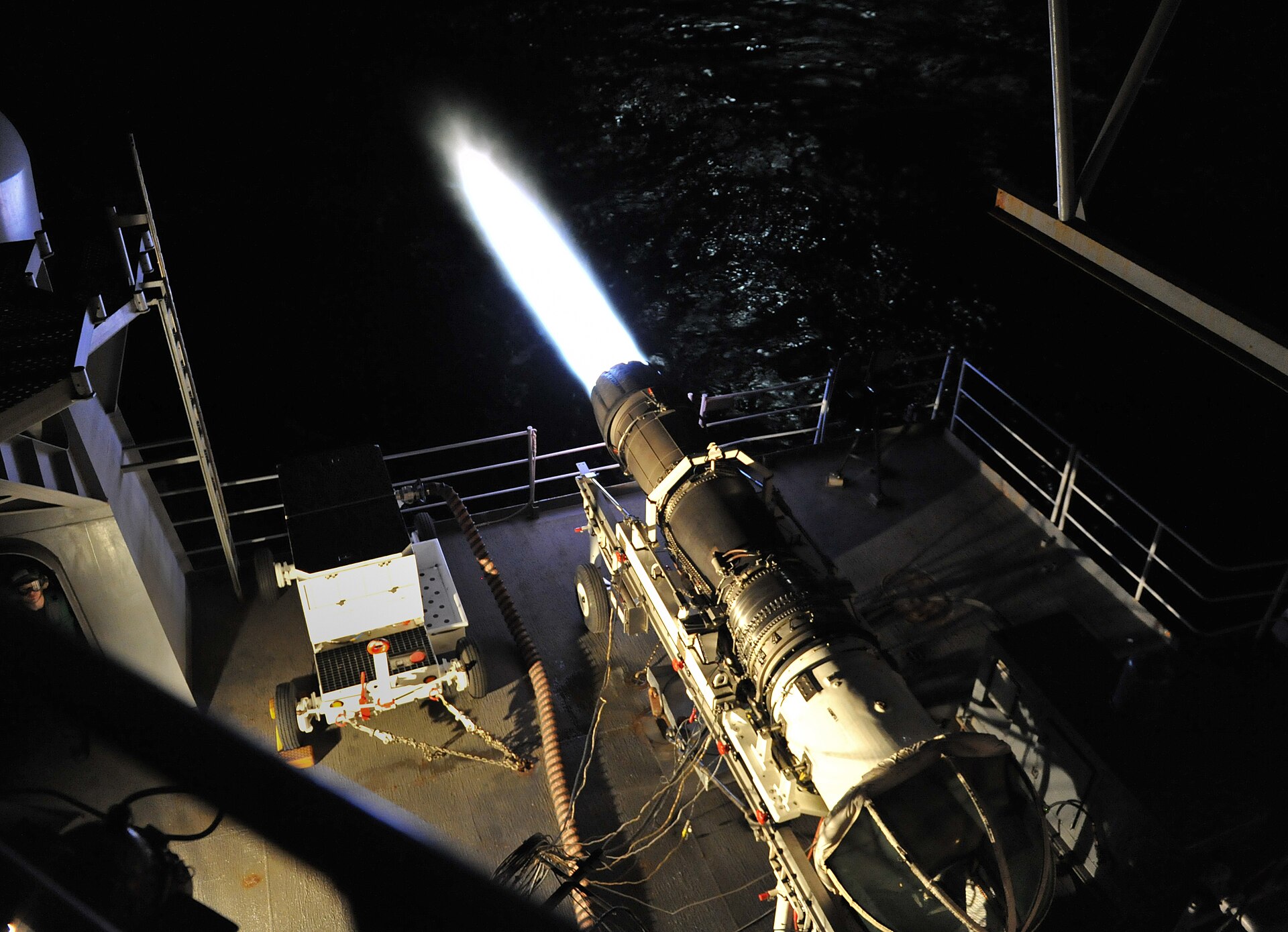
The F414 deal tells you most of what you need to know about the Mk2’s schedule. ADA picked the engine back in 2010. GE and HAL signed a memorandum to co-produce it in India in June 2023, and US approvals followed. In April 2026 the two companies agreed the technical terms. The commercial contract, which sets prices and delivery dates, is reportedly targeted for March 2027.
Once production starts, about 80 percent of the engine is expected to be made in India. A handful of engines have already been supplied for the prototypes. The risk is clear from the Tejas Mk1A, whose deliveries were held up for months by late deliveries of the smaller F404 engine. A DRDO review in 2024 said the only real delay factor for the Mk2 was the engine.
There is a backup idea too. France’s Safran has offered engine options, and India’s planned 120 kN engine with Safran is mainly meant for the AMCA. For now, the Mk2 is an F414 aircraft.
Timeline: when will the Tejas Mk2 fly?
Few programmes show how optimism meets reality better than this one. Here is how the first flight target has moved:
| When stated | First flight target |
|---|---|
| 2021 | 2023 |
| Dec 2023 revision | 2028 (roll-out late 2026 or early 2027) |
| Oct 2024 (Air Chief) | By October 2025 |
| Feb 2025 | Q1 2026 |
| Jan 2026 | June 2026 |
| Oct 2026 (latest report) | Q3 2027 |
The first prototype was rolled out by early 2026 and has been going through ground tests. Engine ground runs are reportedly targeted by March 2027, followed by taxi trials and the first flight. Four prototypes are planned. Older plans spoke of production around 2029 and squadron service in the early 2030s. Given the latest dates, both are likely to slip.
How the Tejas Mk2 compares
| Fighter | Max take-off weight | Engines | Role |
|---|---|---|---|
| Tejas Mk1A | 13.5 t | 1 × GE F404 | Light multirole |
| Tejas Mk2 | 17.5 t (target) | 1 × GE F414 | Medium multirole |
| Saab Gripen E | 16.5 t | 1 × GE F414G | Medium multirole |
| Dassault Rafale | 24.5 t | 2 × Safran M88 | Heavy omnirole |
The closest comparison is the Gripen E, which uses a version of the same engine. The Mk2 aims to offer similar capability at a lower price and with Indian electronics. It will not match the Rafale for range and payload, but it does not need to. For more head-to-head matchups, see our comparison of the world’s top fighter jets.
How many will India build?
The Air Force has talked about an initial 110–120 Tejas Mk2s, about six squadrons, with expectations of more orders later. Combined with the 180 Tejas Mk1As now on order (83 signed in 2021 and 97 more in September 2025), the Tejas family could make up a large share of the fighter fleet by the late 2030s. The Mk2 is expected to be over 80 percent Indian by content, rising further once the engine is built locally. At DefExpo 2022, officials said 16 countries had shown interest, though there are no export orders.
The challenges ahead
- The engine contract. Until the F414 commercial deal is signed and production begins, every date depends on it.
- HAL’s workload. HAL is already struggling to deliver the Tejas Mk1A on time. Building Mk2 prototypes at the same time stretches it further.
- Certification. The Mk1A’s radar and weapons are still being certified. Some of the same systems carry over to the Mk2.
- Time. The jets it replaces will not wait. Every year of delay deepens the squadron gap, at a time when Pakistan is adding Chinese jets (see our India–Pakistan military balance).
Common misconceptions
- “The Mk2 is just an upgraded Tejas.” It is a much larger, new airframe with a different engine, canards and new systems.
- “It is a stealth fighter.” It has some features to reduce its radar signature, but it is a 4.5-generation jet. India’s stealth fighter is the AMCA.
- “The engine is Indian.” It is the American GE F414, to be built under licence in India.
- “It has already flown.” As of November 2026 it has not. The latest target is Q3 2027.
Our take
The Tejas Mk2 is the right aircraft for the Indian Air Force’s biggest problem: it needs a lot of capable, affordable jets, soon. On paper it does that job well, and its Indian-made radar and electronics are a real achievement.
The weak point is time. The first flight has slipped by about four years, and the F414 commercial contract is still not signed. Watch two milestones over the next year: the engine deal by March 2027, and the first flight in the second half of 2027. If both happen, the Tejas Mk2 programme will finally be on a credible path. If not, the Air Force may have to look abroad again.
Frequently asked questions
What is the Tejas Mk2?
The Tejas Mk2, officially the Medium Weight Fighter, is a 17.5-tonne single-engine multirole fighter designed by ADA and built by HAL. It is bigger and more capable than the Tejas Mk1A and is meant to replace the Mirage 2000, Jaguar and MiG-29.
When will the Tejas Mk2 fly?
The latest reported target, from October 2026, is the third quarter of 2027. Earlier targets of 2025 and mid-2026 were missed, mainly due to engine-related delays.
Which engine powers the Tejas Mk2?
One General Electric F414-INS6 producing about 98 kN with afterburner. HAL and GE plan to build it in India, with about 80 percent local content.
Is the Tejas Mk2 a fifth-generation fighter?
No. It is a 4.5-generation fighter with some radar-signature reduction features. India’s fifth-generation stealth fighter is the AMCA.
How many Tejas Mk2 will the IAF buy?
The Air Force has talked about an initial 110–120 aircraft, roughly six squadrons, with more possible later.
What is the difference between Tejas Mk1A and Mk2?
The Mk2 is about 4 tonnes heavier, has canards, a more powerful F414 engine, around 40 percent more internal fuel, more hardpoints and a larger payload. The Mk1A is a light fighter; the Mk2 is a medium fighter.
Sources and further reading
Researched using official statements and published reporting up to 6 November 2026.


Leave a Reply