
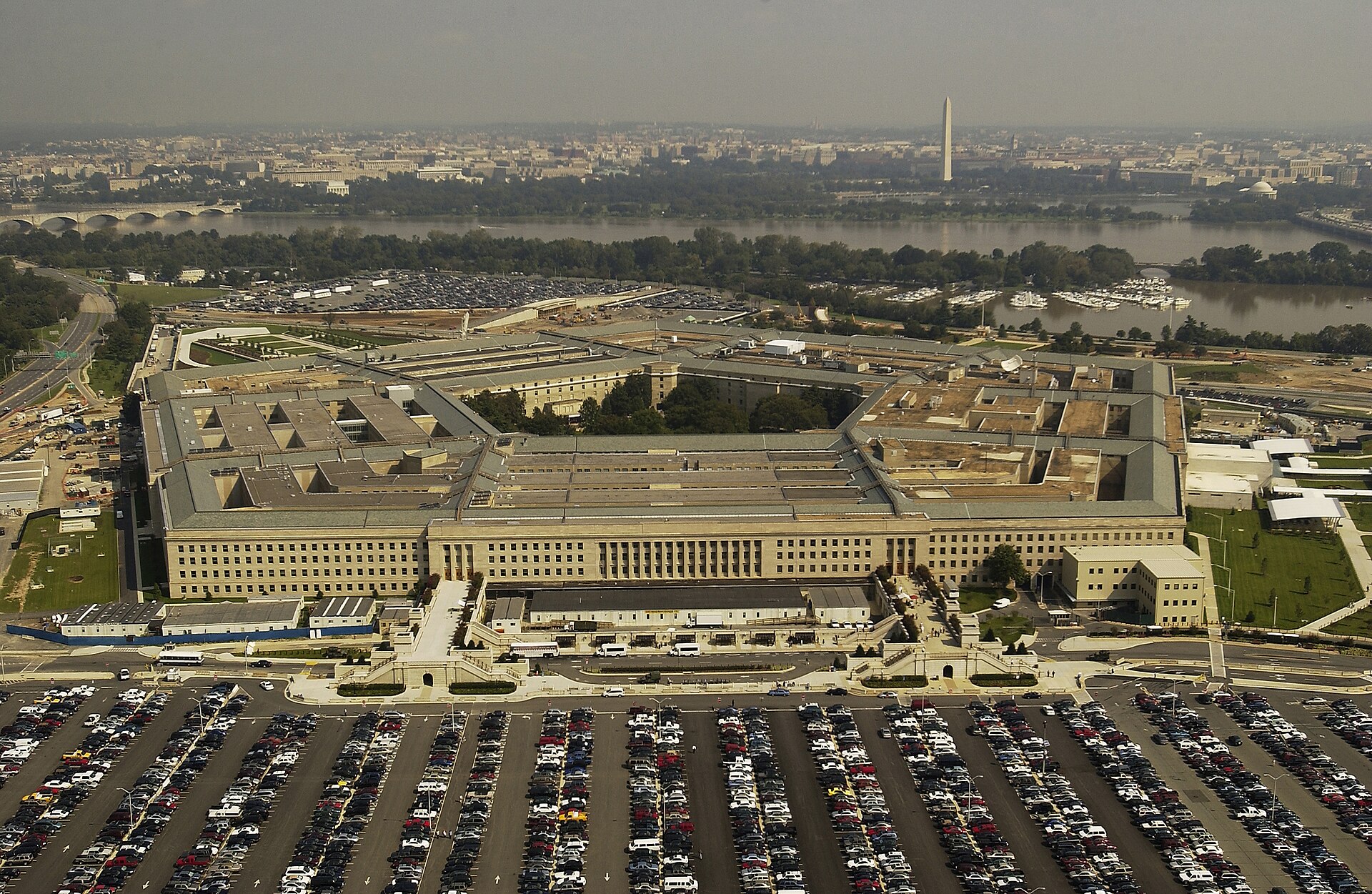
In April 2026, the White House asked Congress for $1.5 trillion for the military in fiscal year 2027. That is roughly 40 percent more than the year before, more than the next several countries combined, and the first time the core US defence budget has topped $1 trillion on its own.
Big numbers like this are hard to picture, so this guide breaks down the FY2027 Pentagon budget: where the money is meant to go, what it buys, why Congress has not passed it, and what it means for China, allies and India.
Quick answer: The US FY2027 defence budget request totals $1.5 trillion: about $1.15 trillion in regular discretionary funding plus $350 billion through a budget reconciliation bill. Its priorities are shipbuilding ($65.8 billion), drones (about $54 billion), AI, munitions, the Golden Dome missile shield and a Space Force that more than doubles. As of November 2026, Congress has not passed it and the Pentagon is running on a temporary funding bill.
FY2027 defence budget at a glance
| Total request | $1.5 trillion |
| Regular (discretionary) budget | About $1.15 trillion |
| Reconciliation (mandatory) add-on | $350 billion |
| Increase over FY2026 | About 42–44% |
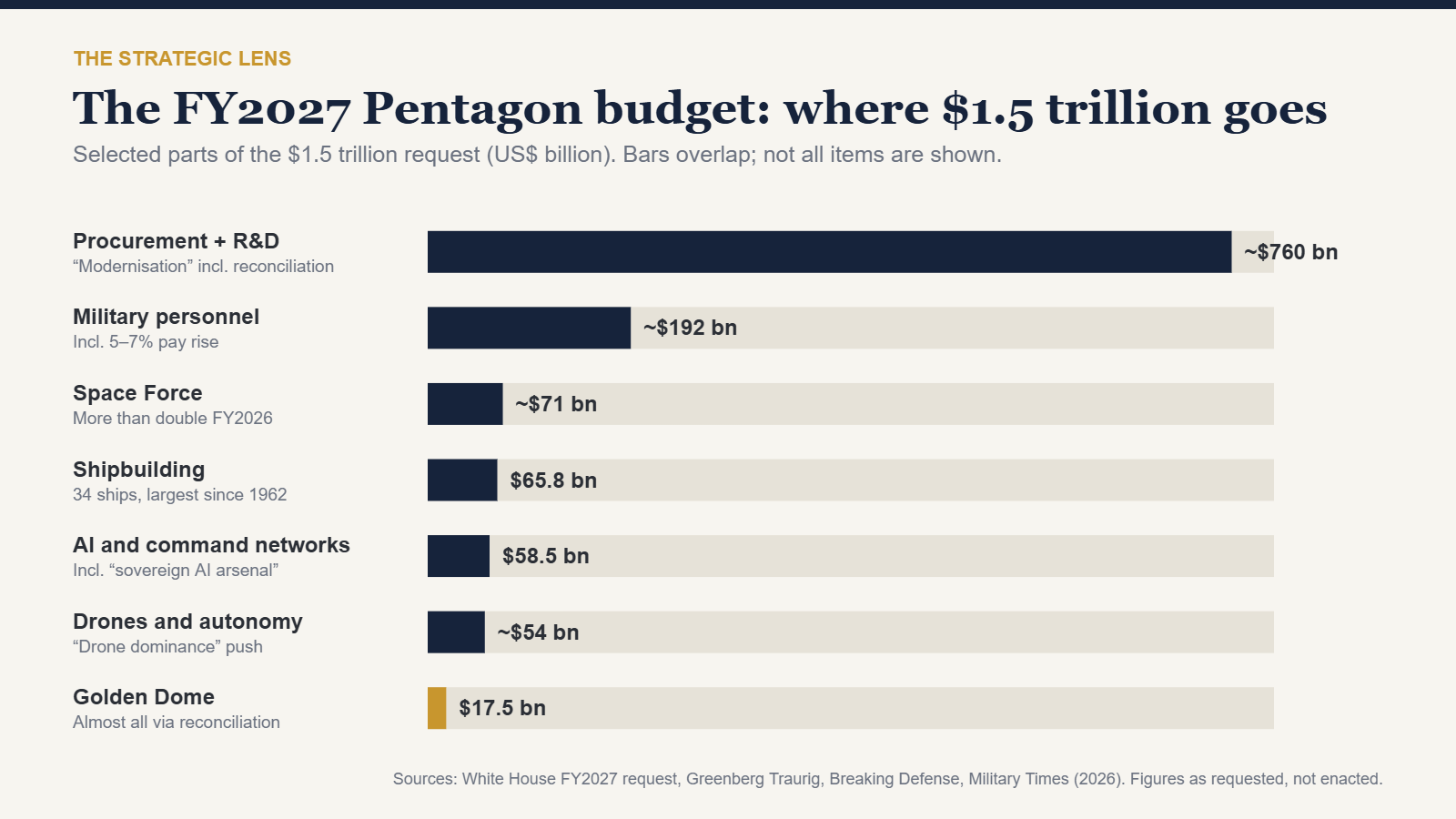
| Procurement + R&D | About $760 billion |
| Military personnel | About $192 billion; pay rises of 5–7% |
| Shipbuilding | $65.8 billion for 34 ships |
| Golden Dome | About $17.5 billion, almost all via reconciliation |
| Status (Nov 2026) | Not enacted; continuing resolution at FY2026 levels |
In this article
- How big is $1.5 trillion?
- Two budgets in one: base plus reconciliation
- Where the money goes
- Winners by service
- Why it says “Department of War”
- Where things stand in Congress
- The big debates
- What it means for India and allies
- Common misconceptions
- Our take
- Frequently asked questions
- Sources and further reading
How big is $1.5 trillion?
The request is about 44 percent more than the roughly $1 trillion the US spent on defence in fiscal 2026, a figure that itself included $150 billion from the 2025 “One Big Beautiful Bill” reconciliation law. For comparison, China announced a 2026 defence budget of about 1.91 trillion yuan (roughly $275 billion), up 7 percent, and India’s 2026-27 defence budget is about $86 billion.
| Country | 2026 defence budget (approx.) |
|---|---|
| United States (FY2027 request) | $1.5 trillion |
| China (official, 2026) | About $275 billion (+7%) |
| India (2026-27) | About $86 billion (+15%) |
China’s real spending is widely believed to be higher than its official figure, but the gap is still enormous.
Two budgets in one: base plus reconciliation
The request has two parts, and the difference matters:
- About $1.15 trillion in discretionary funding, the normal annual budget that Congress approves through appropriations bills.
- $350 billion through reconciliation, a special budget process that can pass the Senate with a simple majority. It is the second time defence has been put in reconciliation, after $150 billion in 2025.
The catch is that several of the administration’s biggest priorities, including Golden Dome, much of the drone push and a large munitions increase, sit mostly in the reconciliation part, which has made little progress in Congress.
Where the money goes
Shipbuilding: $65.8 billion
The largest shipbuilding request since 1962 in inflation-adjusted terms: 34 ships, including two Virginia-class attack submarines, one Columbia-class ballistic missile submarine, the first FF(X) frigate and $1 billion in advance funding for a new Trump-class battleship. Our explainer on the US Navy vs China shipbuilding race explains why.
Drones and autonomy: about $54 billion
A huge push into drones and autonomous systems, including about $39 billion tied to a “Drone Dominance” initiative, plus plans for a new command for autonomous warfare. Lessons from Ukraine, covered in our piece on armies rebuilding around drones, run through this.
AI and command networks: $58.5 billion
Funding for artificial intelligence and the military’s joint command-and-control network, including about $46 billion for what the budget calls a “sovereign AI arsenal”. See our explainer on AI in warfare.
Golden Dome: about $17.5 billion
The homeland missile shield gets about $17.5 billion in FY2027, almost all of it in reconciliation, with only about $400 million in the base budget. The full programme has been put at about $185 billion. Read our Golden Dome explainer for details.
Aircraft and space
- F-35: 85 jets in total, 32 in the base budget and 53 more via reconciliation, up from 47 in FY2026.
- F-15EX: 24 aircraft.
- B-21: about $2.86 billion in research and development. See our B-21 Raider explainer.
- F-47: the sixth-generation fighter targets a first flight in 2028.
- Space Force: about $71 billion, more than double its FY2026 funding.
People, munitions and industry
- Pay: about $192 billion for military personnel, with raises of 7 percent for junior enlisted troops, 6 percent for mid-level ranks and 5 percent for senior officers.
- Munitions: large increases in missiles and interceptors. The base budget funds 267 PAC-3 Patriot interceptors; reconciliation would add almost 3,000 more.
- Industrial base: more than $100 billion, including $48.8 billion for critical minerals and $20.2 billion for the Office of Strategic Capital.
- Nuclear weapons: $32.8 billion for the National Nuclear Security Administration, up 12 percent.
Winners by service
| Service | Increase in FY2027 request |
|---|---|
| Air Force | +33.6% |
| Navy | +24.3% |
| Army | +23.9% |
| Space Force | More than double |
Why it says “Department of War”
The budget documents use the name “Department of War”. A September 2025 executive order allowed the Pentagon to use the old name, which it carried until 1947, as a secondary title. A formal legal change needs Congress. The House Armed Services Committee voted 29–27 along party lines to adopt it in its version of the defence bill, but it is not yet law.
Where things stand in Congress
- Stopgap funding: Congress passed a continuing resolution in September 2026 that keeps the Pentagon at FY2026 levels until 11 December. That leaves it with a working budget of about $838.5 billion, and hurts programmes that depend on reconciliation, such as Golden Dome.
- Defence policy bill (NDAA): the House passed its version in July 2026. Senate Democrats blocked floor action, citing the Iran war and the topline. Both armed services committees backed about $1.14 trillion in discretionary spending, close to the request but excluding reconciliation.
- Appropriations: House appropriators approved roughly $1.0–1.07 trillion for defence, depending on what is counted. The Senate had not released its bill as of late summer.
- Reconciliation: the $350 billion defence reconciliation package has made little progress.
- Iran war costs: the White House also sent an $87.6 billion supplemental request in June 2026, including $67 billion for defence.
One budget analyst quoted by Air & Space Forces Magazine suggested the regular budget may not clear Congress until spring 2027. The November 2026 midterm elections add further uncertainty.
The big debates
- Is it affordable? Critics argue a 40 percent jump is unsustainable alongside large deficits.
- Reconciliation risk: putting key programmes into a one-off reconciliation bill makes them vulnerable if the bill fails.
- Can industry deliver? Shipyards and missile factories are already struggling. Money alone does not create capacity quickly.
- Specific fights: the E-7 Wedgetail radar plane was cancelled and then restored; Congress wants more destroyers than requested; lawmakers disagree on building warships in allied yards.
What it means for India and allies
- China focus: most of the new money targets a possible conflict with China, which aligns with India’s concerns in the Indo-Pacific.
- Co-production: a bigger US industrial push creates openings for partners to build parts and munitions, an area covered in our upcoming piece on the US–India defence partnership.
- Competition for supply: when US factories are stretched, foreign customers can wait longer, as India found with delayed GE engines for the Tejas.
- Comparison: India’s own 15 percent budget rise, discussed in our India–Pakistan military balance analysis, is large by Indian standards but tiny by US ones.
Common misconceptions
- “The Pentagon is getting $1.5 trillion.” That is the request. Congress decides the final amount, and it is likely to differ.
- “It is all for weapons.” Pay, healthcare, operations and maintenance take a large share. Procurement and research make up about half.
- “The name has legally changed to Department of War.” Not yet. The name is used under an executive order, but a legal change needs Congress.
Our take
The FY2027 request is a statement of intent: the United States wants to rearm on a scale not seen since the Reagan years, with the focus on China, drones, ships, missiles and space. Whether that intent survives Congress, deficits and America’s limited industrial capacity is a different question.
Watch for three things: the outcome after the December funding deadline, whether any reconciliation bill passes, and whether shipyards and missile makers can actually turn more money into more weapons. The answer will shape the military balance in Asia for a decade.
Frequently asked questions
How much is the US defence budget for 2027?
The White House requested $1.5 trillion for FY2027: about $1.15 trillion in regular discretionary funding and $350 billion through budget reconciliation. Congress has not yet passed it.
How much did the US spend on defence in 2026?
About $1 trillion in FY2026, including $150 billion from the 2025 reconciliation law.
What is Golden Dome’s budget for 2027?
About $17.5 billion, almost all of it in the reconciliation portion. The full programme has been estimated at about $185 billion.
How does the US defence budget compare with China’s?
China announced a 2026 defence budget of about 1.91 trillion yuan, roughly $275 billion, up 7 percent. The US request is more than five times that, though China’s real spending is believed to be higher than official figures.
Why is it called the Department of War?
A September 2025 executive order allowed “Department of War” as a secondary name. A formal legal rename requires Congress and is still being debated.
What is a continuing resolution?
A temporary law that keeps government funding at the previous year’s levels when Congress has not passed new budgets. The current one runs to 11 December 2026.
Sources and further reading
Researched using official statements and published reporting up to 6 November 2026.
- Military Times: Pentagon seeks funds for Golden Dome, drones, AI, 21 Apr 2026
- Greenberg Traurig: Understanding the FY2027 budget request, May 2026
- Breaking Defense: 13 key issues in the FY27 budget fight, 27 Aug 2026
- Air & Space Forces: Congress passes short-term funding, 1 Sep 2026
- Defense News: China raises 2026 defence budget by 7%, 10 Mar 2026


Leave a Reply