
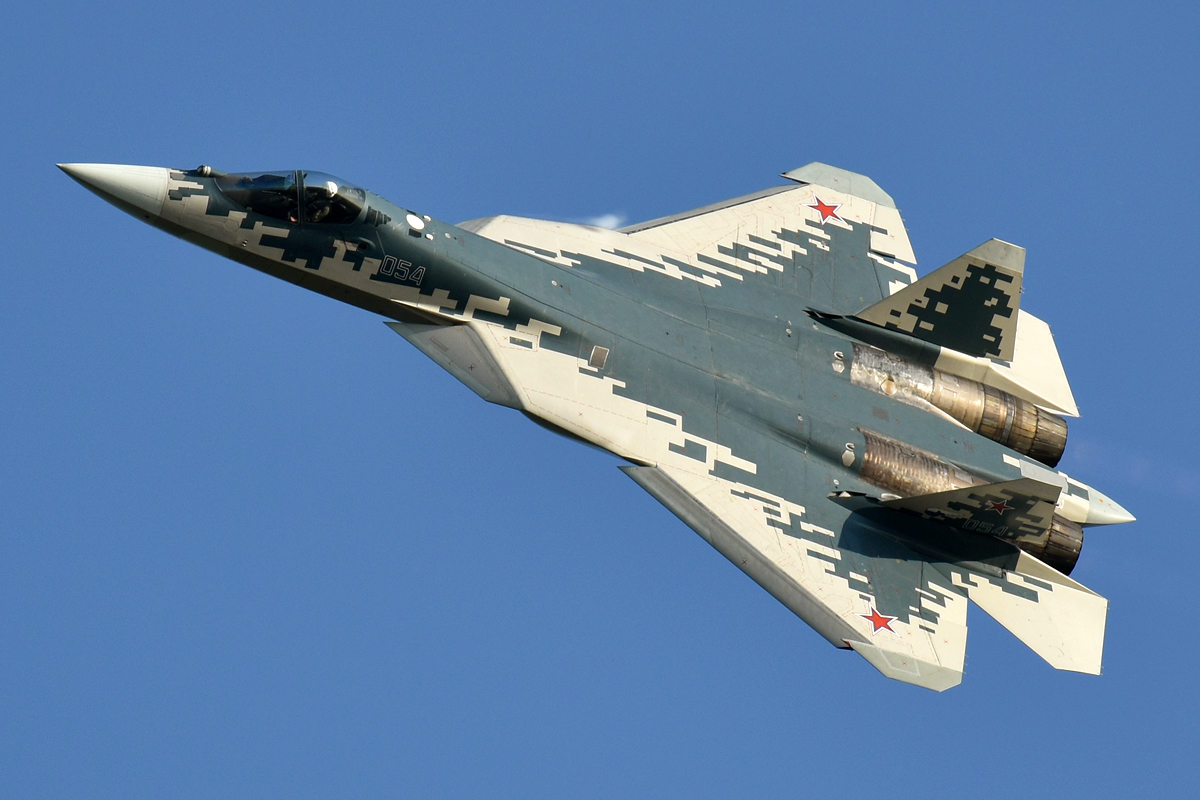
Russia’s Su-57 is one of the most argued-about fighter jets in the world. Moscow calls it a fifth-generation stealth fighter that can match anything the West flies. Critics say it is a capable but not truly stealthy jet that Russia cannot build in meaningful numbers. India, which walked away from the programme in 2018, is now being courted again.
This guide explains what the Su-57 Felon really is, what it can and cannot do, how it compares with the F-35 and J-20, how it has performed in Ukraine, and whether India should accept Russia’s offer.
Quick answer: The Su-57 (NATO name “Felon”) is Russia’s twin-engine fifth-generation fighter. It first flew in 2010 and entered service in 2020, but only around 45–50 have been built. It has internal weapons bays and good manoeuvrability, but its stealth is weaker than the F-35’s. Algeria is its reported first export customer, and Russia has offered India licence production with technology transfer. India has not agreed.
Su-57 at a glance
| Maker | Sukhoi (United Aircraft Corporation) |
| NATO name | Felon |
| First flight | 29 January 2010 (T-50 prototype) |
| Entered service | December 2020 |
| Built (approx.) | About 45–50 including test aircraft (estimates vary) |
| Engines | 2 × AL-41F1; new “izdeliye 177” engine in testing |
| Key weapons | R-37M and R-77M air-to-air missiles, Kh-69 cruise missile |
| Export | Su-57E; Algeria reported first customer |
| India | Offered with licence production; no agreement as of Nov 2026 |
In this article
- What is the Su-57?
- Why India left the programme in 2018
- Design: agility first, stealth second
- How stealthy is it really?
- The engine problem
- How many Su-57s exist?
- The Su-57 in combat: Ukraine
- Su-57E: Algeria and other buyers
- Russia’s offer to India
- Should India buy the Su-57? The case for and against
- Common misconceptions
- Our take
- Frequently asked questions
- Sources and further reading
What is the Su-57?
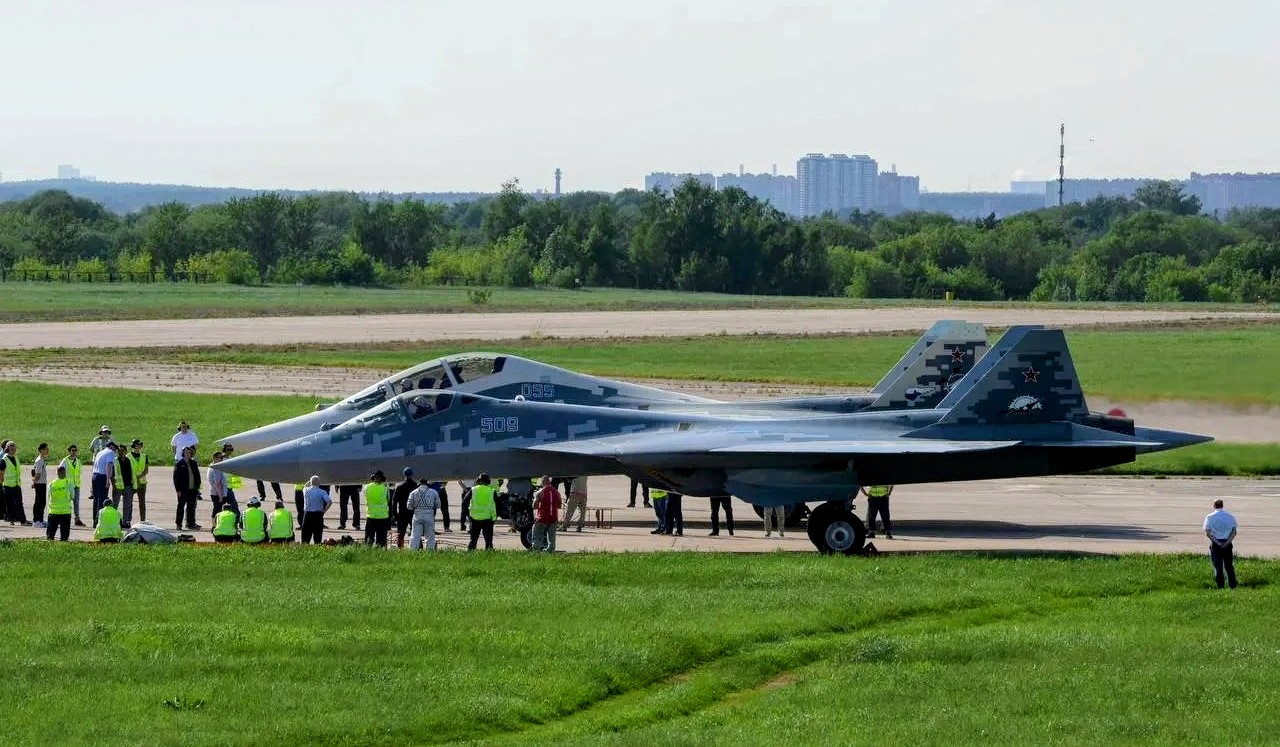
The Su-57 is a large, twin-engine, single-seat multirole fighter designed to combine stealth, speed and the extreme agility for which Sukhoi jets are famous. It carries weapons in internal bays, has thrust-vectoring engines and an array of radars spread around the airframe.
It grew out of the PAK FA programme, launched in 1999. The T-50 prototype first flew on 29 January 2010, the aircraft was named Su-57 in 2017, a contract for 76 jets was signed in June 2019, and the first production aircraft reached the Russian air force in December 2020. A two-seat version, the Su-57D, first flew in May 2026.
Why India left the programme in 2018
India was once Russia’s partner. In 2007 the two countries agreed to co-develop a Fifth Generation Fighter Aircraft (FGFA) based on the PAK FA. By 2018, India pulled out. Reports at the time cited concerns that stealth was limited outside the front of the aircraft, that the engines could not deliver supercruise, that avionics and sensors fell short, and that cost and technology-sharing terms were unsatisfactory. India instead put its money into the AMCA and the Rafale.
Design: agility first, stealth second
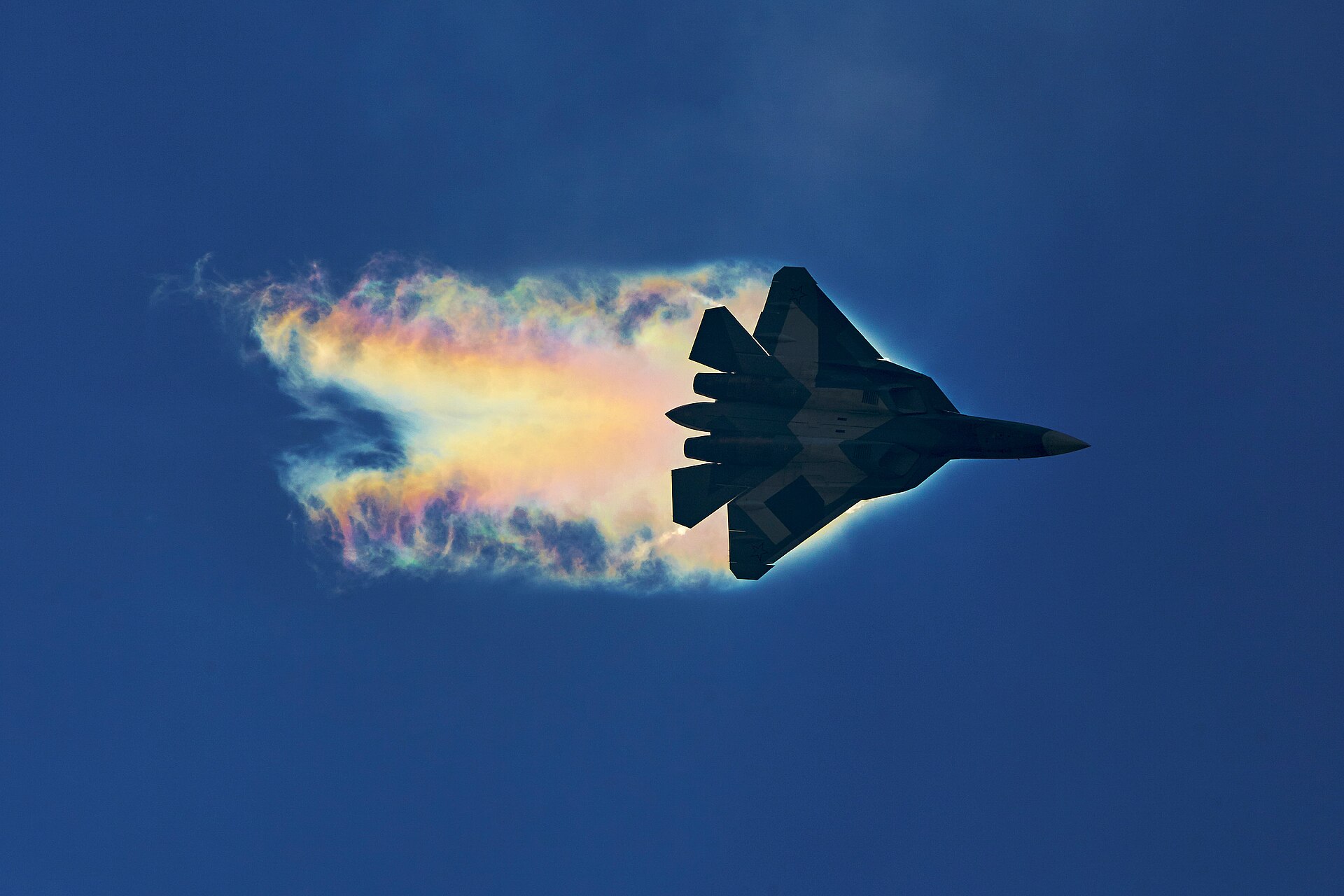
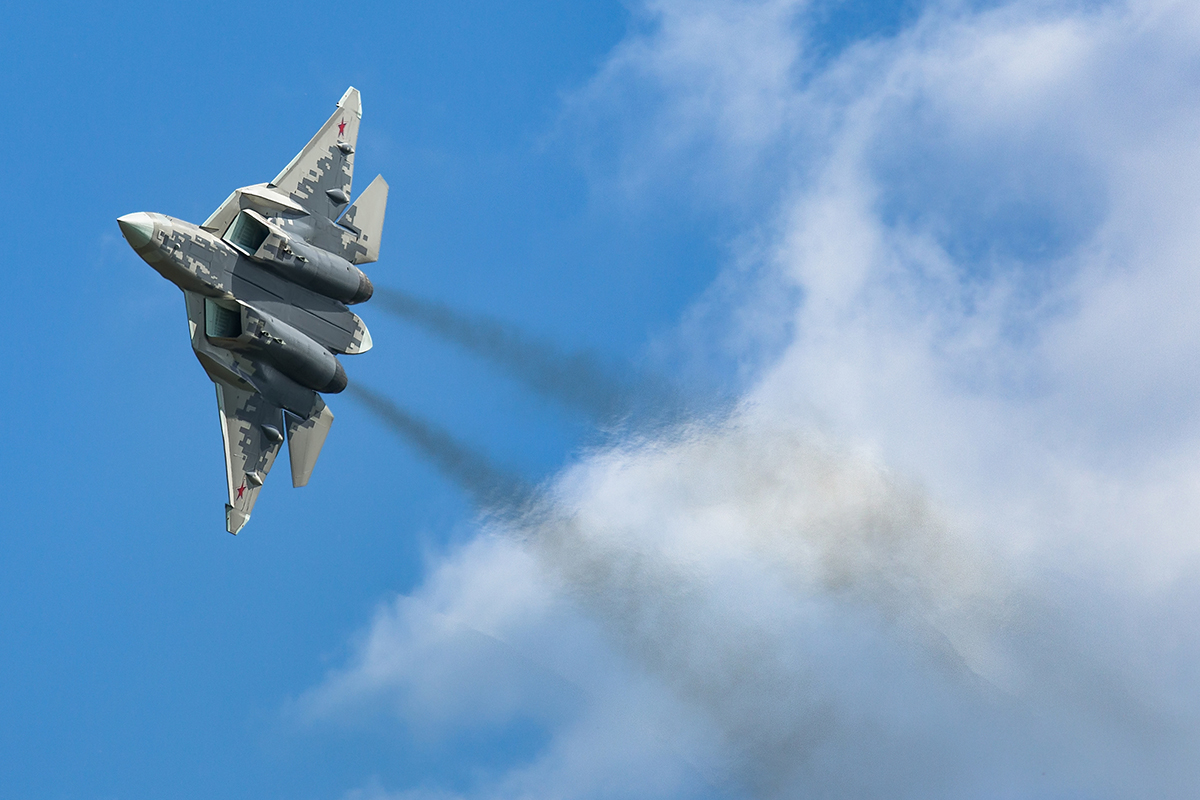
- Manoeuvrability: thrust-vectoring engines and moving wing surfaces make the Su-57 one of the most agile fighters ever built.
- Internal weapons: two large tandem bays under the fuselage and two smaller side bays let it carry missiles without hurting its radar signature.
- Sensors: an AESA radar in the nose plus side-looking and wing-root radars, with infrared and electro-optical sensors.
- Speed: top speed around Mach 2, with Russian claims of supercruise at about Mach 1.3, a claim critics question with current engines.
How stealthy is it really?
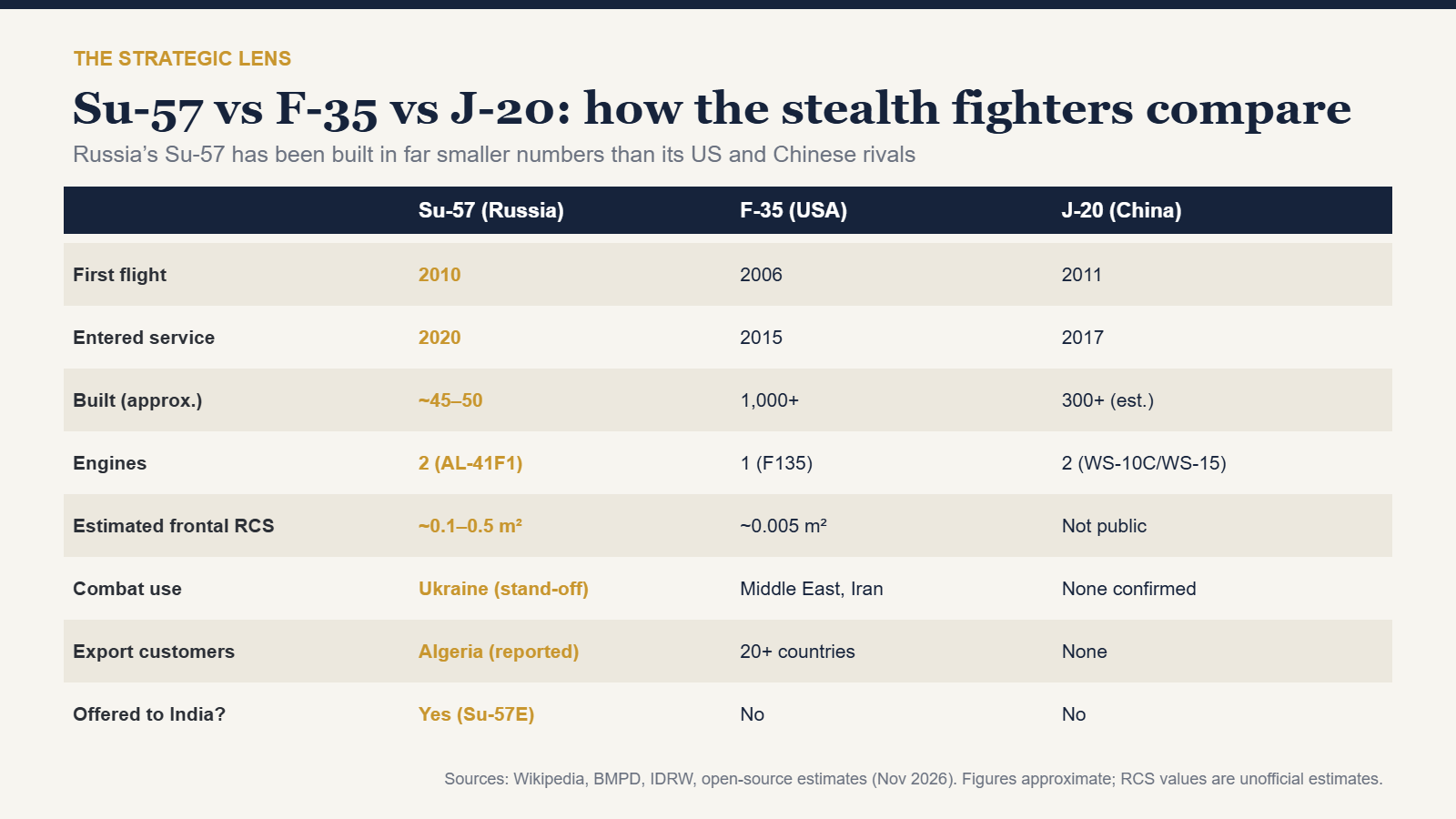
This is the heart of the debate. Sukhoi’s own patent aimed for a radar cross-section of roughly 0.1 to 1 square metre, much smaller than older Sukhoi jets. Open-source estimates put the F-35 at around 0.005 square metres, though all such numbers are unofficial and hard to compare.
Analysts point to visible features that weaken stealth: exposed engine faces in some views, a less stealthy rear fuselage, and, on a prototype shown at Zhuhai in 2024, visible rivets, screws and panel gaps. Production jets are said to be better finished. The fair summary is that the Su-57 is stealthier than a Su-30 or Su-35, especially from the front, but not in the same league as the F-35 or F-22.
The engine problem
Current Su-57s fly with the AL-41F1 (izdeliye 117) engine, about 142 kN with afterburner, an evolution of the Su-35’s engine. The intended “second-stage” engine has been in testing since 2017 and has struggled. In late 2025, Russia revealed a new engine called izdeliye 177, combining technology from both, which first flew on a test aircraft in December 2025. Until a new engine enters production, the Su-57 will fall short of its full design goals.
How many Su-57s exist?
Russia keeps the number secret. Estimates for 2026 range from around 44 built including test aircraft to about 49 production jets, according to the Russian analysis group BMPD. Some reports suggest the operational fleet is smaller. Either way, compared with more than 1,000 F-35s and several hundred J-20s, the Su-57 remains a niche aircraft. Sanctions, the war in Ukraine and limited factory capacity are the main reasons.
The Su-57 in combat: Ukraine
The Su-57 has been used in Ukraine, but cautiously. It typically fires long-range missiles, such as the Kh-69 cruise missile and R-37M air-to-air missile, from inside Russian-controlled airspace rather than flying deep into Ukrainian air defences. Russian claims of air-to-air kills have not been independently confirmed.
It has also proved vulnerable on the ground. In June 2024, Ukrainian drones struck Akhtubinsk air base, and satellite imagery showed a crater next to a Su-57; Russian sources confirmed at least one jet was damaged. Our explainer on how drones are changing war covers why air bases are now so exposed.
Su-57E: Algeria and other buyers
The export version, the Su-57E, was unveiled in 2019. Algeria is widely reported to be the first customer, with around 12–14 jets in a package that included other Sukhoi fighters. Russia’s United Aircraft Corporation said in late 2025 that the first two had gone to an unnamed foreign customer, and footage that appeared to show an Algerian Su-57E surfaced in February 2026. Russia claims other undisclosed buyers.
Russia’s offer to India
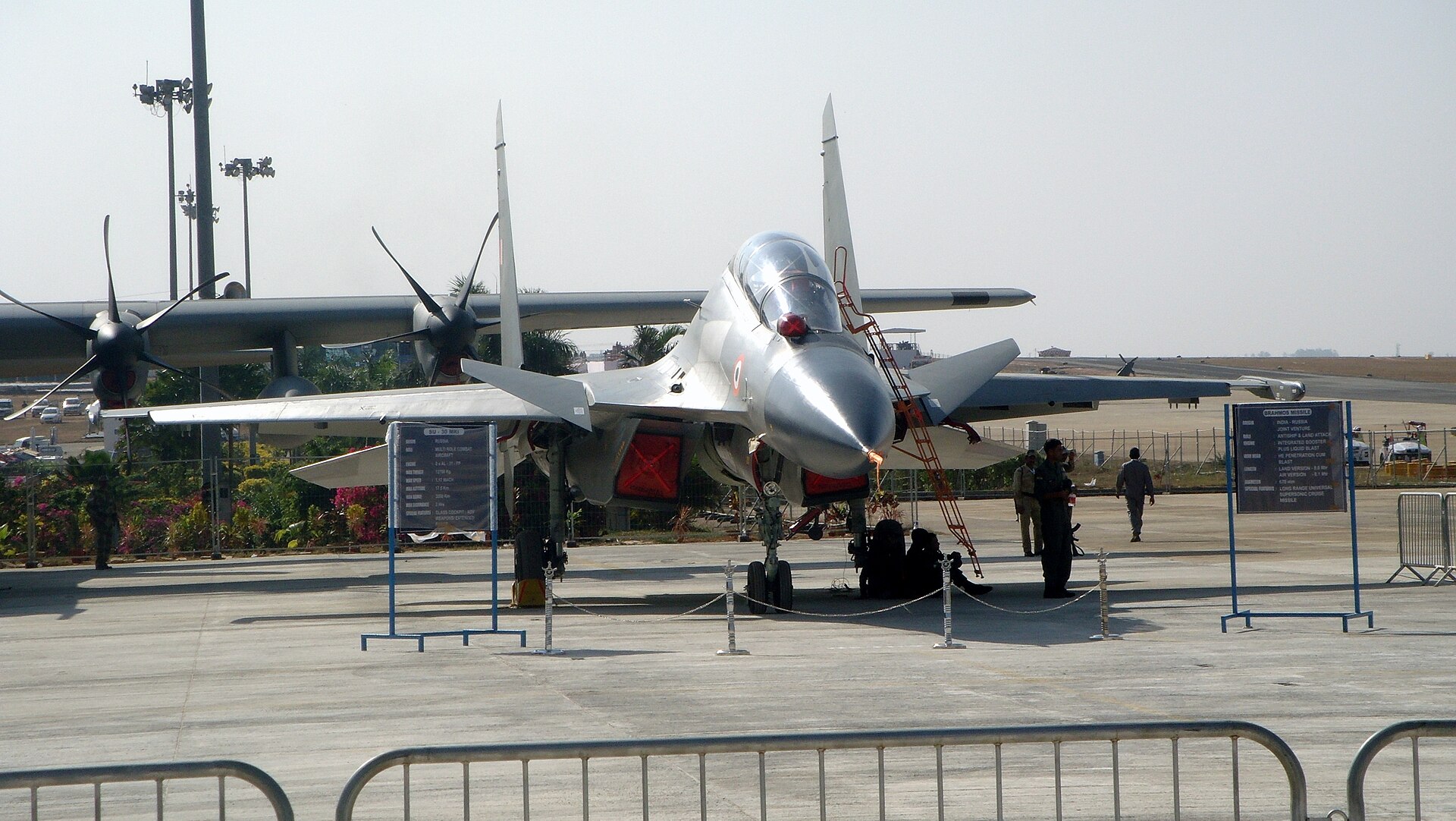
At Aero India in February 2025, Russia pitched the Su-57E to India with licence production at HAL’s Nashik plant, which builds the Su-30MKI, and what Russian officials described as full technology transfer. Indian media reports have said the offer includes access to software source codes and a path to local production of around 100 jets, though these details are not officially confirmed.
In February 2026, the head of United Aircraft Corporation said talks were at an advanced technical stage. But in July 2026, India’s Defence Secretary indicated there were no plans for a new Sukhoi variant, which some outlets read as a rejection. Later reports in October 2026 described India as simply not having agreed. The honest status: there is an offer and there are discussions, but no deal.
Should India buy the Su-57? The case for and against
| Arguments for | Arguments against |
|---|---|
| Fills the stealth gap before the AMCA arrives (mid-2030s) | Stealth is weaker than the F-35 and possibly the J-35 |
| Pakistan may get China’s J-35 years earlier | Engine and production problems are unresolved |
| HAL already builds Sukhois at Nashik | Western sanctions could complicate payments and parts |
| Russia offers deep technology transfer | Money and attention could be diverted from the AMCA |
| Commonality with the large Su-30MKI fleet | India walked away once over the same weaknesses |
The context matters. The reported Pakistani interest in China’s J-35, the long wait for India’s own AMCA and the Air Force’s squadron shortage are all pushing the stopgap debate. For a wider look, see our India–Pakistan military balance analysis and the 114-Rafale deal.
Common misconceptions
- “The Su-57 is as stealthy as the F-35.” Most independent estimates say it is significantly less stealthy, especially from the sides and rear.
- “It has never been used in combat.” It has, in Syria briefly and in Ukraine, mostly firing missiles from long range.
- “India has already rejected it.” Official statements have been ambiguous. There is no deal, but the offer has not been formally closed.
- “Russia has hundreds.” Estimates suggest about 45–50 built, far fewer than the F-35 or J-20.
Our take
The Su-57 is a genuinely capable, highly agile fighter held back by weaker stealth, unfinished engines and tiny production numbers. In Russian service it is a useful long-range missile carrier rather than the game-changing stealth jet Moscow advertises.
For India, the offer is tempting on paper because of the technology transfer and the Nashik production line. But buying it would mean accepting the same compromises India rejected in 2018, plus new sanction risks. A small, carefully negotiated purchase to bridge the gap to the AMCA is defensible; a large buy that slows the AMCA is not. Watch whether the Su-57’s new engine enters production, and whether Pakistan actually receives J-35s, before India decides.
Frequently asked questions
What is the Su-57 Felon?
The Su-57, known to NATO as Felon, is Russia’s twin-engine fifth-generation fighter. It first flew in 2010 and entered service in December 2020.
How many Su-57s does Russia have?
Russia does not publish the number. Estimates in 2026 range from about 44 aircraft including test jets to about 49 production aircraft.
Is the Su-57 really stealthy?
It is stealthier than older Russian jets, especially from the front, but most analysts consider it less stealthy than the US F-35 and F-22.
Has India bought the Su-57?
No. Russia has offered the Su-57E with licence production and technology transfer, and talks have taken place, but India has not agreed to buy it as of November 2026.
Which countries have bought the Su-57?
Algeria is widely reported to be the first export customer. Russia says it has other undisclosed buyers.
Why did India leave the FGFA programme?
India withdrew in 2018, citing concerns about limited stealth, engines, avionics and sensors, as well as cost and technology-sharing terms.
Sources and further reading
Researched using official statements and published reporting up to 6 November 2026.


Leave a Reply