
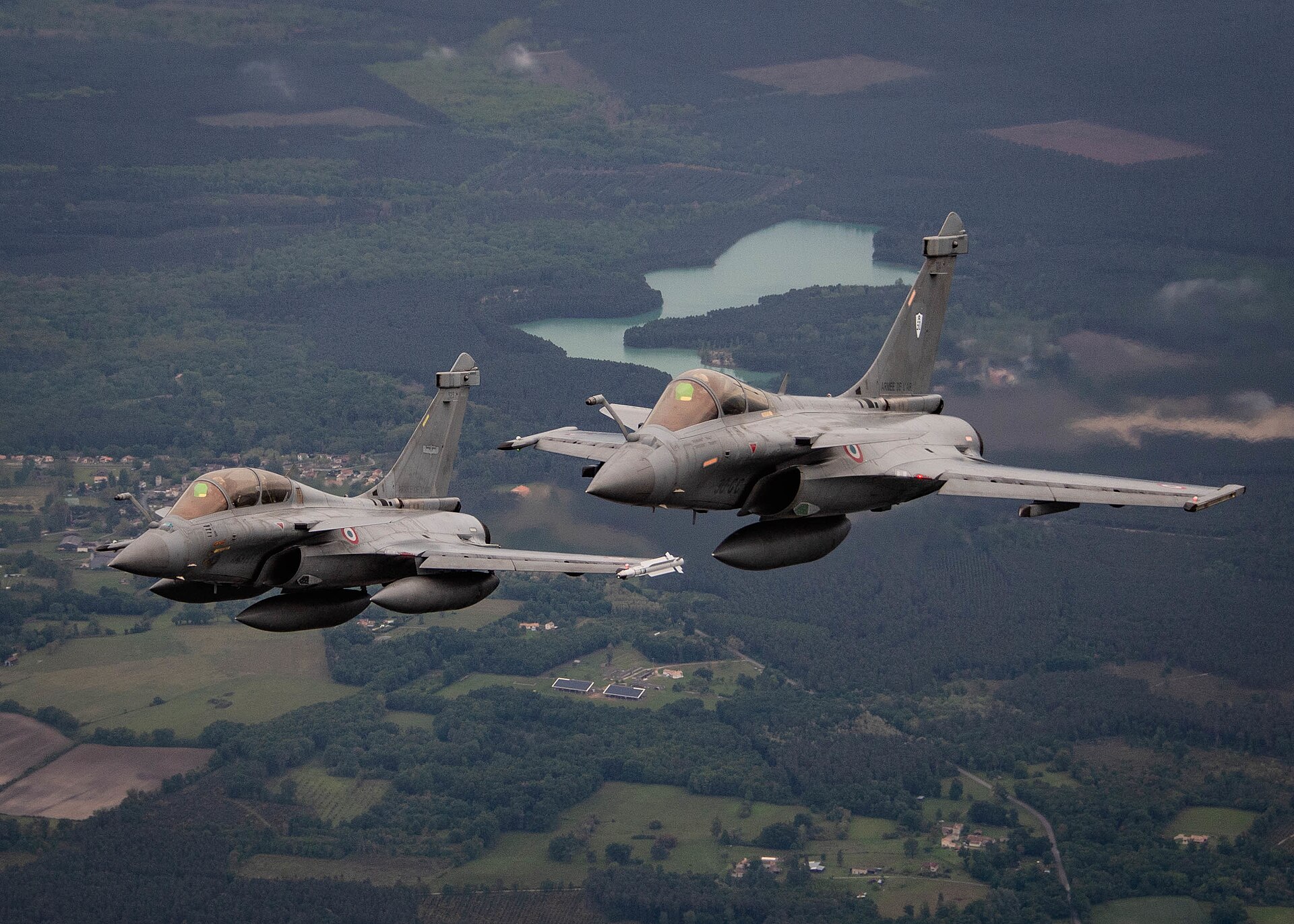
On 2 March 2026, Emmanuel Macron stood at Île Longue, the Brittany base that houses France’s nuclear-armed submarines, and announced the biggest change to French nuclear policy in decades. France would build more warheads for the first time since the Cold War, stop publishing how many it has, and offer to station nuclear-capable aircraft temporarily in allied countries. “To be free, one needs to be feared,” he said.
With doubts growing over America’s commitment to Europe and Russia brandishing its own arsenal, the French nuclear deterrent is suddenly at the centre of European security. This guide explains what France has, what Macron changed, which countries are involved and what critics say.
Quick answer: France has an estimated 290 nuclear warheads: about 240 on M51 missiles carried by four Triomphant-class submarines, and about 50 on ASMP-A missiles carried by Rafale jets. In March 2026, Macron ordered an increase in warhead numbers, stopped disclosing the total and launched “forward deterrence”, allowing French nuclear-capable aircraft to deploy temporarily to eight European partners. Decisions on nuclear use remain France’s alone.
France’s nuclear deterrent at a glance
| Warheads | About 290 (2024 estimate); increase ordered in 2026, number no longer disclosed |
| Sea leg | 4 Triomphant-class SSBNs with M51 missiles; one always at sea |
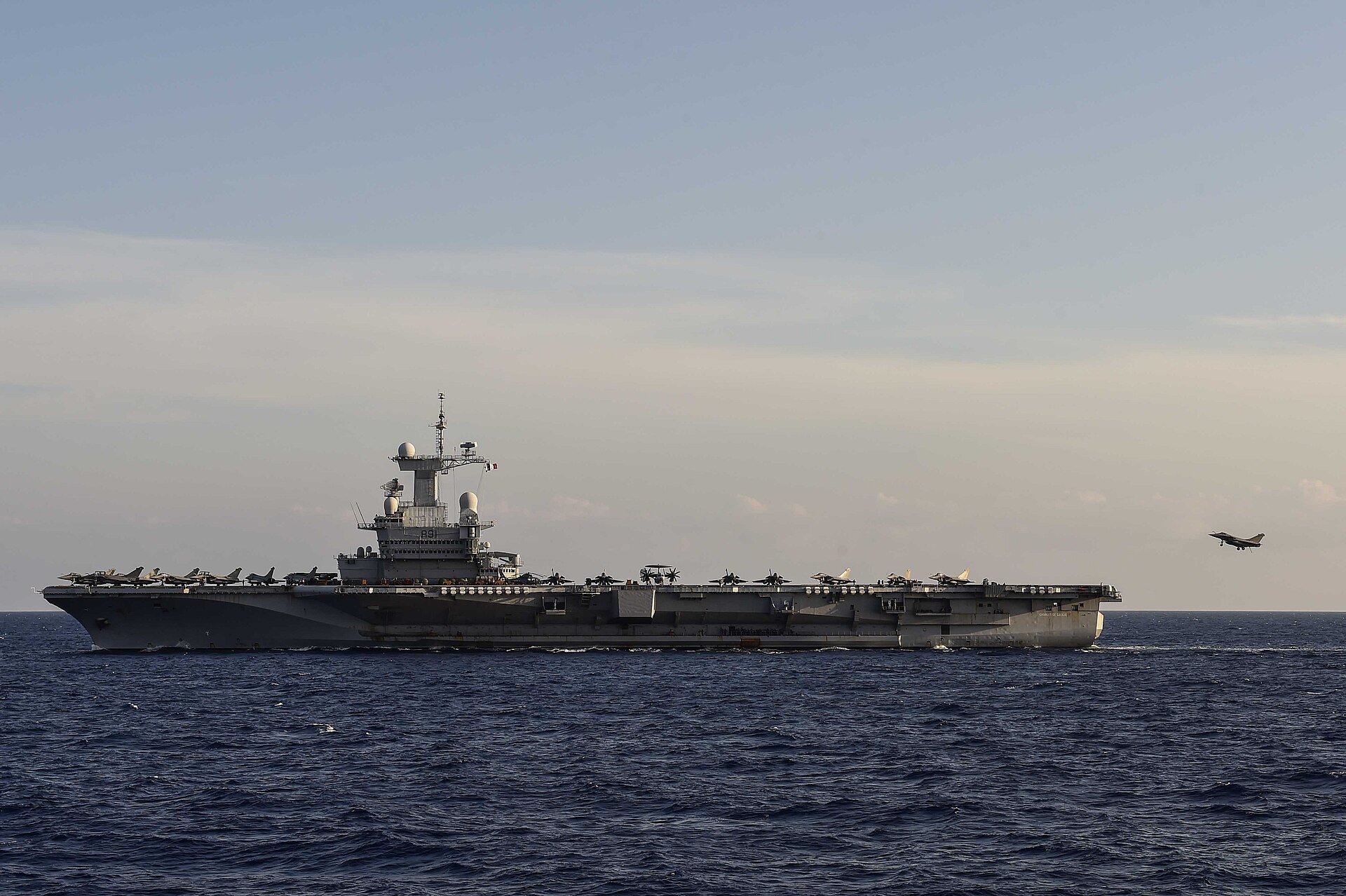
| Air leg | Rafale jets with ASMP-A cruise missiles, including from the carrier Charles de Gaulle |
| Land leg | None since 1996 |
| First test | Gerboise Bleue, 13 February 1960, Algeria |
| Last test | January 1996 |
| Doctrine | Strictly strategic, “vital interests” with a European dimension, possible single “final warning” strike |
| 2026 change | “Forward deterrence” with eight European partners |
In this article
- What France has: the force de frappe
- A short history: from Algeria to the Pacific
- The doctrine: vital interests and a “final warning”
- What Macron announced at Île Longue
- Which countries are involved?
- Why now?
- How much does it cost?
- The critics
- What it means for India
- Common misconceptions
- Our take
- Frequently asked questions
- Sources and further reading
What France has: the force de frappe
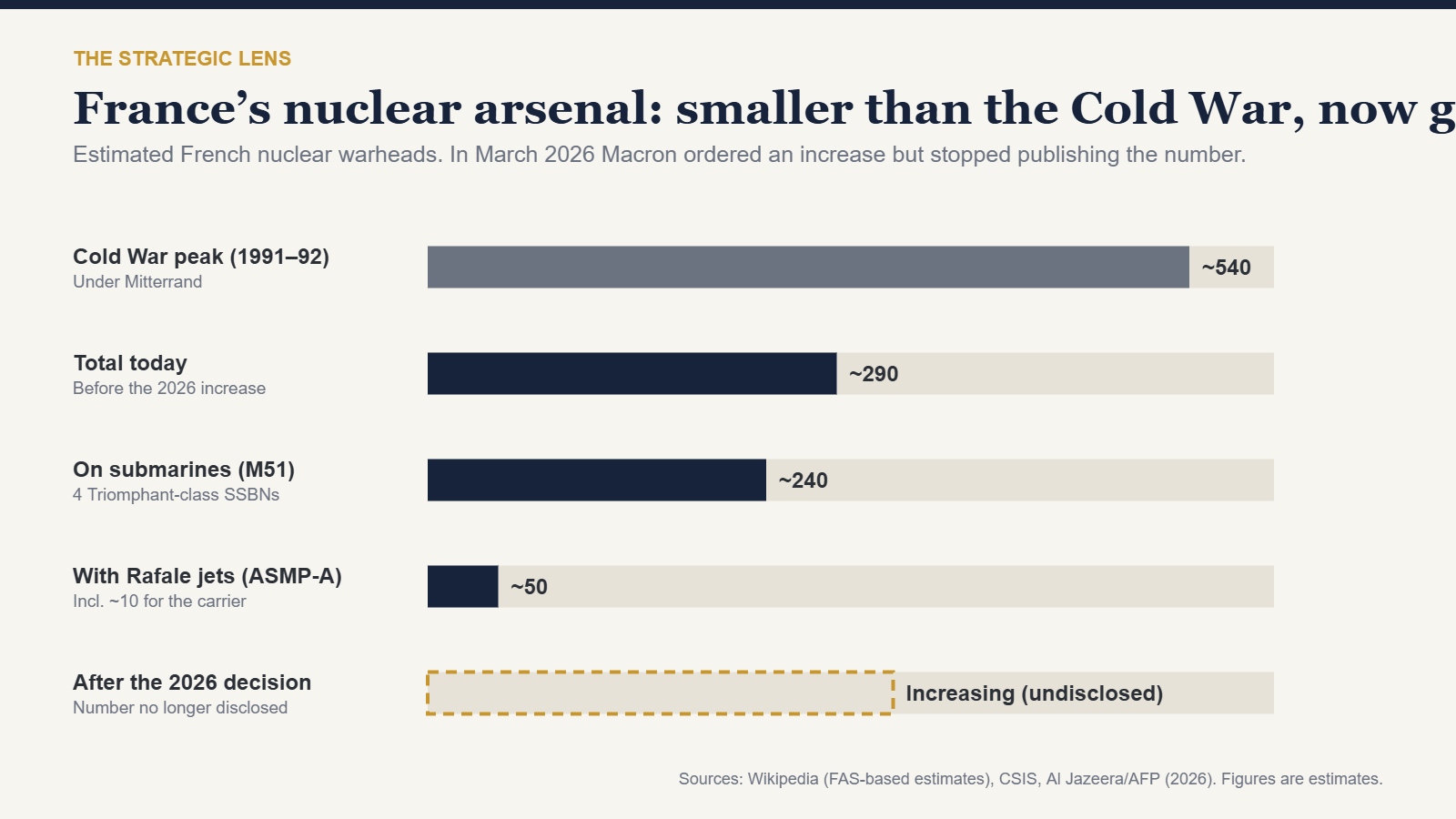
France’s nuclear force, the force de frappe or force de dissuasion, is the fourth-largest confirmed arsenal in the world, after those of Russia, the United States and China. It peaked at about 540 warheads in 1991–92 and was cut to about 290 after the Cold War.
- Submarines: about 240 warheads on 48 M51 missiles, carried by four Triomphant-class ballistic missile submarines (SSBNs). At least one has been on patrol at all times since the early 1970s.
- Aircraft: about 50 warheads on ASMP-A supersonic cruise missiles carried by Rafale fighters, including roughly 10 for the carrier Charles de Gaulle.
- No land-based missiles: France scrapped its silo-based missiles in 1996. Like the UK, it relies on submarines and aircraft.
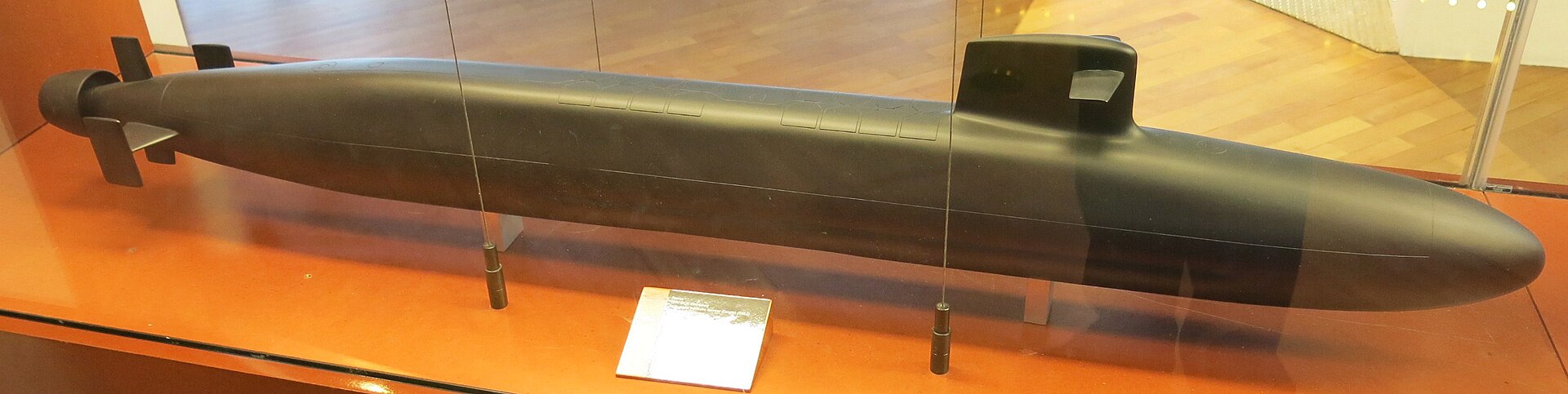
Both legs are being modernised. A new generation of submarines, the SNLE 3G, is planned for the 2030s, and a hypersonic air-launched missile, the ASN4G, will replace the ASMP-A.
A short history: from Algeria to the Pacific
France authorised its nuclear weapons programme in 1954 and became the fourth country to test a bomb, codenamed Gerboise Bleue, in the Algerian Sahara on 13 February 1960. Its first hydrogen bomb followed in 1968 over Fangataufa atoll in French Polynesia. In total, France carried out 210 tests: 17 in Algeria and 193 in Polynesia. The last took place in January 1996, after which France signed the Comprehensive Test Ban Treaty.
Charles de Gaulle built the deterrent to guarantee French independence from both superpowers. France is still the only NATO member that does not take part in the alliance’s Nuclear Planning Group, a legacy of that Gaullist insistence on sovereignty.
The doctrine: vital interests and a “final warning”
French doctrine has three key features:
- Strictly strategic: nuclear weapons are for deterrence only, not for fighting wars. Macron again rejected tactical nuclear weapons in 2026.
- Vital interests: France would use nuclear weapons only if its vital interests were threatened. Since a 2020 speech, Macron has said these interests have a “European dimension”, though they are deliberately left undefined.
- The final warning: France reserves the option of a single, non-renewable nuclear “warning” strike to restore deterrence before an all-out exchange.
What Macron announced at Île Longue
In his 2 March 2026 speech, Macron announced several changes at once:
- More warheads: he ordered an increase in the number of nuclear warheads, the first quantitative increase since at least 1992.
- Less transparency: France will no longer disclose the size of its arsenal, reversing past practice.
- “Forward deterrence”: elements of France’s strategic air forces can deploy temporarily to allied countries, spreading nuclear-capable Rafales across Europe in a crisis.
- A conventional pillar: partners would help with early warning, air and missile defence, and long-range strike to support French nuclear operations.
- No sharing of the button: there will be no shared planning, no joint decision on nuclear use and no collective definition of France’s vital interests.
Macron also replaced the old cap of 300 warheads with what analysts call a “dynamic” sufficiency: enough to overwhelm an adversary’s defences and inflict unacceptable damage.
Which countries are involved?
Eight European countries agreed to take part in the new arrangements, according to AFP: the United Kingdom, Germany, Poland, the Netherlands, Belgium, Greece, Sweden and Denmark. The UK is described as the forerunner, building on the July 2025 Northwood Declaration, in which London and Paris said there was no extreme threat to Europe that would not prompt a response from both. Germany is the lead continental partner, and a Franco-German High-Level Nuclear Steering Group was set up the same day. Reports in 2026 suggested Norway and Finland were also open to closer dialogue.
Why now?
- Russia: Moscow’s nuclear threats, its lowered threshold and its deployment of the Oreshnik missile in Belarus, explained in our guide to Russia’s nuclear weapons.
- American doubts: European leaders worry about the reliability of the US nuclear umbrella. See our piece on NATO 3.0.
- Arms control collapse: the end of New START in February 2026.
- Hybrid war: drones, sabotage and airspace violations along NATO’s eastern flank, covered in our Russia vs NATO explainer.
How much does it cost?
The deterrent is expensive. The submarine force alone costs nearly €4 billion a year to maintain, roughly 13 percent of the defence budget, according to CEPA. A RAND estimate cited by Euro-sd puts the long-term average cost of France’s nuclear forces at about 0.7 percent of GDP. Building more warheads and new submarines will push those costs higher at a time when France’s public finances are already stretched.
The critics
- “Too little, too late”: Carnegie’s Ulrich Kühn argued France will not permanently base weapons abroad or share decision-making, so it cannot replace America’s umbrella.
- Politics: the arrangements depend on the French president. Allies worry a victory by Marine Le Pen’s National Rally in 2027 could change them.
- Credibility: some experts say France’s small, retaliation-focused arsenal is not designed for limited nuclear threats, and that words may be outpacing capability.
- Tiers: others warn of an uneven system where some allies get steering groups and others do not.
Supporters counter that Macron delivered as much as any French president could without giving up sovereignty, and that the speech was among the most significant on nuclear policy by a Western leader since the Cold War.
What it means for India
- Different doctrines: India has a No First Use policy; France keeps ambiguity and the “final warning” option. Both describe their weapons as strictly strategic. See our guide to India’s nuclear triad.
- A trusted partner: France was one of the few countries that did not condemn India’s 1998 nuclear tests, and it was the first to sign a civil nuclear agreement with India after 2008.
- A changing world: Europe building up its own nuclear deterrence is part of a wider move towards more nuclear weapons and less arms control, which affects India’s security environment too.
Common misconceptions
- “France is sharing its nuclear button with Europe.” No. Decisions remain entirely French. Allies can host aircraft and support operations.
- “France will station nuclear weapons permanently in Germany.” The plan is for temporary deployments of aircraft, not permanent bases for warheads.
- “France announced how many warheads it will have.” It did not. It ordered an increase and stopped publishing the figure.
Our take
Macron’s Île Longue speech marked a real shift: France has moved from saying its deterrent has a European dimension to building the practical arrangements to back that up. It is not a replacement for the US umbrella, and it was never meant to be. But it gives Europe a second, independent layer of nuclear deterrence at a time when Russia is testing the alliance.
Watch three things: the first actual deployment of French nuclear-capable Rafales to an ally, how the 2027 French presidential election affects the policy, and whether the UK and France move towards a more joint European deterrent.
Frequently asked questions
How many nuclear weapons does France have?
France was estimated to have about 290 warheads before 2026. In March 2026 Macron ordered an increase and said France would no longer disclose the total.
What did Macron announce in his 2026 nuclear speech?
On 2 March 2026 at Île Longue, he ordered more warheads, ended public disclosure of the arsenal’s size and launched “forward deterrence”, allowing French nuclear-capable aircraft to deploy temporarily to allied countries.
Which countries are part of France’s forward deterrence?
The UK, Germany, Poland, the Netherlands, Belgium, Greece, Sweden and Denmark agreed to take part, according to AFP.
Can other countries use France’s nuclear weapons?
No. Macron said there would be no shared planning or joint decision-making on nuclear use. The decision remains the French president’s alone.
Does France have land-based nuclear missiles?
No. France dismantled its land-based missiles in 1996 and now relies on submarines and aircraft.
When did France last test a nuclear weapon?
In January 1996. France then signed the Comprehensive Test Ban Treaty and ratified it in 1998.
Sources and further reading
Researched using official statements and published reporting up to 6 November 2026.
- CSIS: Macron’s Île-Longue speech, 4 Mar 2026
- Al Jazeera (AFP): France to increase nuclear warheads, 2 Mar 2026
- Carnegie Endowment: Is France’s new nuclear doctrine ambitious enough?, 12 Mar 2026
- ECFR: Under my parapluie, 17 Mar 2026
- CEPA: French defence funding, 12 Mar 2026
- Wikipedia: France and weapons of mass destruction


Leave a Reply