

On the night of 9–10 September 2025, around 20 Russian drones crossed into Poland. NATO fighter jets shot some of them down, the first time allied aircraft had engaged Russian drones over NATO territory. Nine days later, three Russian MiG-31s sat in Estonian airspace for about 12 minutes. Since then, drones over airports, cut undersea cables, arson attacks and sabotage plots have become a regular part of European news.
This is the Russia vs NATO confrontation in 2026: not a war, but not peace either. This guide explains the grey-zone campaign, the flashpoints along NATO’s eastern flank, how NATO is responding, and how real the risk of a direct clash has become.
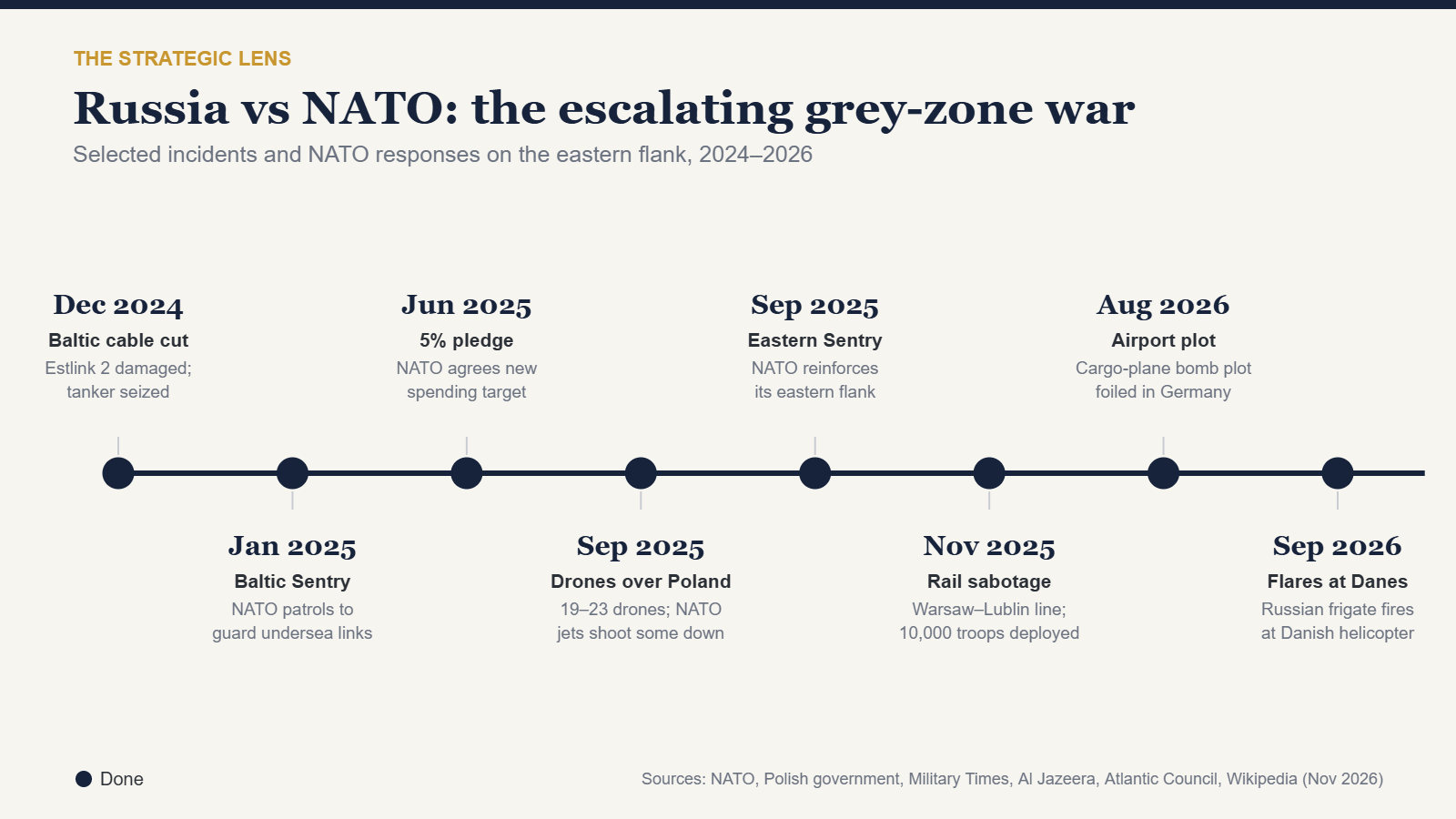
Quick answer: Russia and NATO are locked in a “grey-zone” conflict below the threshold of war: drone and jet incursions, undersea cable damage, sabotage and cyberattacks, mainly targeting Poland, the Baltic states and the Nordics. NATO has responded with new operations, Baltic Sentry and Eastern Sentry, and a pledge to spend 5% of GDP on defence by 2035. European intelligence services warn the risk of escalation is rising.
In this article
- What is the grey-zone war?
- The Poland drone incursion (September 2025)
- The Baltic Sea: “NATO’s lake” under pressure
- Sabotage, arson and assassination plots
- The eastern flank: Kaliningrad and the Suwałki Gap
- How NATO is responding
- The American question
- How likely is a direct war?
- Why it matters for India and Asia
- Common misconceptions
- Our take
- Frequently asked questions
- Sources and further reading
What is the grey-zone war?
Grey-zone or hybrid warfare means hostile actions designed to harm an opponent without triggering a full military response. For Russia, the aim appears to be to test NATO’s reactions, intimidate European publics, punish support for Ukraine and sow division, while keeping enough deniability to avoid NATO’s Article 5 collective defence clause.
Denmark’s defence intelligence service put it bluntly in September 2026: “The hybrid war is escalating.” Not every incident can be proven to be Russian, and Moscow denies involvement, but European governments attribute a growing number to Russian intelligence services.
The Poland drone incursion (September 2025)
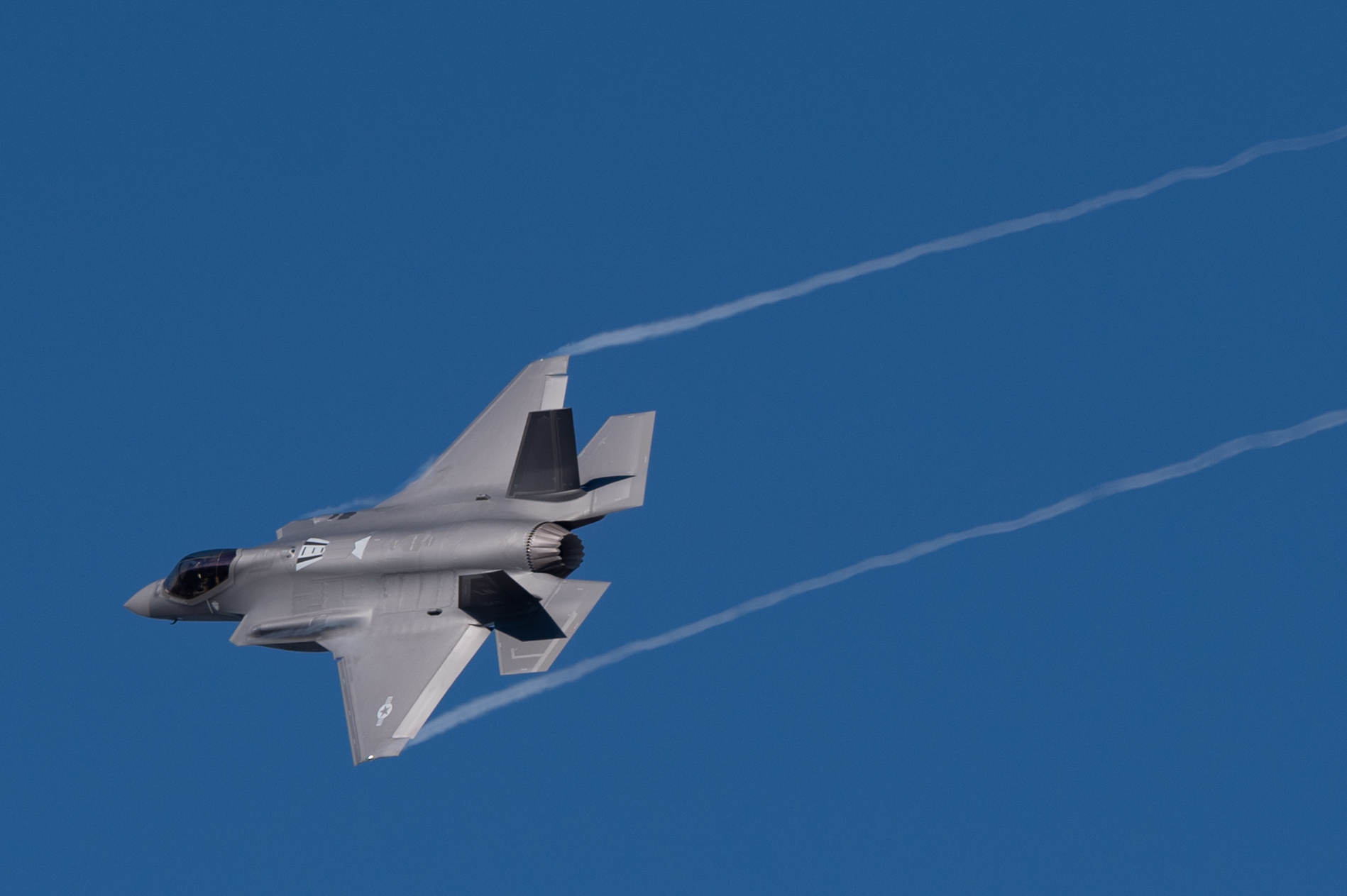
- Between 19 and 23 drones entered Polish airspace during a Russian attack on Ukraine, flying deep into the country over about seven hours.
- NATO aircraft, mainly Dutch F-35s, shot down up to four. Polish prosecutors said those recovered were unarmed Gerbera decoy drones.
- Poland requested consultations under NATO’s Article 4. Russia denied targeting Poland and claimed the drones lacked the range.
- Germany’s defence minister said the drones were “quite obviously” deliberately directed. A stray Polish air-to-air missile damaged a house during the interception.
Two days later, on 12 September 2025, NATO launched Operation Eastern Sentry to reinforce air defence along the eastern flank, with jets, ships and air defence systems from several allies.
The Baltic Sea: “NATO’s lake” under pressure
With Finland joining NATO in 2023 and Sweden in 2024, almost the entire Baltic coastline belongs to the alliance, apart from Russia’s St Petersburg area and its Kaliningrad exclave. But the sea is crowded with undersea cables and pipelines, and it has become a key arena for hybrid attacks.
- Cable damage: in December 2024, the Estlink 2 power cable between Finland and Estonia was damaged; Finland seized a tanker linked to Russia’s shadow fleet.
- Baltic Sentry: in January 2025 NATO launched an open-ended operation to protect undersea infrastructure.
- Harassment: in September 2026 a Russian frigate fired flares at a Danish military helicopter near Denmark’s coast. Danish intelligence warned Russian forces were acting increasingly aggressively towards NATO units in the Baltic.
Sabotage, arson and assassination plots
Across Europe, investigators have linked a string of incidents to Russian intelligence, often carried out by locally recruited agents paid small sums online. Reported cases include:
- Sabotage of a railway line between Warsaw and Lublin in November 2025, after which Poland deployed thousands of troops to protect infrastructure.
- Dozens of arrests: Poland said in October 2025 it had detained 55 people suspected of acting for Russian intelligence; Lithuania charged 13 people in April 2026 over an alleged GRU-directed plot.
- A foiled plot in August 2026 to bomb cargo planes at Germany’s Leipzig/Halle airport, which the European Commission said was Russian.
- Five EU intelligence agencies told the Financial Times in October 2026 that Russia was seeking to kill European defence industry executives.
Russia rejects these accusations. But the pattern, combined with cyberattacks on energy systems in Poland and elsewhere, has convinced many European governments that they are already under attack.
The eastern flank: Kaliningrad and the Suwałki Gap
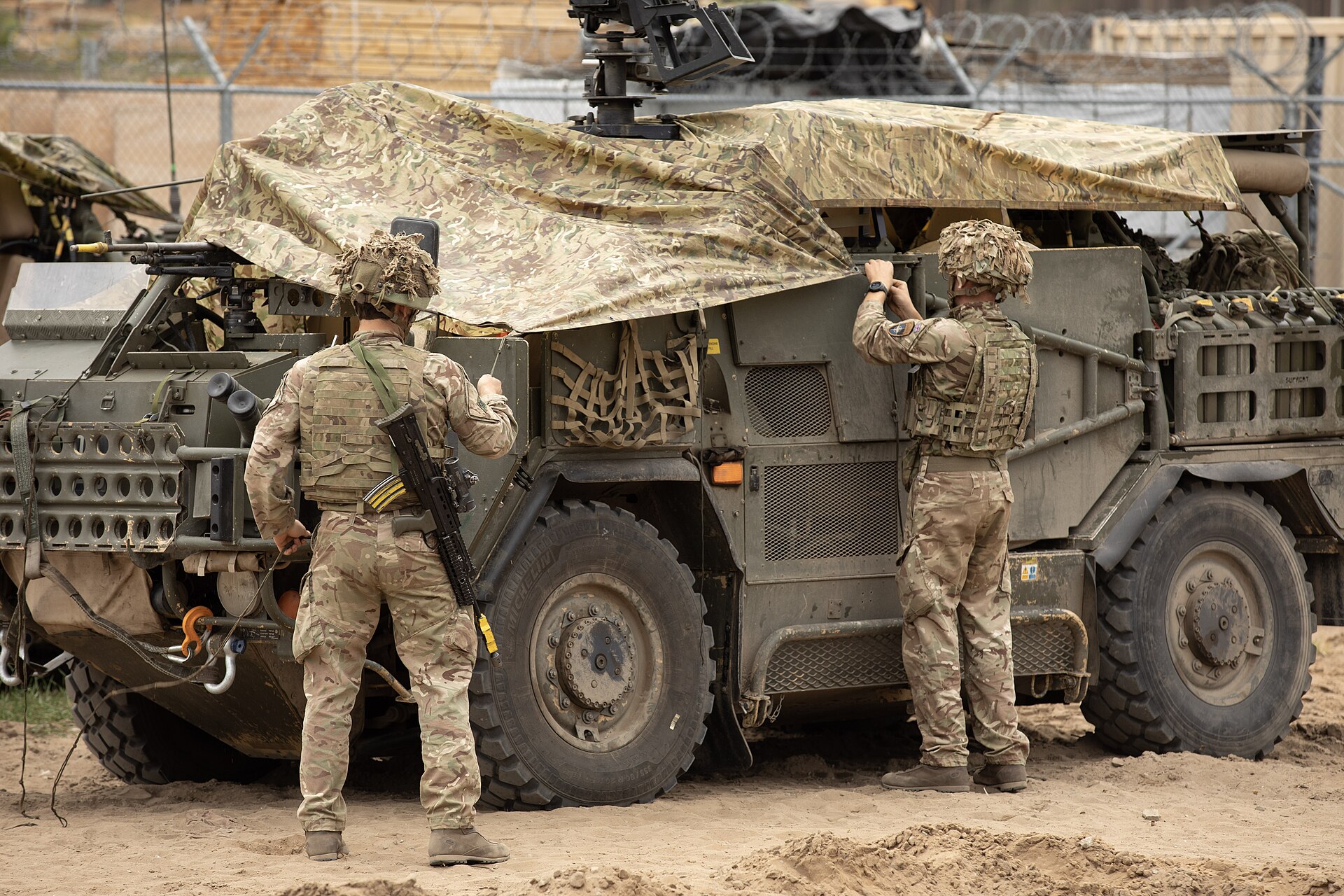
The most worrying point on the map is the Suwałki Gap, a roughly 65 km stretch of the Polish–Lithuanian border between Russia’s Kaliningrad exclave and Belarus. If Russia closed it, the Baltic states would be cut off from the rest of NATO by land.
Russia has rebuilt its forces facing NATO. It recreated the Leningrad Military District in 2024, expanded units in Kaliningrad, and held the large Zapad-2025 exercise with Belarus in September 2025. A French defence study estimated about 40,000 Russian ground troops in the Baltic region, capable of rising to around 100,000 under the cover of exercises. NATO, for its part, has stationed multinational brigades in the Baltic states and Poland.
How NATO is responding
- Spending: at the June 2025 summit in The Hague, allies agreed to spend 5 percent of GDP on defence and security by 2035, including 3.5 percent on core defence. See our piece on Europe’s rearmament boom.
- New operations: Baltic Sentry (January 2025) and Eastern Sentry (September 2025).
- Counter-drone defences: eastern flank states are building border defence lines and counter-drone networks, a lesson from Ukraine covered in our explainer on laser and counter-drone weapons.
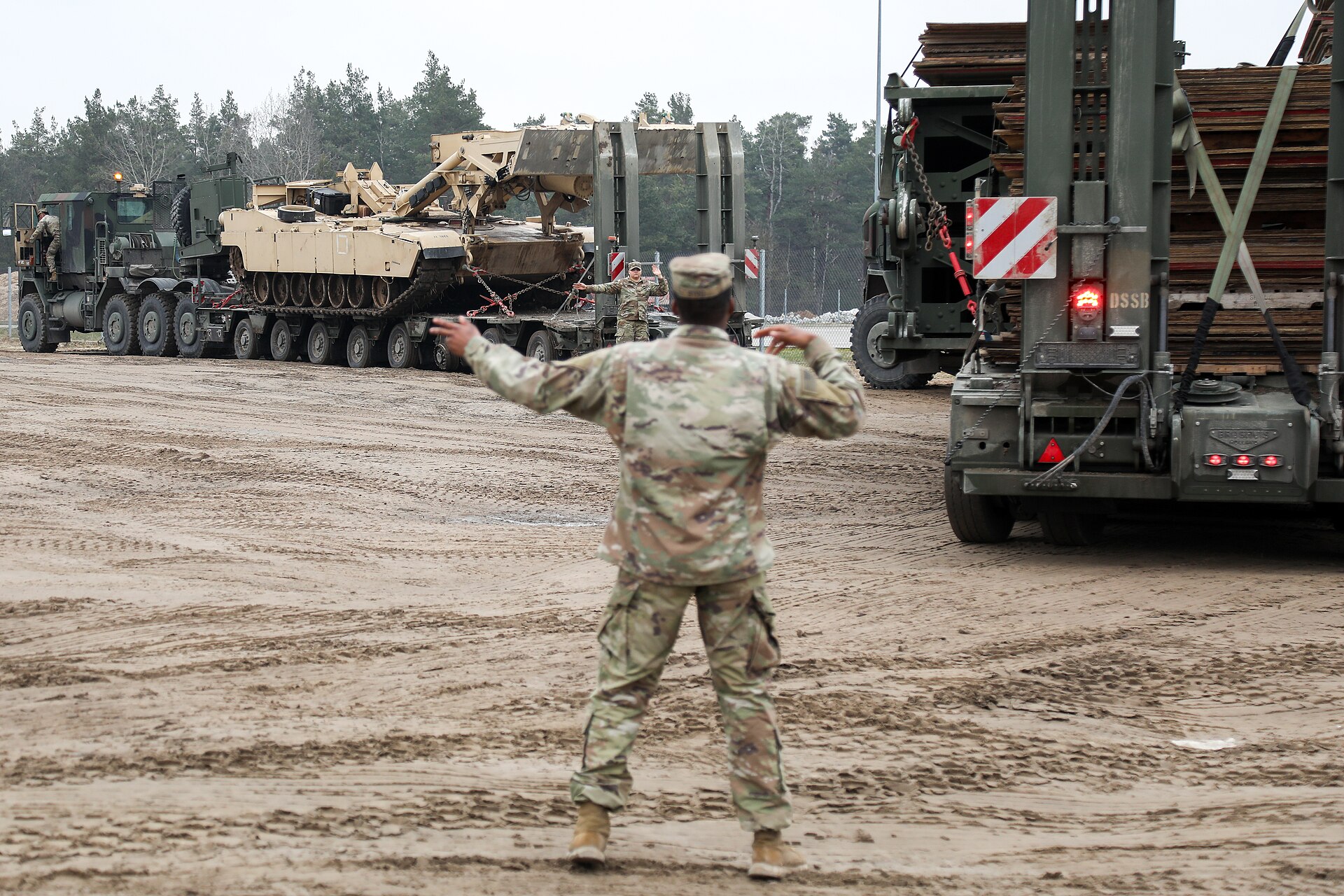
- Forward presence: more troops, air defence and jets stationed in Poland, the Baltics and Finland.
The American question
European anxiety is sharpened by uncertainty about the US commitment. Washington is focused on China and has pressed Europe to take more responsibility, as explained in our piece on NATO 3.0. The FY2027 US budget, covered in our Pentagon budget explainer, prioritises the Indo-Pacific. Many Europeans fear Russia may test whether the US would really defend a Baltic state.
How likely is a direct war?
Opinions differ. Czech intelligence chief Michal Koudelka warned in September 2026 that Russia could attack a NATO member within “months, not years”. Dutch military intelligence has warned of a real risk of unintended escalation. US intelligence says Russia could attack NATO territory in the coming years. Others argue Russia’s military is too stretched in Ukraine, and its economy too strained, to take on NATO directly. See our analysis of Russia’s war economy.
The most realistic danger is not a planned invasion but escalation from an incident: a drone that kills civilians, a collision at sea, or a sabotage attack that causes mass casualties. Russia’s nuclear threats, explained in our guide to Russia’s nuclear weapons, make such a crisis especially dangerous.
Why it matters for India and Asia
- US attention: a crisis in Europe would pull US forces and attention away from Asia, which matters for China’s calculations. See our Russia–China partnership explainer.
- Energy and markets: escalation would hit energy prices and supply chains that India depends on.
- Diplomatic balance: India’s ties with both Russia and the West would face harder choices in a direct NATO–Russia crisis.
Common misconceptions
- “Russia and NATO are already at war.” Not formally. Hybrid attacks are serious, but no NATO member has invoked Article 5 over them.
- “Every drone incident is Russian.” Not always. In 2026, some drones that strayed into Latvia were Ukrainian, diverted by Russian jamming.
- “NATO cannot respond to hybrid attacks.” It has launched new operations, expelled diplomats, arrested agents and boosted defences, though deterrence remains a challenge.
Our take
Russia’s grey-zone campaign is designed to stay just below the line that would trigger NATO’s full response, and so far it has worked well enough to keep Europe on edge. The danger is that each incident pushes the line a little further, until one goes badly wrong.
Watch three things: whether hybrid attacks start causing deaths on NATO soil, whether European states actually meet their new spending targets, and whether the US commitment to the eastern flank holds. The Baltic and Poland are where Europe’s next crisis is most likely to begin.
Frequently asked questions
What happened with Russian drones in Poland?
On 9–10 September 2025, between 19 and 23 Russian drones entered Polish airspace during an attack on Ukraine. NATO jets shot down up to four, and Poland requested Article 4 consultations.
What is Operation Eastern Sentry?
A NATO operation launched on 12 September 2025 to strengthen air defence along the alliance’s eastern flank after the Poland drone incursion.
What is hybrid warfare?
Hostile actions such as sabotage, cyberattacks, airspace incursions and disinformation, designed to harm an opponent without triggering a full military response.
What is the Suwałki Gap?
A roughly 65 km stretch of the Polish–Lithuanian border between Russia’s Kaliningrad exclave and Belarus. Closing it would cut the Baltic states off from NATO by land.
How much has NATO agreed to spend on defence?
At the June 2025 Hague summit, allies agreed to spend 5% of GDP on defence and security by 2035, including 3.5% on core defence.
Could Russia attack NATO?
Some European intelligence chiefs warn it is possible within months or years; others think Russia is too stretched by the Ukraine war. Most see accidental escalation as the bigger near-term risk.
Sources and further reading
Researched using official statements and published reporting up to 6 November 2026.


Leave a Reply