
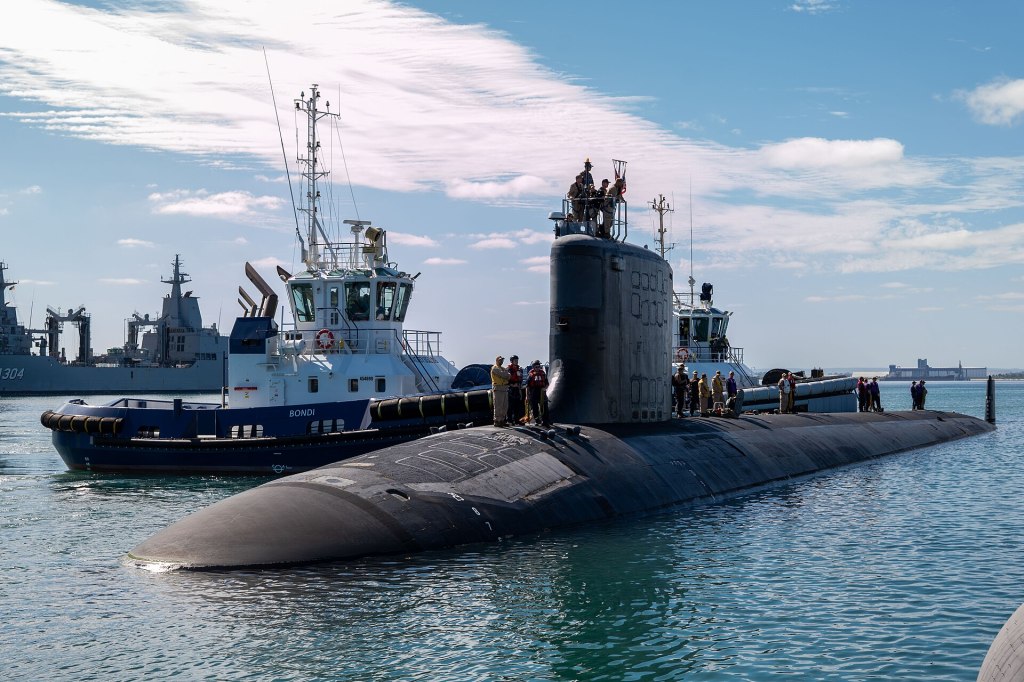
Australia has never operated a nuclear-powered vessel. It does not have a nuclear power station. Yet under AUKUS, the 2021 pact with the United States and the United Kingdom, it is set to become only the seventh country in the world to operate nuclear-powered submarines, and the first to be given access to American naval nuclear propulsion since Britain in 1958.
In May 2026 the plan changed again: instead of buying any brand-new US submarines, Australia will take three second-hand Virginia-class boats. This article explains AUKUS submarines: the original plan, what changed in 2026, the timeline, the cost, the US production problem and whether it can all work.
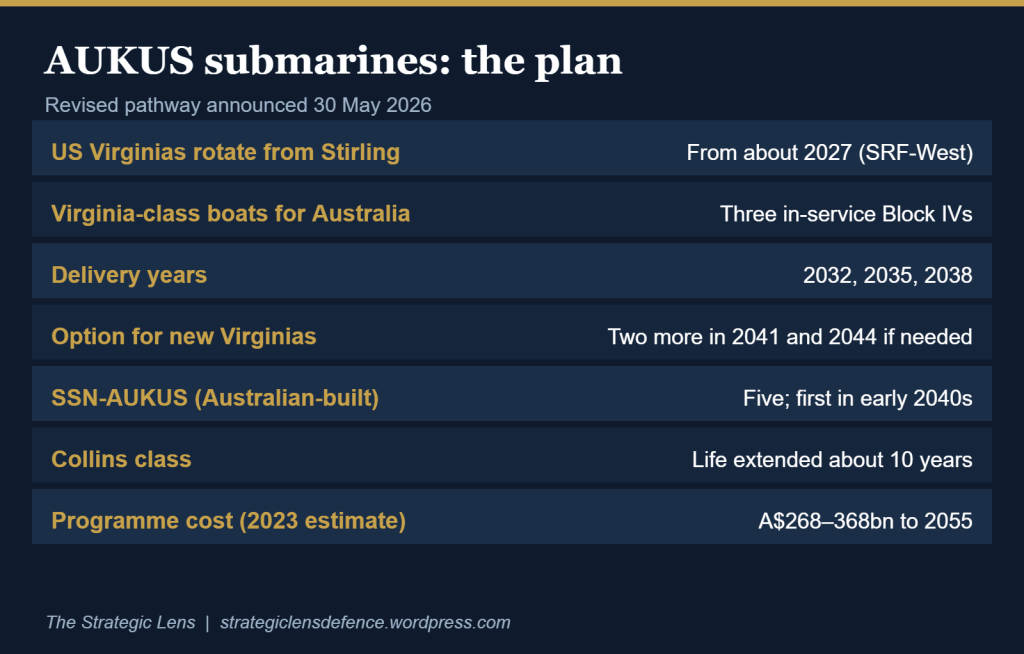
Quick answer: Under the revised plan announced at the Shangri-La Dialogue on 30 May 2026, Australia will receive three in-service Block IV Virginia-class submarines in 2032, 2035 and 2038, with an option for two new ones later. It will then build five SSN-AUKUS submarines, a new British-designed class, in Adelaide from the early 2040s. US and British submarines will start rotating through HMAS Stirling in Western Australia from around 2027. The whole programme was estimated in 2023 at A$268–368 billion to 2055.
In this article
What is AUKUS?
AUKUS was announced in September 2021 by Australia, the UK and the US. It has two parts. Pillar I is about helping Australia acquire conventionally armed, nuclear-powered attack submarines (SSNs). Pillar II covers joint work on advanced technologies such as artificial intelligence, undersea drones, quantum, cyber and hypersonic weapons.
To join AUKUS, Australia cancelled a A$90 billion deal for French diesel-electric submarines, which badly damaged relations with Paris at the time. The submarines will not carry nuclear weapons; Australia remains a non-nuclear-weapon state under the Non-Proliferation Treaty.
Why nuclear-powered submarines?
Australia’s current Collins-class boats are diesel-electric. They are quiet but must regularly come near the surface to run their engines and recharge batteries, which makes them easier to detect. The distances Australia must cover are enormous: from Perth to the South China Sea is more than 5,000 km.
- Endurance: a nuclear reactor lets a submarine stay submerged for months, limited mainly by food for the crew.
- Speed: SSNs can travel at high speed underwater for long periods, reaching distant patrol areas far faster.
- Firepower: Virginia-class boats can carry Tomahawk cruise missiles, giving Australia long-range strike from under the sea, as we explain in our guide to Australia’s long-range missiles.
The 2023 “Optimal Pathway”
In March 2023, the three leaders announced the detailed plan, called the Optimal Pathway:
- From 2027, US and UK submarines would rotate through HMAS Stirling near Perth as Submarine Rotational Force-West.
- From the early 2030s, Australia would buy three to five Virginia-class submarines: two refurbished boats already in US service, and at least one new one.
- A new class, SSN-AUKUS, based on a British design with American technology, would be built in the UK and in Adelaide, with Australian boats from the early 2040s.
- The estimated cost was A$268–368 billion through to the mid-2050s.
In 2025, the Trump administration ordered a review of AUKUS led by Under Secretary of Defense Elbridge Colby, a known sceptic of exporting Virginias while the US Navy is short of submarines. In October 2025 the plan was reported to have survived “broadly unchanged”.
What changed in 2026
On 30 May 2026, at the IISS Shangri-La Dialogue in Singapore, Defence Minister Richard Marles announced with his US and UK counterparts that Australia would acquire three in-service Block IV Virginia-class submarines rather than a mix of used and new boats. They come from a group of submarines commissioned between 2020 and 2028.
Marles said the change would streamline the plan and save significant money. Under the old plan, Australia faced “almost having four classes of submarines operating at the same time”: Collins, older Virginias, newer Virginias and SSN-AUKUS. Now all three Virginias will be the same type. The option to buy two new Virginias, in 2041 and 2044, is kept in case SSN-AUKUS is delayed.
Analysts are mostly positive. Jennifer Parker of the ANU National Security College called the Block IV “arguably the best submarine in the world right now”. Marcus Hellyer of Strategic Analysis Australia said the boats are “not old clunkers”. The trade-off is fewer service years: Hellyer estimates the third boat will retire around 2061, about a decade earlier than a new-build would have.
The timeline
| Year | Milestone |
|---|---|
| 2027 | Submarine Rotational Force-West begins at HMAS Stirling: up to four US Virginias and one UK Astute |
| 2032 | First Virginia-class submarine transferred to Australia |
| 2035 | Second Virginia |
| Late 2030s | First SSN-AUKUS delivered to the Royal Navy |
| 2038 | Third Virginia |
| Early 2040s | First Australian-built SSN-AUKUS from Osborne, Adelaide |
| 2041 / 2044 | Option for two new Virginias if needed |
| 2060s | Last of five Australian SSN-AUKUS completed |
The US production problem
The biggest risk to AUKUS is in American shipyards. The US Navy needs to build about 2.33 Virginia-class submarines a year to meet its own needs and supply Australia. Since 2022, it has averaged only about 1.1–1.3 a year. The US attack submarine fleet is expected to fall to about 47 boats around 2030.
The US Chief of Naval Operations, Adm. Daryl Caudle, has said AUKUS only works if the Navy reaches that build rate. That is why Australia agreed to contribute money to the US submarine industrial base; it had contributed about US$1.6 billion by mid-2025, according to the Guardian. Australian companies are also joining the supply chain: steelmaker Bisalloy became the first non-US company qualified to supply HY-80 steel for Virginia hulls. We cover the wider problem in US Navy vs China: the shipbuilding race.
Shipyards, bases and dry docks
- HMAS Stirling (Perth): an A$8 billion expansion to host rotating US and UK submarines and about 1,000 US personnel.
- Osborne (Adelaide): a new submarine construction yard, with A$4.6 billion more announced in July 2026, bringing the total to about A$8.5 billion.
- Henderson (Perth): a maintenance precinct with more than A$12 billion of early works. In July 2026 Australia chose Leidos Gibbs & Cox Australia to design a floating dry dock, due in the early 2030s, with a permanent graving dock in the late 2030s.
The Lowy Institute estimates the overall base and shipyard boom at nearly $30 billion and has called for closer scrutiny. Henderson will also build Australia’s new Mogami frigates.
Pillar II: beyond submarines
Pillar II is less visible but may matter sooner. The three countries are working on undersea drones, seabed surveillance, AI-enabled targeting, electronic warfare and hypersonic missiles. Australia’s own Ghost Bat and Ghost Shark drones show how far it has already gone in autonomy.
The criticism
- Cost: hundreds of billions of dollars over three decades, with many sceptics arguing the money could buy more conventional submarines, missiles and drones.
- Sovereignty: critics say AUKUS ties Australia so closely to the US that it could not stay out of a war over Taiwan.
- Capability gap: if SSN-AUKUS slips, the ageing Collins fleet must keep going even longer, at an estimated cost of about A$11 billion for its life extension.
- Dependence on US politics: each transfer needs US approval, and the 2025 review showed how quickly support can be questioned.
- Maintenance: without a permanent dry dock until the late 2030s, Australia’s first Virginia may arrive before the country can fully maintain it.
What it means for India
India operates its own nuclear-powered ballistic missile submarines and has approved building nuclear attack submarines, so it understands better than most how hard this path is. A capable Australian SSN fleet patrolling the eastern Indian Ocean and the approaches to the South China Sea broadly helps India by keeping a closer eye on Chinese submarines heading west. AUKUS also adds to the case for India and Australia sharing undersea surveillance, building on cooperation through the Quad.
Our take
The 2026 change makes AUKUS more realistic, not less ambitious. Three identical Virginias reduce risk for a navy that has never run a reactor, and taking boats already in service eases the pressure on stretched US shipyards. But the hard parts remain: workforce, dry docks and SSN-AUKUS delivered on time. AUKUS will be judged in the 2040s, and the decisions that decide it are being made now.
Frequently asked questions
How many nuclear submarines will Australia get under AUKUS?
Three Virginia-class submarines from the US in 2032, 2035 and 2038, with an option for two more, followed by five Australian-built SSN-AUKUS submarines from the early 2040s.
Why is Australia buying used Virginia-class submarines?
Under the May 2026 revision, Australia chose three in-service Block IV boats to simplify the fleet, save money and ease pressure on US shipyards, which are behind on production.
Will Australia’s AUKUS submarines carry nuclear weapons?
No. They are nuclear-powered but conventionally armed. Australia remains a non-nuclear-weapon state.
How much does AUKUS cost?
The 2023 estimate was A$268–368 billion for the submarine programme through to the mid-2050s.
What is SSN-AUKUS?
A new class of nuclear-powered attack submarine based on a British design with American technology, to be built in the UK and Adelaide.
What is Submarine Rotational Force-West?
From about 2027, up to four US Virginia-class submarines and one UK Astute-class submarine will rotate through HMAS Stirling in Western Australia.
Sources and further reading
Researched using official statements and published reporting up to 6 November 2026.
- United States Studies Centre: AUKUS revised timeline comparison, June 2026
- ABC News: The impact of Australia buying second-hand US submarines, 2 June 2026
- Army Recognition: Why Australia dropped new Virginias for used ones, June 2026
- Navy Lookout: AUKUS submarine plan survives US review, October 2025
- Foreign Policy Research Institute: AUKUS still has a Virginia problem, October 2025
- Tech Times: Australia picks AUKUS dry dock designer, July 2026
- Lowy Institute: Australia’s base boom needs scrutiny too, October 2026


Leave a Reply