
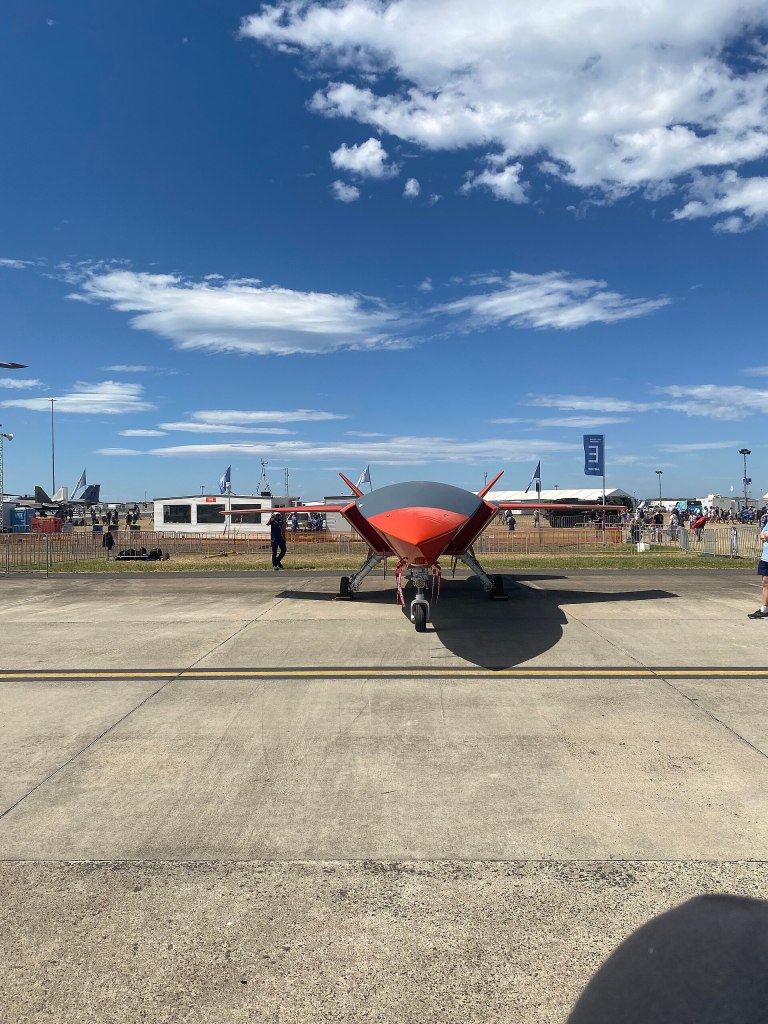
On 8 December 2025, over the Woomera range in South Australia, a pilotless jet fired an AIM-120 air-to-air missile and destroyed a target drone. The order to fire came from an operator sitting in an RAAF E-7A Wedgetail radar plane. It was the first time an uncrewed aircraft had fired an AMRAAM, and the aircraft was Australian: the Boeing MQ-28 Ghost Bat.
Under the sea, Australia is building a fleet of large robotic submarines called Ghost Shark. Together they make Australia one of the world’s leaders in military autonomy. This article explains the MQ-28 Ghost Bat and Ghost Shark: what they are, what they can do, how much they cost, and why autonomy matters so much for a country with a small military and a huge area to defend.
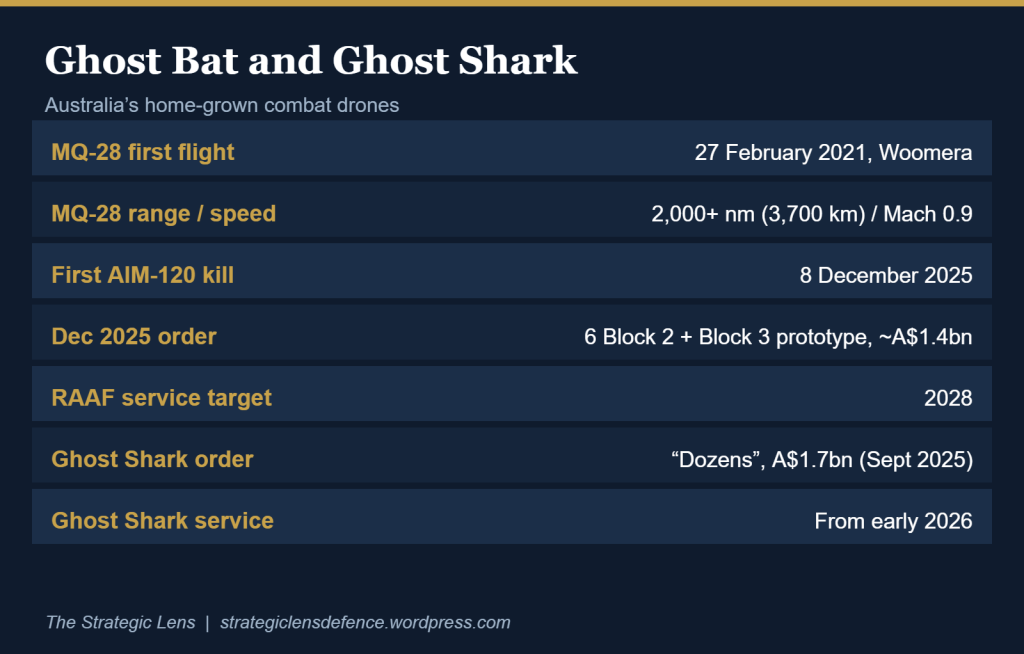
Quick answer: The MQ-28 Ghost Bat is a jet-powered “loyal wingman” drone designed and built in Australia by Boeing. It flies alongside crewed jets, has a range of more than 3,700 km and is due to enter RAAF service in 2028. In December 2025 Australia ordered six operational Block 2 aircraft and a Block 3 prototype for about A$1.4 billion. Ghost Shark is an extra-large autonomous undersea vehicle built by Anduril; Australia ordered dozens of them for A$1.7 billion in September 2025, entering service from early 2026.
In this article
- What is a loyal wingman?
- MQ-28 Ghost Bat: origins and specs
- The AMRAAM shot
- Block 2, Block 3 and the 2025 order
- Exports: the US, Germany and beyond
- Ghost Shark: the robot submarine
- Why autonomy matters for Australia
- Risks and open questions
- Lessons for India
- Our take
- Frequently asked questions
- Sources and further reading
What is a loyal wingman?
A loyal wingman, or Collaborative Combat Aircraft (CCA) in US terms, is a drone that flies with crewed aircraft as part of a team. It can scout ahead, jam enemy radars, carry extra missiles or act as a decoy, while the human pilot or operator makes the key decisions. The aim is to multiply the power of each expensive crewed jet with cheaper drones that can be risked in ways pilots cannot. As Australia’s defence industry minister Pat Conroy put it, Ghost Bat “transforms a single fighter jet into a formidable team”.
MQ-28 Ghost Bat: origins and specs
Boeing Australia began the programme, originally called the Airpower Teaming System, in partnership with the RAAF. It first flew on 27 February 2021 at RAAF Base Woomera and was named MQ-28A Ghost Bat in March 2022. It was designed and built in Melbourne, and a dedicated factory is planned at Wellcamp near Toowoomba in Queensland.
| Specification | MQ-28A Ghost Bat |
|---|---|
| Length | 11.7 m |
| Wingspan | 7.3 m |
| Weight | About 3,175 kg |
| Range | More than 2,000 nautical miles (3,700 km) |
| Top speed | About Mach 0.9 |
| Ceiling | Above 40,000 ft |
| Engine | One Williams FJ44 turbofan |
| Payload | Swappable nose modules for sensors, electronic warfare or combat |
The interchangeable nose is one of its smartest features: the same airframe can be turned into a reconnaissance platform, an electronic-warfare jammer or a strike aircraft in hours.
The AMRAAM shot
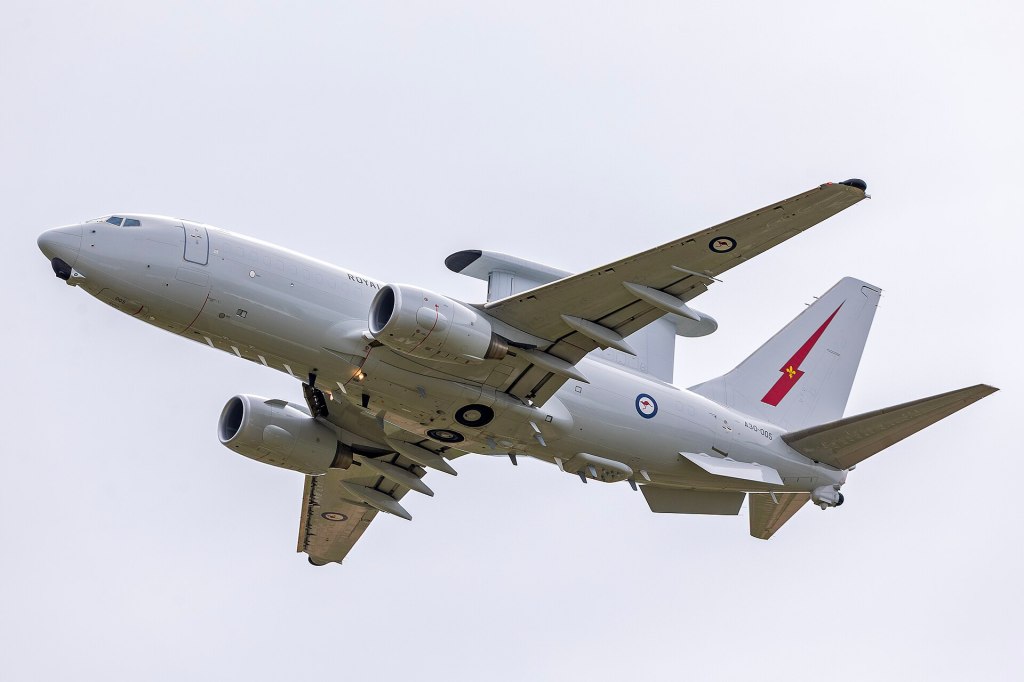
The December 2025 test, called Trial Kareela 25-4, showed how the system is meant to fight. The Ghost Bat carried a single AIM-120 under its left wing. An operator in an E-7A Wedgetail, supported by an F/A-18F Super Hornet, gave four commands: take off, fly a combat air patrol, commit to intercept, and clear to fire. The Ghost Bat then guided the missile mid-course to destroy an Australian-made Phoenix jet target drone.
It was reported as the first time an uncrewed aircraft had fired an AMRAAM, and only the second time a combat drone had destroyed an aerial target with a beyond-visual-range missile, after Turkey’s Bayraktar Kizilelma.
Block 2, Block 3 and the 2025 order
- Block 1: eight prototypes used for testing, with more than 100 flight hours by October 2024.
- Block 2: the operational version, with an improved wing and military-grade navigation. Three were funded in February 2024 for A$400 million.
- December 2025 order: on 9 December 2025, Marles and Conroy announced six more Block 2 aircraft and development of a Block 3 prototype, worth about A$1.4 billion.
- Block 3: shown at the ILA Berlin air show in June 2026, with a wing about 25% larger, an internal bay for two AMRAAMs or four small-diameter bombs, and three external hardpoints. Construction is due to start in 2027.
The RAAF aims to have an operational capability in 2028. In June 2026 a production-representative Ghost Bat also flew in the US exercise Valiant Shield in the Pacific, which US Pacific Air Forces called a significant milestone for collaborative combat aircraft.
Exports: the US, Germany and beyond
Boeing wants Ghost Bat to be an export success, but it has had setbacks. It was dropped from the US Air Force’s main CCA competition in 2025; the USAF picked General Atomics’ FQ-42A and Anduril’s FQ-44A. Germany looked closely at buying Ghost Bats with Rheinmetall, but in October 2026 the German defence ministry said it would not buy them directly, citing procurement law. The US Navy and Poland have been mentioned as other possible customers, and Block 3 is designed as the export version.
Ghost Shark: the robot submarine
Ghost Shark is an extra-large autonomous undersea vehicle (XL-AUV) developed by Anduril Australia with the Defence Science and Technology Group. The contract for three prototypes was signed in May 2022, and the first prototype was revealed in Sydney in April 2024, well ahead of schedule.
- Size: no official specifications have been released; estimates suggest it is around 12 metres long.
- Design: a “flooded” hull without a conventional pressure hull, which saves cost and weight.
- Brain: Anduril’s Lattice software controls navigation and mission decisions.
- Missions: intelligence gathering, signals intelligence, guarding seabed infrastructure such as undersea cables, and covert mine-laying. It can be launched from shore or from warships.
In September 2025 Defence Minister Richard Marles announced a fleet of “dozens” of Ghost Sharks worth A$1.7 billion, entering service from early 2026. Anduril has invested A$60 million in an Australian factory with more than 40 local suppliers.
Why autonomy matters for Australia
- Small force, huge area. Australia has a population of about 27 million and must watch millions of square kilometres of sea to its north. It cannot afford enough crewed jets and submarines to cover it all.
- Mass at lower cost. Drones can be built in larger numbers than F-35s or nuclear submarines, adding “mass” to a small military.
- Lower risk to people. Drones can go first into heavily defended areas.
- Sovereign industry. Both programmes are designed and built in Australia, creating skills and export opportunities.
- Bridging the submarine gap. Ghost Sharks can take on surveillance work while Australia waits for its AUKUS submarines.
Risks and open questions
- Cost creep: “affordable” drones are still expensive; each Ghost Bat costs well over A$100 million when development is included.
- Communications: drones depend on secure data links that an enemy will try to jam.
- Rules of engagement: keeping a human “in the loop” for lethal decisions is central to Australian policy, as the Wedgetail-controlled shot showed.
- Scale: six or nine Ghost Bats are a start, not a force. The real test is whether production rises to dozens.
Lessons for India
India is developing its own loyal wingman, HAL’s CATS Warrior, and the stealthy Ghatak combat drone. Australia shows what a focused programme with a single industrial partner and close air force involvement can achieve in five years. India’s challenge will be similar: integrating drones with fighters like the Tejas Mk2 and AMCA, and building secure networks. Our explainer on AI and autonomous weapons covers the wider debate.
Our take
Ghost Bat and Ghost Shark are among the most important things Australia has built for its military in decades, not because of their size but because of the idea behind them: a small country using autonomy to punch above its weight. The AMRAAM shot proved the concept. The next three years, scaling up production and integrating them into everyday operations, will show whether Australia can turn a technology lead into real combat power.
Frequently asked questions
What is the MQ-28 Ghost Bat?
An Australian-built, jet-powered uncrewed combat aircraft designed by Boeing to fly alongside crewed jets as a “loyal wingman”.
Has the Ghost Bat fired a missile?
Yes. On 8 December 2025 it fired an AIM-120 AMRAAM and destroyed a target drone over the Woomera range, under the command of an operator in an E-7A Wedgetail.
When will the Ghost Bat enter service?
The RAAF is aiming for an operational capability in 2028.
How many Ghost Bats has Australia ordered?
Eight Block 1 test aircraft, three Block 2 aircraft in 2024, and six more Block 2 aircraft plus a Block 3 prototype in December 2025.
What is Ghost Shark?
An extra-large autonomous undersea vehicle built by Anduril for the Royal Australian Navy, used for surveillance, seabed protection and potentially mine-laying.
How much did Australia pay for Ghost Shark?
A$1.7 billion for a fleet of dozens of vehicles, announced in September 2025.
Sources and further reading
Researched using official statements and published reporting up to 6 November 2026.
- The War Zone: MQ-28 Ghost Bat has fired an AIM-120 AMRAAM, December 2025
- DroneXL: Australia orders MQ-28 after missile test, December 2025
- Aviation Today: PACAF evaluating MQ-28 in Valiant Shield, July 2026
- Army Recognition: MQ-28 to enter combat service by 2028, February 2026
- MiGFlug: Germany drops direct MQ-28 purchase, October 2026
- Boeing MQ-28 Ghost Bat (reference overview)
- Ghost Shark (reference overview)


Leave a Reply