
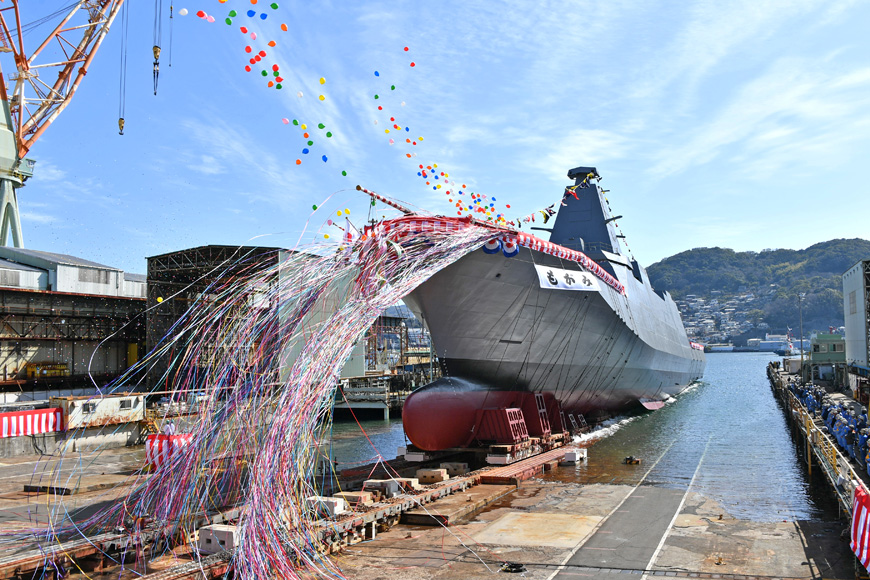
For 80 years after the Second World War, Japan did not sell warships abroad. In April 2026 that changed in a big way: Australia signed contracts with the Japanese government and Mitsubishi Heavy Industries (MHI) for the first three of up to 11 upgraded Mogami-class frigates. It is Japan’s largest defence export since it relaxed its arms export rules, and for Australia, in the words of defence industry minister Pat Conroy, “the fastest acquisition for the Royal Australian Navy in peacetime”.
This article explains Australia’s Mogami frigates: why the Navy needed them, why Japan won, what the ships can do, the timeline, and the risks.
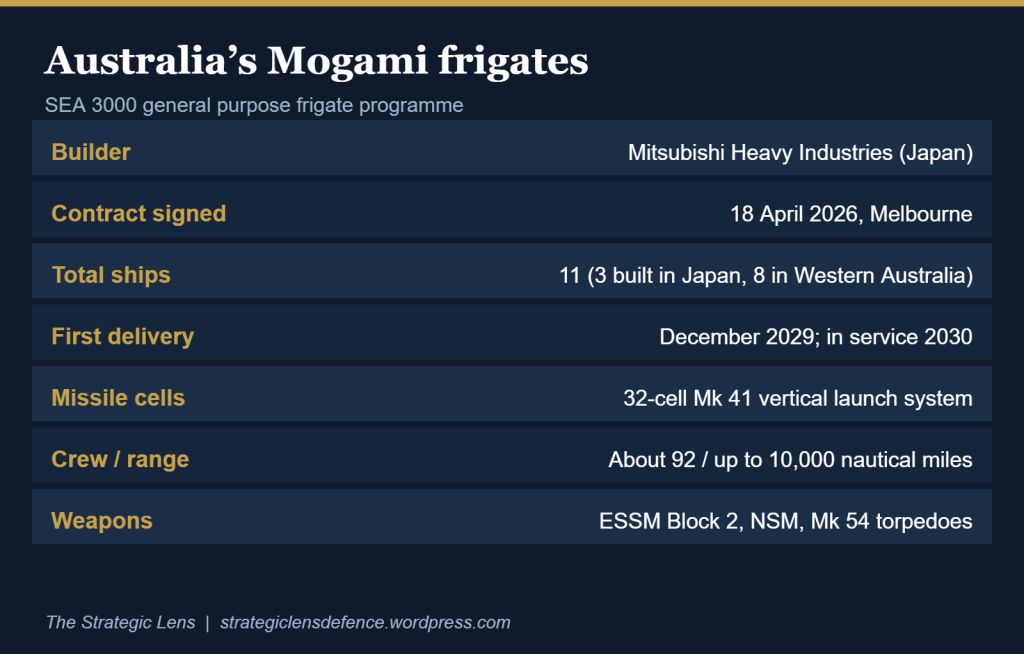
Quick answer: Under its SEA 3000 programme, Australia is buying 11 “Upgraded Mogami” general purpose frigates from MHI. The first three will be built in Nagasaki, with the first delivered in December 2029 and entering service in 2030. The remaining eight will be built at Henderson in Western Australia from the early 2030s. Each ship has a 32-cell vertical launch system, a crew of about 92 and a range of up to 10,000 nautical miles, and will carry ESSM, Naval Strike Missiles and an MH-60R helicopter.
In this article
Why Australia needs new frigates
The Royal Australian Navy’s surface fleet has been shrinking and ageing. Its eight Anzac-class frigates entered service between 1996 and 2006 and are wearing out. The replacement, the Hunter-class frigate built by BAE Systems in Adelaide, became a large, expensive anti-submarine warship whose first ship has been delayed into the 2030s.
Meanwhile, the threat grew. China’s navy is now the largest in the world, and in early 2025 a Chinese naval task group sailed around Australia and held live-fire drills in the Tasman Sea, forcing airlines to divert flights. Australia needed more ships, faster.
The 2024 surface fleet review
In February 2024 the government released an independent analysis of the surface fleet and committed to more than doubling the size of the Navy’s major surface combatant fleet. The plan:
- Cut the Hunter-class frigates from nine to six.
- Keep and upgrade the three Hobart-class air-warfare destroyers.
- Buy 11 new general purpose frigates, quickly, from an existing foreign design (this became SEA 3000).
- Add six large optionally crewed surface vessels, essentially floating missile magazines.
Speed was the priority: the government wanted the first new frigate in the water by around 2030, which meant buying an existing design rather than developing a new one.
The competition: Japan vs Germany
Australia shortlisted two designs: Germany’s TKMS MEKO A-200 and Japan’s Upgraded Mogami from MHI. In August 2025 the government chose the Mogami. Officials pointed to its larger missile load, its high level of automation, which allows a smaller crew, and Japan’s ability to deliver the first ships quickly from its own shipyards. Strategic ties also mattered: Japan is Australia’s closest security partner in Asia after the US.
The ship: what is an Upgraded Mogami?
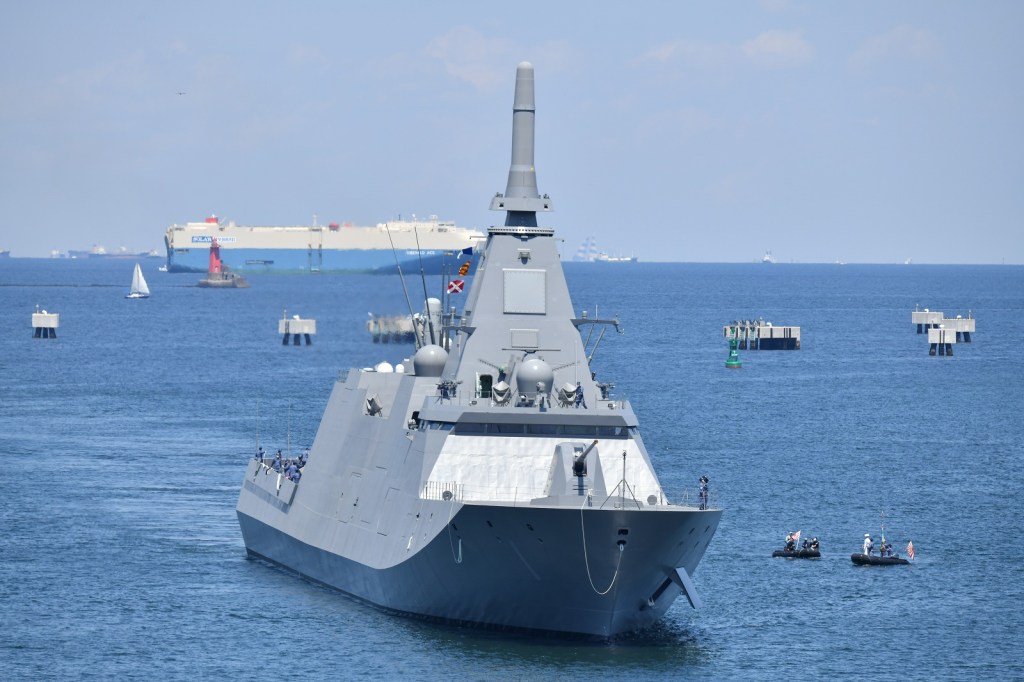
The original Mogami class (also called 30FFM) entered Japanese service in 2022. It is a compact, stealthy multi-role frigate designed to run with a small crew thanks to heavy automation. The upgraded version, also known as the new FFM or 06FFM, is larger and better armed. Japan plans to build at least 12 for itself.
| Feature | Australia’s Upgraded Mogami |
|---|---|
| Missile cells | 32-cell Mk 41 vertical launch system (twice the original Mogami’s) |
| Air defence | ESSM Block 2 medium-range missiles |
| Anti-ship | Kongsberg Naval Strike Missile |
| Anti-submarine | Mk 54 torpedoes and an MH-60R Seahawk helicopter |
| Crew | About 92 |
| Range | Up to 10,000 nautical miles |
| Radar | Upgraded suite for improved air defence |
Australia originally wanted “zero change” to the Japanese design to save time. That has been partly relaxed so the ships can use American and European weapons already in Australian service, such as the NSM, which also links with our coverage of Australia’s missile build-up.
The April 2026 deal
On 18 April 2026, in Melbourne, Defence Minister Richard Marles and Japanese Defence Minister Shinjiro Koizumi signed a “Mogami Memorandum”, alongside contracts with the Japanese government and MHI for the first three ships. Some reports value the initial three-ship deal at around A$10 billion; the 2026 Integrated Investment Program commits up to A$20 billion over the decade to general purpose frigates.
Marles called the agreement “absolutely fundamental for delivering capability for the Royal Australian Navy”. Koizumi said Japan’s revised export framework would allow transfers that meet the needs of like-minded countries. By September 2026, Conroy said production of long-lead items for the first ship had already begun.
Timeline
| Date | Milestone |
|---|---|
| February 2024 | Surface fleet review: 11 general purpose frigates planned |
| August 2025 | Mogami selected over the MEKO A-200 |
| 18 April 2026 | Contracts signed for the first three ships |
| September 2026 | Long-lead items in production in Japan |
| December 2029 | First ship delivered |
| 2030 | First ship enters service |
| Early 2030s | Construction starts at Henderson, Western Australia |
| 2034 | Last Japanese-built ship enters service |
The Henderson ships will be built by Austal once the precinct is consolidated, the same area that will maintain Australia’s AUKUS submarines. The government says the wider precinct will support around 10,000 skilled jobs.
Why it matters for Japan
For decades Japan banned almost all arms exports. It began loosening the rules in 2014 and further in 2023–24. Early attempts to export, including a bid to sell Soryu-class submarines to Australia in 2016, failed. The Mogami deal is the breakthrough: the first major Japanese warship export and a sign that Japan can be a serious defence supplier. New Zealand is also reported to be evaluating the class. It also binds Japan and Australia together for decades of training, maintenance and upgrades, deepening a partnership we also touch on in the Philippines’ security network.
The risks
- First export: MHI has never built warships for a foreign navy, with different standards, language and requirements.
- Changes to the design: every modification for Australian weapons adds time and cost.
- Local construction: building eight ships at Henderson depends on a shipyard that is still being expanded and must also support submarine maintenance.
- Workforce: the Navy is short of sailors, and a small crew only helps if the automation works as advertised.
What it means for India
India’s own frigate programmes, such as the Project 17A Nilgiri class, are built at home by Indian shipyards. The Australian deal shows another model: buy a proven foreign design quickly, then build it locally. It also confirms Japan’s emergence as an arms exporter, which could open the door to more Japan–India defence cooperation, for example in shipbuilding, radars or unmanned systems.
Our take
The Mogami decision is the most significant naval procurement choice Australia has made since AUKUS, and arguably a better-run one: a proven design, a fast timeline and a strategic partner. The test will be whether the “fastest acquisition in peacetime” actually delivers a ship in 2029, and whether Henderson can build the rest without the delays that dogged the Hunter class.
Frequently asked questions
How many Mogami frigates is Australia buying?
Eleven general purpose frigates: three built in Japan by MHI and eight to be built in Western Australia.
When will Australia get its first Mogami frigate?
The first ship is due to be delivered in December 2029 and enter service in 2030.
Why did Australia choose the Mogami over the MEKO A-200?
Australia selected the Upgraded Mogami in August 2025, citing its larger missile load, automation that allows a smaller crew, and the ability to deliver ships quickly.
What weapons will Australia’s Mogami frigates carry?
A 32-cell Mk 41 vertical launch system with ESSM Block 2 missiles, Naval Strike Missiles, Mk 54 torpedoes and an MH-60R helicopter.
How much is the Mogami deal worth?
The 2026 Integrated Investment Program commits up to A$20 billion over a decade to the general purpose frigates. Some reports value the first three-ship contract at about A$10 billion.
Is this Japan’s first major warship export?
Yes. It is Japan’s largest defence export since it relaxed its arms export rules.
Sources and further reading
Researched using official statements and published reporting up to 6 November 2026.
- Australian Department of Defence: Navy locks in future frigates, April 2026
- Naval News: Australia signs contract with Japan for three Upgraded Mogami, April 2026
- Asian Military Review: Australia inks Mogami frigate deal, April 2026
- Australian Defence Magazine: First Mogami for Australia in production, September 2026
- The Diplomat: Australia–Japan frigate deal faces 3 critical challenges, April 2026


Leave a Reply