
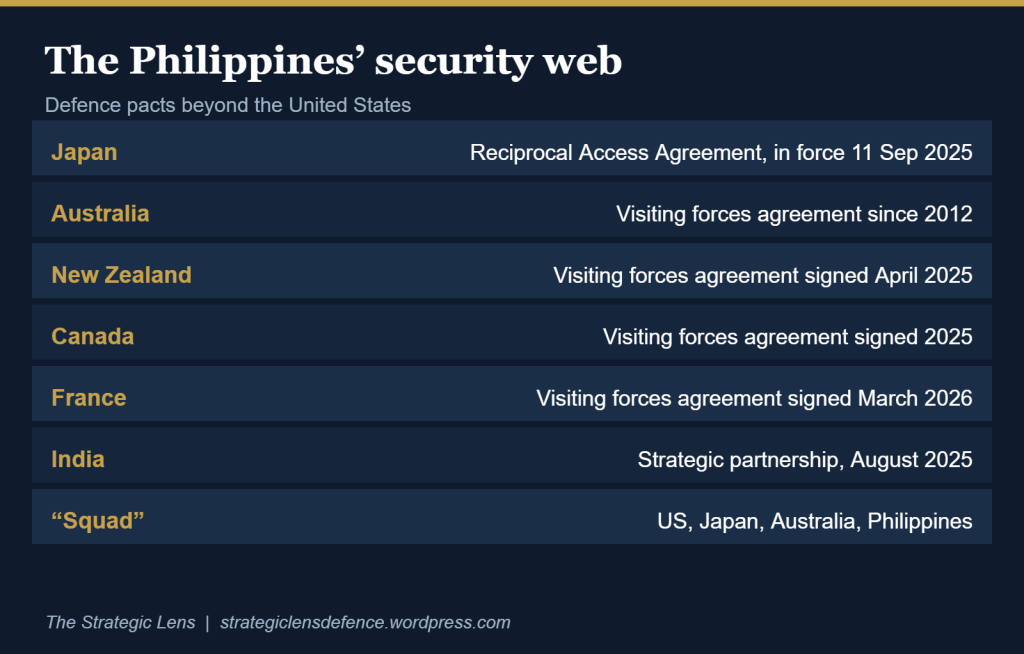
For 70 years, Philippine security rested on one pillar: the alliance with the United States. That pillar still stands, but Manila is building a lot of scaffolding around it. In just two years it has signed visiting forces agreements with Japan, New Zealand, Canada and France, deepened its partnership with Australia, upgraded ties with India, and joined a four-way grouping with the US, Japan and Australia known informally as the “Squad”.
This article explains the Philippines’ security network beyond the United States: what each agreement does, why Japan’s return matters so much, and whether this web of partners actually adds up to deterrence against China.
Quick answer: The most important new pact is the Japan–Philippines Reciprocal Access Agreement, which took effect on 11 September 2025 and allows Japanese forces to train in the Philippines for the first time since the Second World War. Australia has had a visiting forces agreement since 2012 and runs the large Alon exercise. New Zealand, Canada and France have signed similar deals. None is a defence treaty, but together they make it easier for friendly forces to operate in the Philippines and harder for China to isolate Manila.
In this article
- Why Manila is building a network
- Japan: the Reciprocal Access Agreement
- What Japan is giving the Philippines
- Australia: the oldest new partner
- New Zealand, Canada and France
- The “Squad” and joint patrols
- India
- How the agreements compare
- The limits of a network
- Our take
- Frequently asked questions
- Sources and further reading
Why Manila is building a network
- China’s pressure. Daily confrontations at sea, which we cover in our South China Sea explainer, have convinced Manila it needs as many friends as possible watching.
- Hedging against Washington. US policy can change from one administration to the next. Multiple partners reduce dependence on one capital.
- Capacity. Japan, Australia and others bring ships, radars, training and money the Philippines cannot afford alone.
- Legitimacy. When several countries back the 2016 arbitral ruling and sail together, China’s claim that the dispute is a US plot is harder to sell.
Japan: the Reciprocal Access Agreement
The Japan–Philippines Reciprocal Access Agreement (RAA) was signed in Manila on 8 July 2024 by Defense Secretary Gilberto Teodoro and Japanese Foreign Minister Yoko Kamikawa, with President Marcos present. The Philippine Senate approved it on 16 December 2024 and Japan’s parliament followed in June 2025. After diplomatic notes were exchanged on 12 August 2025, it entered into force on 11 September 2025.
The RAA is what the Philippine foreign ministry calls a status of visiting forces agreement. It sets the legal rules for Japanese troops, ships, aircraft and equipment entering the Philippines for agreed training and exercises, including jurisdiction if something goes wrong. It was the first such agreement Japan signed in Asia; it has similar deals with Australia and the UK.
The history makes it remarkable. Japan occupied the Philippines during the Second World War, and the RAA allows Japanese troops back on Philippine soil for the first time since then. Teodoro said the pact “provides deterrence for those actors who may not see things the way we do”.
What Japan is giving the Philippines
- Radars and patrol ships. Through its Official Security Assistance programme, Japan has funded coastal radars, and it has supplied many of the Philippine Coast Guard’s patrol vessels.
- Warships. In 2025, Japan decided to transfer six decommissioned Abukuma-class destroyer escorts to the Philippine Navy, according to reporting by Yomiuri and Reuters.
- Logistics. In January 2026 the two countries agreed on a pact allowing them to supply each other with fuel and ammunition, an important step for joint operations.
- Missiles. Japan sent Type 88 coastal anti-ship missiles to the Balikatan exercise in 2026. In May 2026 one fired at a target ship near Laoag under US command and control.
- Diplomacy. During President Marcos’s state visit to Japan in May 2026, the two sides agreed to deepen defence ties, including arms sales, intelligence sharing and exercises.
Australia: the oldest new partner
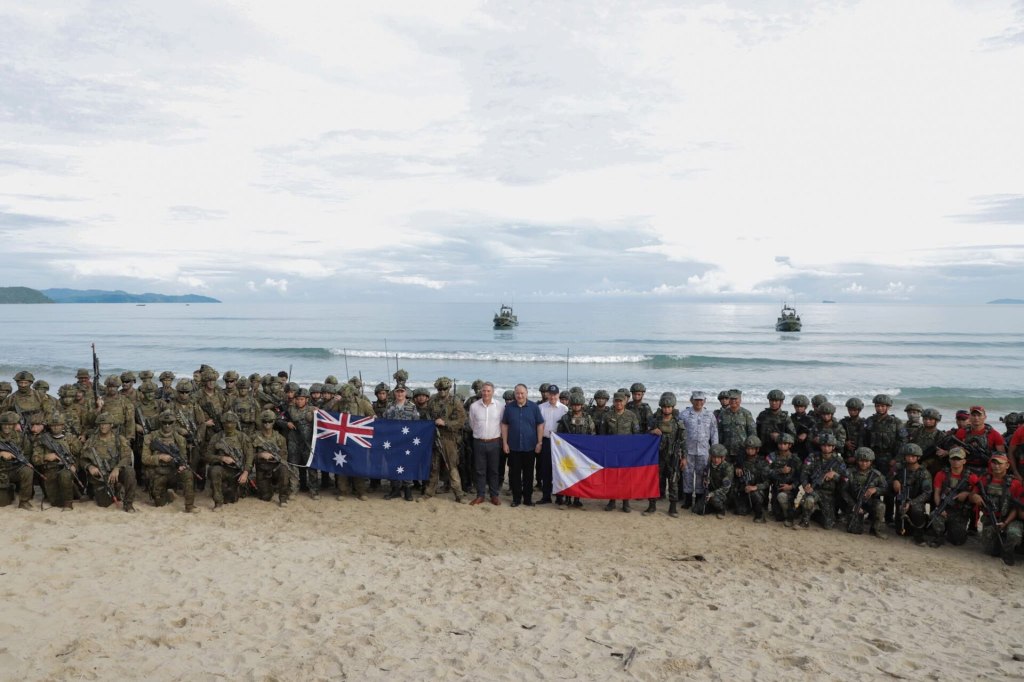
Australia was ahead of the curve. Its Status of Visiting Forces Agreement with the Philippines was signed in 2007 and entered into force in 2012, the only such agreement Manila had other than with the US for a decade. The two countries upgraded their relationship to a strategic partnership in 2023, and in February 2024 Marcos became the first Philippine president to address the Australian parliament.
The centrepiece of military cooperation is Exercise Alon, a large amphibious and joint exercise. Australia also transferred landing craft to the Philippine Navy and joins maritime patrols in the South China Sea.
New Zealand, Canada and France
- New Zealand signed a visiting forces agreement with the Philippines in April 2025.
- Canada signed its visiting forces agreement in 2025, after years of growing cooperation, including Canadian ships joining South China Sea patrols.
- France signed a visiting forces agreement in Paris in March 2026. France has a permanent military presence in the Pacific through New Caledonia and French Polynesia.
All three sent forces or observers to Balikatan 2026, which grew into a multinational exercise of more than 17,000 troops. We cover it in our US–Philippines alliance explainer.
The “Squad” and joint patrols
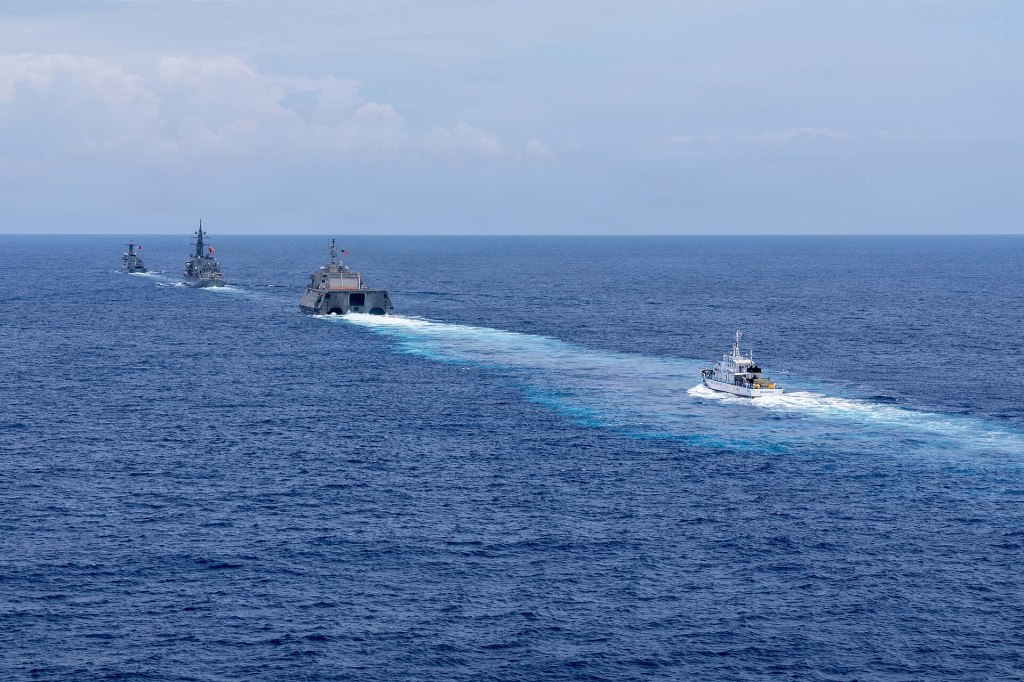
Since 2023, the defence ministers of the US, Japan, Australia and the Philippines have met as a group, nicknamed the “Squad” by analogy with the Quad. Its most visible output is multilateral maritime cooperative activities: joint sails by warships and coast guard vessels inside the Philippines’ exclusive economic zone. They are a quiet but clear message to China that the Philippines is not alone.
India
India is not a Squad member, but it has become an important partner. It sold the Philippines BrahMos missiles, backs the 2016 arbitral ruling, and in August 2025, during Marcos’s state visit to New Delhi, the two countries upgraded their relationship to a strategic partnership. Their navies held their first joint sail in the South China Sea around the same time.
How the agreements compare
| Partner | Main agreement | Status | What it allows |
|---|---|---|---|
| United States | Mutual Defense Treaty (1951), VFA, EDCA | In force | Mutual defence commitment, rotational presence at 9 sites |
| Japan | Reciprocal Access Agreement | In force since 11 Sep 2025 | Japanese forces can train in the Philippines |
| Australia | Status of Visiting Forces Agreement | In force since 2012 | Australian forces can train in the Philippines |
| New Zealand | Visiting forces agreement | Signed April 2025 | Training and exercises |
| Canada | Visiting forces agreement | Signed 2025 | Training and exercises |
| France | Visiting forces agreement | Signed March 2026 | Training and exercises |
| India | Strategic partnership | Since August 2025 | Defence trade and cooperation, no forces agreement |
The limits of a network
It is important to be precise: only the United States has a treaty obligation to defend the Philippines. Japan, Australia and the others have committed to train, exercise and help build capacity, not to fight. In a real crisis, their governments would decide based on their own interests. Japan’s pacifist constitution also limits what its forces can do abroad.
The network’s real value is deterrence and resilience: more ships and aircraft watching the West Philippine Sea, more countries publicly supporting international law, and a Philippine military that learns to work with modern forces. That makes Chinese coercion more costly diplomatically, even if it does not guarantee anyone will come to the rescue.
Our take
Manila has played a weak hand well. By turning a single alliance into a web of partnerships, it has raised the diplomatic cost of Chinese pressure and pulled in resources it could never buy alone. Japan’s return is the most significant shift, both symbolically and practically. The next test is whether these agreements turn into regular, real-world presence at sea, not just exercises.
Frequently asked questions
What is the Japan–Philippines Reciprocal Access Agreement?
A visiting forces agreement signed on 8 July 2024 that allows Japanese and Philippine forces to train in each other’s countries. It entered into force on 11 September 2025.
Does Japan have to defend the Philippines?
No. The RAA covers training and exercises. Only the United States has a mutual defence treaty with the Philippines.
Which countries have visiting forces agreements with the Philippines?
The United States, Australia, Japan, New Zealand, Canada and France.
What is the “Squad”?
An informal grouping of the defence ministers of the United States, Japan, Australia and the Philippines, which coordinates joint patrols in the South China Sea.
What is Exercise Alon?
A large joint exercise between Australia and the Philippines, focused on amphibious and joint operations.
Is India a defence partner of the Philippines?
Yes. India supplies BrahMos missiles, and the two countries upgraded their ties to a strategic partnership in August 2025.
Sources and further reading
Researched using official statements and published reporting up to 6 November 2026.
- Philippine DFA: Exchange of notes on entry into force of the RAA, 12 August 2025
- GMA News: PH–Japan defense pact enters into force on Sept 11, August 2025
- South China Morning Post: Japan–Philippines defence pact comes into force, September 2025
- Philstar: Philippines, New Zealand sign visiting forces agreement, April 2025
- Naval News: Philippines, France sign visiting forces deal, March 2026
- Inquirer: PH pacts with Canada, New Zealand to boost AFP readiness
- Australia–Philippines relations (reference overview)


Leave a Reply